TeSelle Erienne K, Baum Dana A
Department of Chemistry, Saint Louis University, 3501 Laclede Avenue, St Louis, Missouri, 63013, USA.
Aptamers (Oxf). 2018;2:82-87. Epub 2018 Dec 11.
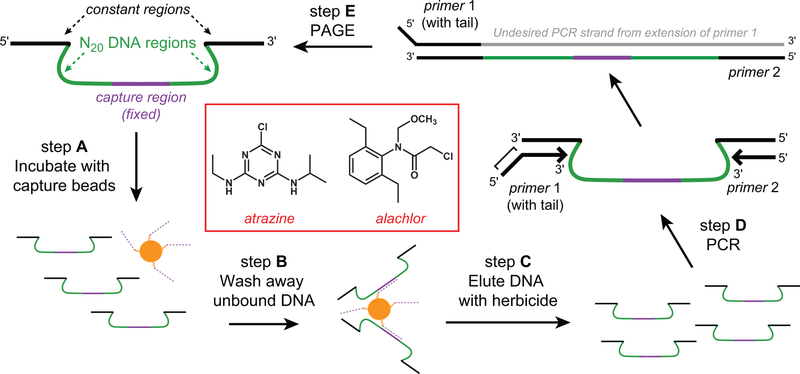
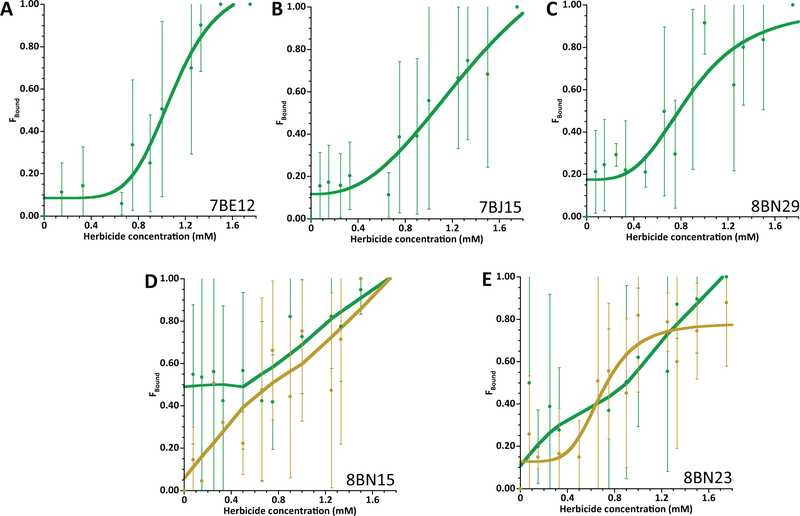
Functional nucleic acids, including aptamers and deoxyribozymes, have become important in a variety of applications, particularly sensors. Aptamers are useful for recognition because of their ability to bind to targets with high selectivity and affinity. They can also be paired with deoxyribozymes to form signaling aptazymes. These aptamers and aptazymes have the potential to significantly improve the detection of small molecule pollutants, such as herbicides, in the environment. One challenge when developing aptazymes is that aptamer selection conditions can vary greatly from optimal deoxyribozyme reaction conditions. Aptamer selections commonly mimic physiological conditions, while deoxyribozyme selections are conducted under a wider range of divalent metal ion conditions. Isolating aptamers under conditions that match deoxyribozyme reaction conditions should ease the development of aptazymes and facilitate the activities of both the binding and catalytic components. Therefore, we conducted in vitro selections under different divalent metal ion conditions to identify DNA aptamers for the herbicides atrazine and alachlor. Conditions were chosen based on optimal reaction conditions for commonly-used deoxyribozymes. Each set of conditions yielded aptamers that were unrelated to aptamers identified under other selection conditions. No particular set of conditions stood out as being optimal from initial binding analysis. The best aptamers bound their target with high-micromolar to low-millimolar affinity, similar to the concentrations used during the selection procedures, as well as regulatory guidelines. Our results demonstrate that different metal ion concentrations can achieve the common goal of binding to a particular target, while providing aptamers that function under alternate conditions.
包括适体和脱氧核酶在内的功能性核酸在各种应用中变得越来越重要,特别是在传感器方面。适体因其能够以高选择性和亲和力结合靶标而可用于识别。它们还可以与脱氧核酶配对形成信号适体酶。这些适体和适体酶有潜力显著改善环境中除草剂等小分子污染物的检测。开发适体酶时面临的一个挑战是适体选择条件可能与最佳脱氧核酶反应条件有很大差异。适体选择通常模拟生理条件,而脱氧核酶选择是在更广泛的二价金属离子条件下进行的。在与脱氧核酶反应条件相匹配的条件下分离适体应能简化适体酶的开发,并促进结合和催化成分的活性。因此,我们在不同的二价金属离子条件下进行了体外筛选,以鉴定针对除草剂阿特拉津和甲草胺的DNA适体。选择的条件是基于常用脱氧核酶的最佳反应条件。每组条件产生的适体与在其他选择条件下鉴定的适体无关。从初始结合分析来看,没有一组特定的条件脱颖而出被认为是最佳的。最佳适体以高微摩尔到低微摩尔的亲和力结合其靶标,类似于选择过程中使用的浓度以及监管指南。我们的结果表明,不同的金属离子浓度可以实现结合特定靶标的共同目标,同时提供在不同条件下起作用的适体。