School of Medicine, Huaqiao University, Quanzhou 362021, Fujian, China.
Molecules. 2018 Feb 7;23(2):344. doi: 10.3390/molecules23020344.
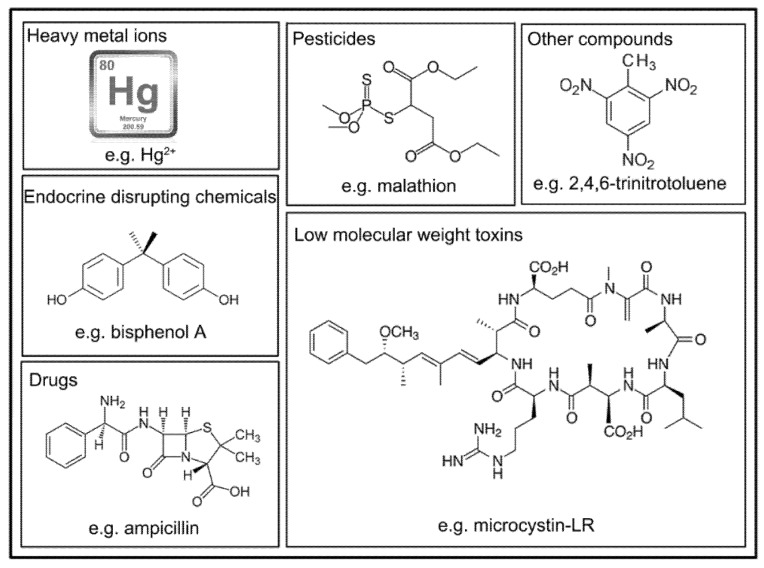
Water pollution has become one of the leading causes of human health problems. Low molecular weight pollutants, even at trace concentrations in water sources, have aroused global attention due to their toxicity after long-time exposure. There is an increased demand for appropriate methods to detect these pollutants in aquatic systems. Aptamers, single-stranded DNA or RNA, have high affinity and specificity to each of their target molecule, similar to antigen-antibody interaction. Aptamers can be selected using a method called Systematic Evolution of Ligands by EXponential enrichment (SELEX). Recent years we have witnessed great progress in developing aptamer selection and aptamer-based sensors for low molecular weight pollutants in water sources, such as tap water, seawater, lake water, river water, as well as wastewater and its effluents. This review provides an overview of aptamer-based methods as a novel approach for detecting low molecular weight pollutants in water sources.
水污染已成为人类健康问题的主要原因之一。由于在长时间暴露后会产生毒性,即使在水源中痕量浓度的低分子量污染物也引起了全球关注。因此,人们越来越需要在水生系统中检测这些污染物的合适方法。适体是单链 DNA 或 RNA,它们对各自的目标分子具有高亲和力和特异性,类似于抗原-抗体相互作用。适体可以通过一种称为指数富集配体系统进化(SELEX)的方法进行选择。近年来,我们见证了在开发适体选择和基于适体的传感器方面的巨大进展,用于检测自来水中、海水中、湖水中、河水中以及废水中及其流出物中的低分子量污染物。本综述概述了基于适体的方法作为一种检测水源中低分子量污染物的新方法。