Centre for Gerontology and Rehabilitation, University College Cork, Cork, Ireland.
Tyndall Institute, Cork, Ireland.
JMIR Mhealth Uhealth. 2021 Jun 3;9(6):e23832. doi: 10.2196/23832.
Older adults may use wearable devices for various reasons, ranging from monitoring clinically relevant health metrics or detecting falls to monitoring physical activity. Little is known about how this population engages with wearable devices, and no qualitative synthesis exists to describe their shared experiences with long-term use.
This study aims to synthesize qualitative studies of user experience after a multi-day trial with a wearable device to understand user experience and the factors that contribute to the acceptance and use of wearable devices.
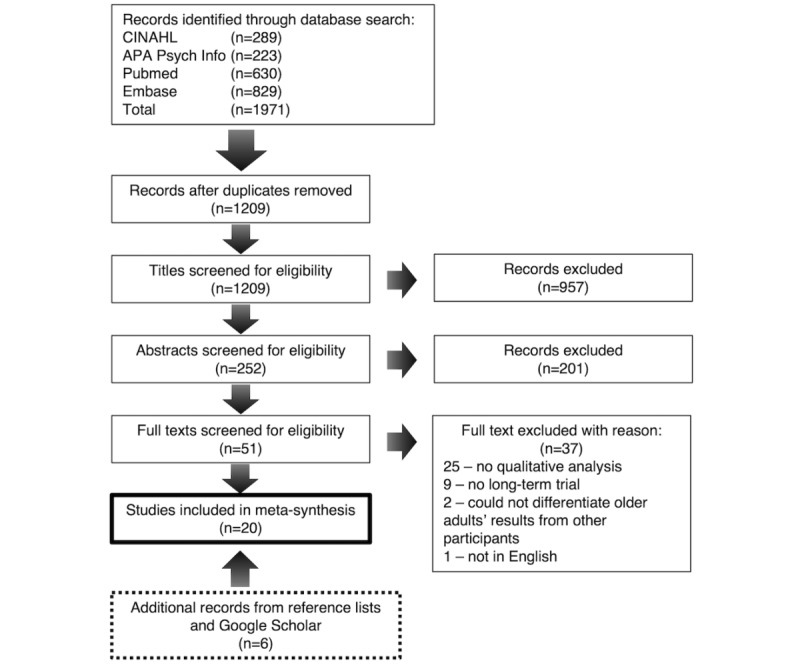
We conducted a systematic search in CINAHL, APA PsycINFO, PubMed, and Embase (2015-2020; English) with fixed search terms relating to older adults and wearable devices. A meta-synthesis methodology was used. We extracted themes from primary studies, identified key concepts, and applied reciprocal and refutational translation techniques; findings were synthesized into third-order interpretations, and finally, a "line-of-argument" was developed. Our overall goal was theory development, higher-level abstraction, and generalizability for making this group of qualitative findings more accessible.
In total, we reviewed 20 papers; 2 evaluated fall detection devices, 1 tested an ankle-worn step counter, and the remaining 17 tested activity trackers. The duration of wearing ranged from 3 days to 24 months. The views of 349 participants (age: range 51-94 years) were synthesized. Four key concepts were identified and outlined: motivation for device use, user characteristics (openness to engage and functional ability), integration into daily life, and device features. Motivation for device use is intrinsic and extrinsic, encompassing many aspects of the user experience, and appears to be as, if not more, important than the actual device features. To overcome usability barriers, an older adult must be motivated by the useful purpose of the device. A device that serves its intended purpose adds value to the user's life. The user's needs and the support structure around the device-aspects that are often overlooked-seem to play a crucial role in long-term adoption. Our "line-of-argument" model describes how motivation, ease of use, and device purpose determine whether a device is perceived to add value to the user's life, which subsequently predicts whether the device will be integrated into the user's life.
The added value of a wearable device is the resulting balance of motivators (or lack thereof), device features (and their accuracy), ease of use, device purpose, and user experience. The added value contributes to the successful integration of the device into the daily life of the user. Useful device features alone do not lead to continued use. A support structure should be placed around the user to foster motivation, encourage peer engagement, and adapt to the user's preferences.
老年人可能出于各种原因使用可穿戴设备,从监测与临床相关的健康指标或检测跌倒,到监测身体活动。对于这一人群如何使用可穿戴设备,人们知之甚少,也没有定性综合研究来描述他们长期使用的共同体验。
本研究旨在综合使用可穿戴设备进行多天试验后的定性研究,以了解用户体验以及促成可穿戴设备接受和使用的因素。
我们使用固定的检索词在 CINAHL、APA PsycINFO、PubMed 和 Embase 中进行了系统检索(2015-2020 年;英文),这些检索词与老年人和可穿戴设备有关。使用元综合方法。我们从主要研究中提取主题,确定关键概念,并应用互惠和反驳翻译技术;研究结果综合为第三级解释,最后发展出“论证线”。我们的总体目标是为这组定性研究提供理论发展、更高层次的抽象和推广,使其更易于理解。
我们共回顾了 20 篇论文;2 篇评估跌倒检测设备,1 篇测试踝部佩戴的计步器,其余 17 篇测试活动追踪器。佩戴时间从 3 天到 24 个月不等。综合了 349 名参与者(年龄:51-94 岁)的观点。确定并概述了四个关键概念:使用设备的动机、用户特征(参与意愿和功能能力)、融入日常生活以及设备特征。使用设备的动机既有内在的,也有外在的,包含了用户体验的许多方面,而且似乎与设备的实际功能一样重要,甚至更重要。为了克服可用性障碍,老年人必须对设备的有用目的感兴趣。如果设备能满足其预期用途,就能为用户的生活增加价值。用户的需求和设备周围的支持结构——这些往往被忽视的方面——似乎在长期采用中起着至关重要的作用。我们的“论证线”模型描述了动机、易用性和设备目的如何决定设备是否被认为能为用户的生活增加价值,进而预测设备是否会被融入用户的生活。
可穿戴设备的附加值是激励因素(或缺乏激励因素)、设备功能(及其准确性)、易用性、设备目的和用户体验的综合结果。这种附加值有助于设备成功融入用户的日常生活。仅仅有用的设备功能并不能导致持续使用。应该为用户提供一个支持结构,以激发他们的动机、鼓励同行参与,并适应他们的偏好。