López-Muñoz Francisco, Weinreb Robert N, Moghimi Sasan, Povedano-Montero F Javier
Faculty of Health Sciences, University Camilo José Cela, Madrid, Spain; Hospital Doce de Octubre Research Institute (i+12), Madrid, Spain.
Hamilton Glaucoma Center, Shiley Eye Institute, Viterbi Family Department of Ophthalmology, University of California, San Diego, La Jolla, California.
Ophthalmol Glaucoma. 2022 Jan-Feb;5(1):16-25. doi: 10.1016/j.ogla.2021.05.008. Epub 2021 May 31.
To explore the relevance of scientific production on glaucoma using bibliometric tools.
Bibliographic study.
Original articles published from 1900 through 2019.
We performed a search in Web of Science for documents published between 1900 and 2019. We used bibliometric indicators to explore documents production, dispersion, distribution, time of duplication, and annual growth, as characterized by Price's law of scientific literature growth, Lotka's law, the transient index, and the Bradford model. We also calculated the participation index of different countries and institutions. Finally, we explored with bibliometric mapping the co-occurrence networks for the most frequently used terms in glaucoma research.
Bibliometric indicators for individuals, institutions, and countries.
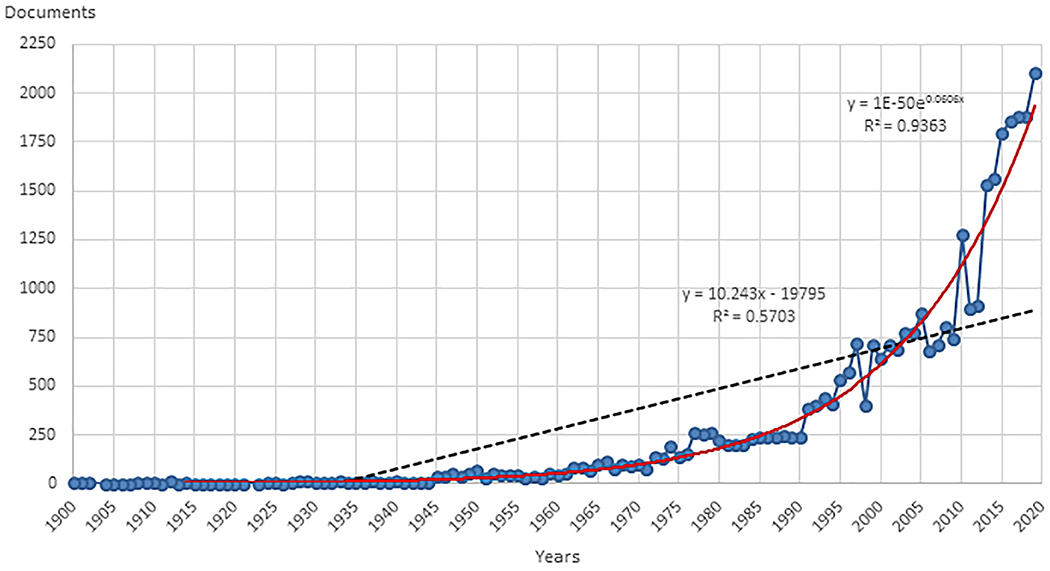
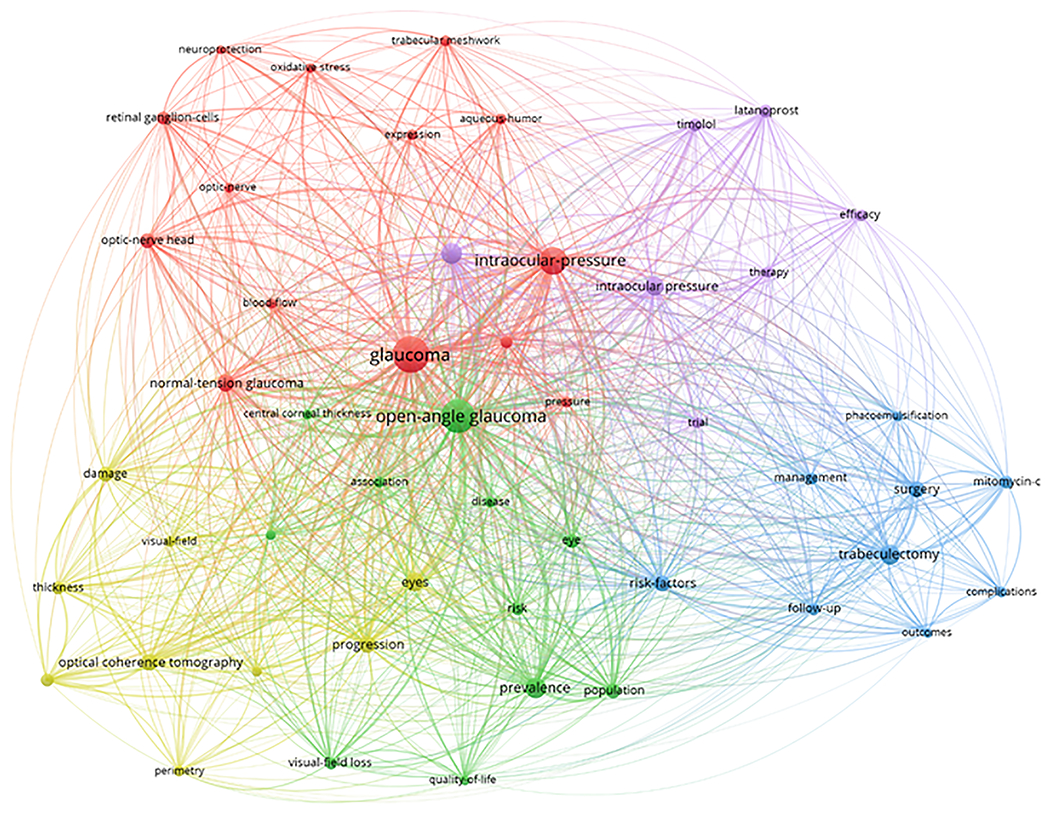
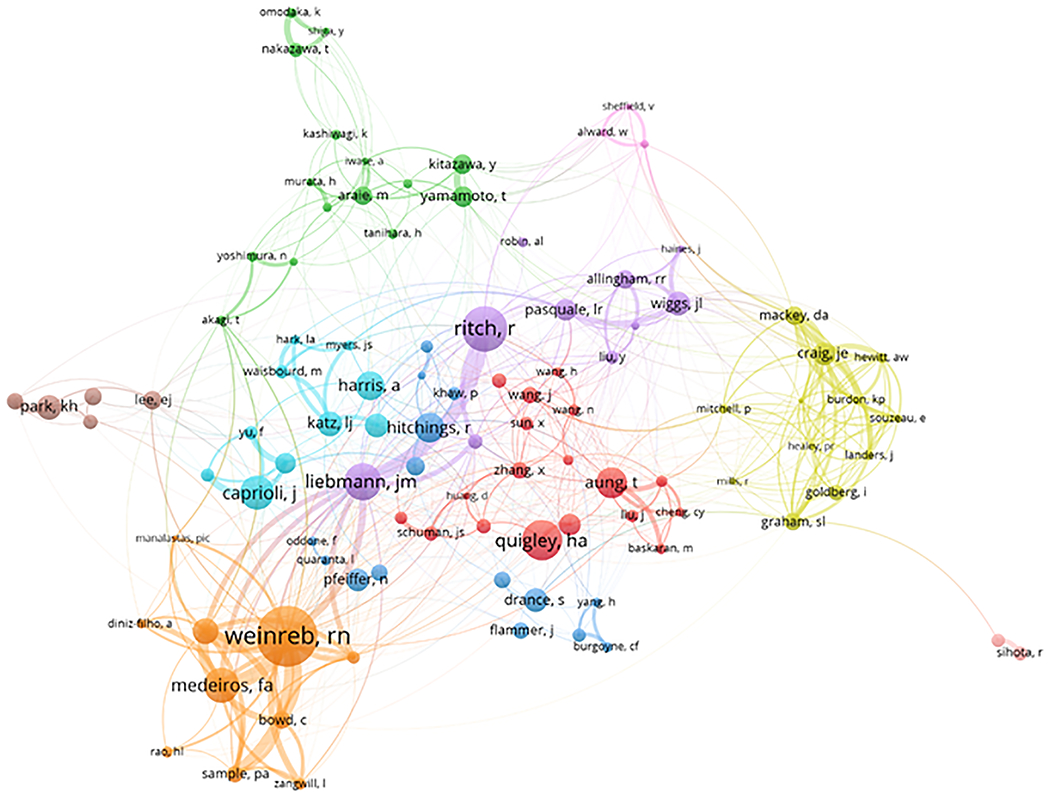
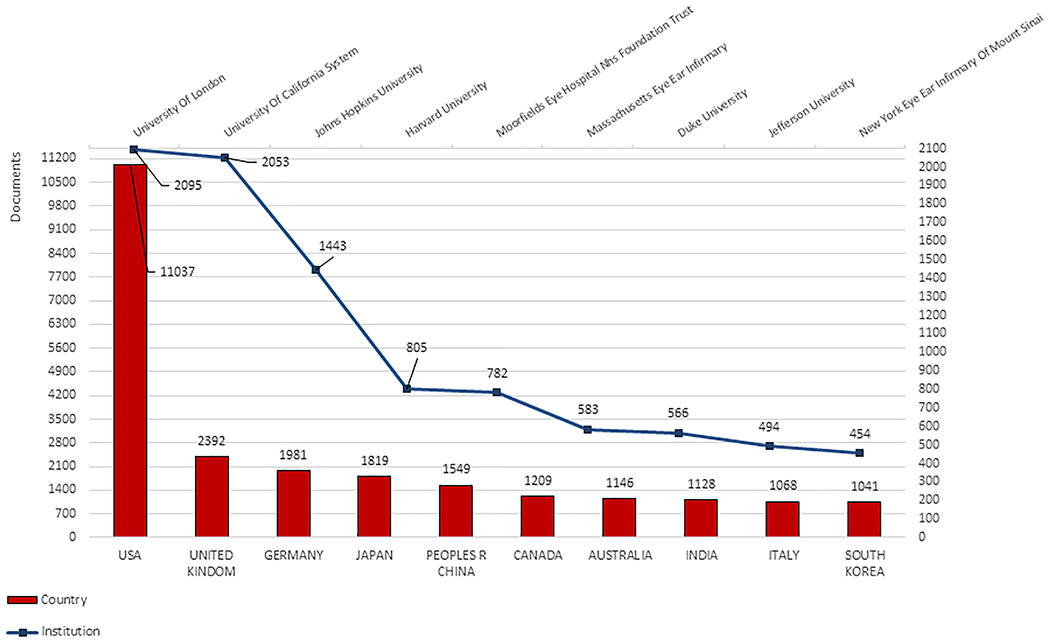
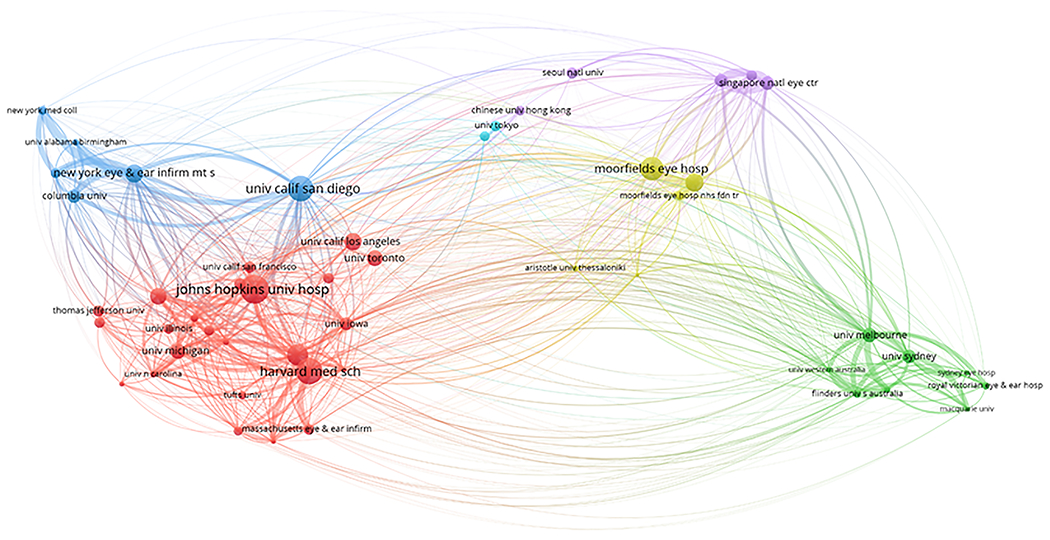
A total of 33 631 original articles were collected from the timeframe 1900 through 2019. Price's law showed an exponential growth. Scientific production was adjusted better to exponential growth (r = 0.967) than linear growth (r = 0.755). Literature on glaucoma research increased its growth in the last 30 years at a rate of 5.1% per year with a production that doubled its size every 13.9 years. The transience index was 60.08%; this indicates that most of the scientific production is the output of very few authors. Bradford's law showed a high concentration of articles published in a small core of specialized journals. Lotka's law indicated that the distribution of authors is concentrated heavily in small producers. The United States and University of London demonstrated the highest production of original articles. Map network visualization showed the generated term map detailing clusters of closely related terms.
Glaucoma literature has grown exponentially. A very high rate of transience was found that indicates the presence of numerous authors who sporadically publish on this topic. No evidence of a saturation point in the glaucoma literature was observed.
运用文献计量学工具探讨青光眼科研产出的相关性。
文献研究。
1900年至2019年发表的原创文章。
我们在科学网中搜索1900年至2019年发表的文献。我们使用文献计量指标来探究文献产出、分散情况、分布、重复时间及年增长率,这些指标由科学文献增长的普赖斯定律、洛特卡定律、瞬变指数和布拉德福德模型来表征。我们还计算了不同国家和机构的参与指数。最后,我们通过文献计量映射探究青光眼研究中最常用术语的共现网络。
个人、机构和国家的文献计量指标。
从1900年至2019年的时间段内共收集到33631篇原创文章。普赖斯定律显示呈指数增长。科研产出与指数增长的拟合度(r = 0.967)优于线性增长(r = 0.755)。青光眼研究文献在过去30年中以每年5.1%的速度增长,每13.9年产出规模翻倍。瞬变指数为60.08%;这表明大部分科研产出是极少数作者的成果。布拉德福德定律显示,大量文章集中发表在一小部分专业核心期刊上。洛特卡定律表明作者分布高度集中在少量高产作者中。美国和伦敦大学的原创文章产出量最高。图谱网络可视化展示了生成术语图,详细说明了紧密相关术语的聚类情况。
青光眼文献呈指数增长。发现瞬变率非常高,这表明有众多作者偶尔就该主题发表文章。未观察到青光眼文献有饱和点的证据。