Dept of Internal Medicine, Pulmonary Medicine Section, Gentofte University Hospital, Hellerup, Denmark.
Dept of Respiratory Medicine, Respiratory Research Unit, Hvidovre and Amager University Hospital, Hvidovre, Denmark
Eur Respir J. 2022 Jan 6;59(1). doi: 10.1183/13993003.00752-2021. Print 2022 Jan.
Combining the antibiotic azithromycin and hydroxychloroquine induces airway immunomodulatory effects, with the latter also having antiviral properties. This may improve outcomes in patients hospitalised for coronavirus disease 2019 (COVID-19).
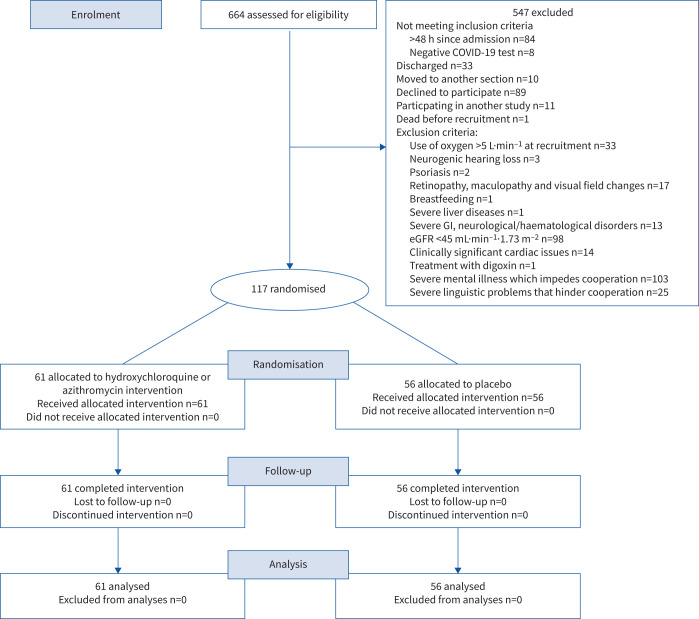
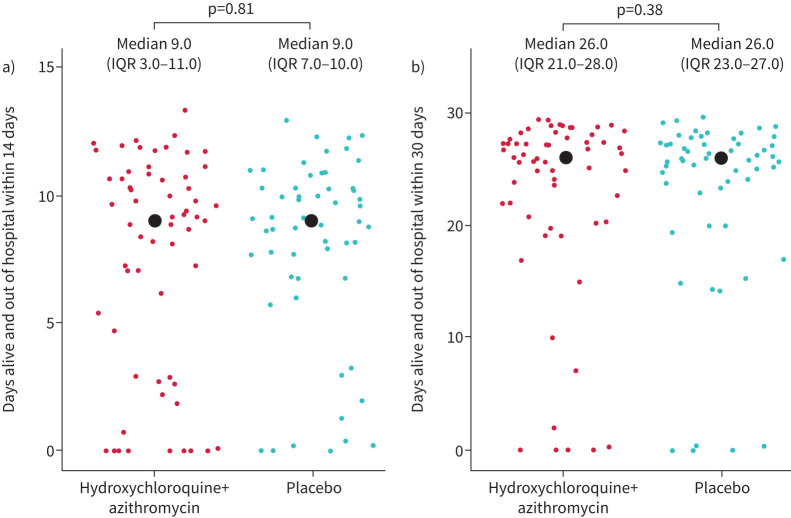
Placebo-controlled double-blind randomised multicentre trial. Patients aged ≥18 years, admitted to hospital for ≤48 h (not intensive care) with a positive severe acute respiratory syndrome coronavirus 2 (SARS-CoV-2) reverse transcription PCR test were recruited. The intervention was 500 mg daily azithromycin for 3 days followed by 250 mg daily azithromycin for 12 days combined with 200 mg twice-daily hydroxychloroquine for all 15 days. The control group received placebo/placebo. The primary outcome was days alive and discharged from hospital within 14 days (DAOH14).
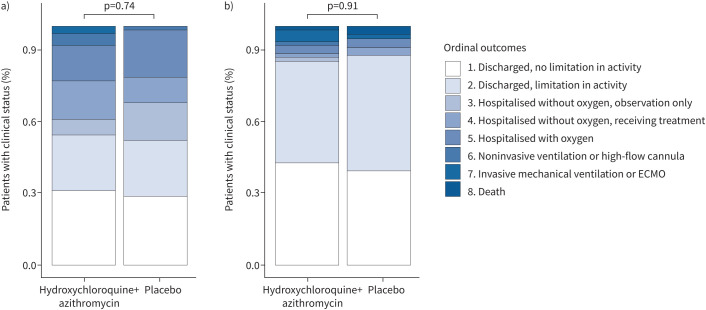
After randomisation of 117 patients, at the first planned interim analysis, the data and safety monitoring board recommended stopping enrolment due to futility, based on pre-specified criteria. Consequently, the trial was terminated on 1 February 2021. 61 patients received the combined intervention and 56 patients received placebo. In the intervention group, patients had a median (interquartile range) 9.0 (3-11) DAOH14 9.0 (7-10) DAOH14 in the placebo group (p=0.90). The primary safety outcome, death from all causes on day 30, occurred for one patient in the intervention group two patients receiving placebo (p=0.52), and readmittance or death within 30 days occurred for nine patients in the intervention group six patients receiving placebo (p=0.57).
The combination of azithromycin and hydroxychloroquine did not improve survival or length of hospitalisation in patients with COVID-19.
联合使用抗生素阿奇霉素和羟氯喹可诱导气道免疫调节作用,后者还具有抗病毒特性。这可能会改善因 2019 年冠状病毒病(COVID-19)住院的患者的结局。
安慰剂对照、双盲、随机、多中心试验。招募年龄≥18 岁、因 SARS-CoV-2 逆转录 PCR 检测阳性而在发病后≤48 小时内(非重症监护)住院的患者。干预措施为连续 3 天每天服用 500mg 阿奇霉素,然后连续 12 天每天服用 250mg 阿奇霉素,同时 15 天内每天服用 2 次 200mg 羟氯喹。对照组接受安慰剂/安慰剂。主要结局是 14 天内存活并出院的天数(DAOH14)。
在对 117 名患者进行随机分组后,根据预先设定的标准,数据和安全监测委员会在第一次计划的中期分析中建议由于无效而停止入组。因此,该试验于 2021 年 2 月 1 日终止。61 名患者接受了联合干预,56 名患者接受了安慰剂。在干预组中,患者的 DAOH14 中位数(四分位距)为 9.0(3-11)天,安慰剂组为 9.0(7-10)天(p=0.90)。主要安全性结局,即第 30 天的全因死亡,在干预组中发生 1 例,安慰剂组中发生 2 例(p=0.52),在干预组中,30 天内再入院或死亡的患者有 9 例,安慰剂组中发生 6 例(p=0.57)。
联合使用阿奇霉素和羟氯喹并未改善 COVID-19 患者的生存率或住院时间。