Family Medicine, Primary Care Health Center Jesús Marín Molina de Segura, Murcia, Spain.
Pediatric Primary Care, Primary Care Health Center Jesús Marín, Murcia, Spain.
NPJ Prim Care Respir Med. 2021 Jun 3;31(1):34. doi: 10.1038/s41533-021-00247-7.
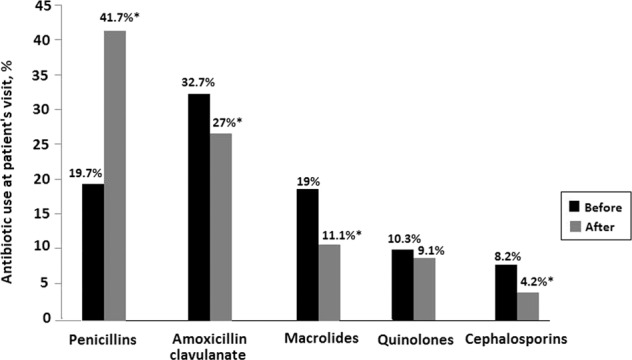
The objective of this study was to assess the impact of an education intervention for primary health care physicians, based on the knowledge of clinical practice guidelines and availability of rapid antigen detection test for group A streptococci (GAS), on the improvement of antibiotic prescription for patients with acute respiratory tract infections. Before and after the intervention, physicians collected data from ten consecutive patients who attended during a 3-week period. This process was performed twice a year for 6 consecutive years (2012-2017). A total of 18,001 patients were visited by 391 primary care physicians during the study period, 55.6% before intervention and 44.4% after intervention. After intervention, the antibiotic prescription decreased significantly, from 33.0 to 23.4% (p < 0.01). However, there was a statistically significant increase (p < 0.01) in the use of penicillins. This study, carried out in daily practice conditions, confirms that the educational strategy was associated with an overall reduction in the use of antibiotics and an improvement in the antibiotic prescription profile in acute respiratory tract infections.
本研究旨在评估基于临床实践指南知识和 A 组链球菌(GAS)快速抗原检测可用性的初级保健医生教育干预对改善急性呼吸道感染患者抗生素处方的影响。在干预前后,医生从连续就诊的 10 名患者中收集数据,为期 3 周。该过程每年进行两次,持续了 6 年(2012-2017 年)。在研究期间,共有 391 名初级保健医生对 18,001 名患者进行了就诊,干预前为 55.6%,干预后为 44.4%。干预后,抗生素处方显著下降,从 33.0%降至 23.4%(p<0.01)。然而,青霉素的使用却呈显著增加(p<0.01)。本研究在日常实践条件下进行,证实了教育策略与抗生素总体使用减少以及急性呼吸道感染抗生素处方改善相关。