Diabetes, Endocrinology and Obesity Branch, National Institute of Diabetes, Digestive and Kidney Diseases, National Institutes of Health, Bethesda, MD, United States.
Department of Endocrinology and Diabetes, Children's National Hospital, Washington, DC, United States.
Front Endocrinol (Lausanne). 2021 May 18;12:665292. doi: 10.3389/fendo.2021.665292. eCollection 2021.
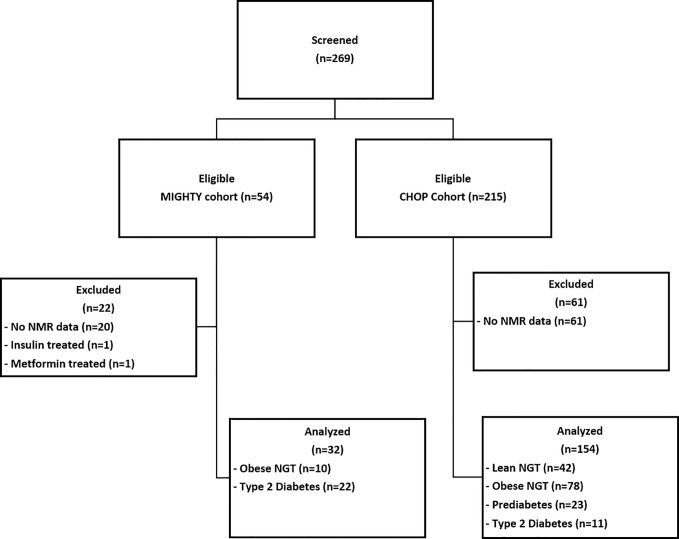
Youth with obesity have an increased risk for cardiometabolic disease, but identifying those at highest risk remains a challenge. Four biomarkers that might serve this purpose are "by products" of clinical NMR LipoProfile lipid testing: LPIR (Lipoprotein Insulin Resistance Index), GlycA (inflammation marker), BCAA (total branched-chain amino acids), and glycine. All are strongly related to insulin resistance and type 2 diabetes (T2DM) in adults (glycine inversely) and are independent of biological and methodological variations in insulin assays. However, their clinical utility in youth is unclear. We compared fasting levels of these biomarkers in 186 youth (42 lean normal glucose tolerant (NGT), 88 obese NGT, 23 with prediabetes (PreDM), and 33 with T2DM. All four biomarkers were associated with obesity and glycemia in youth. LPIR and GlycA were highest in youth with PreDM and T2DM, whereas glycine was lowest in youth with T2DM. While all four were correlated with HOMA-IR (Homeostatic Model Assessment for Insulin Resistance), LPIR had the strongest correlation (LPIR: r = 0.6; GlycA: r = 0.4, glycine: r = -0.4, BCAA: r = 0.2, all < 0.01). All four markers correlated with HbA1c (LPIR, GlycA, BCAA: r ≥ 0.3 and glycine: r = -0.3, all < 0.001). In multi-variable regression models, LPIR, GlycA, and glycine were independently associated with HOMA-IR (Adjusted R = 0.473, P < 0.001) and LPIR, glycine, and BCAA were independently associated with HbA1c (Adjusted R = 0.33, P < 0.001). An LPIR index of >44 was associated with elevated blood pressure, BMI, and dyslipidemia. Plasma NMR-derived markers were related to adverse markers of cardiometabolic risk in youth. LPIR, either alone or in combination with GlycA, should be explored as a non-insulin dependent predictive tool for development of insulin resistance and diabetes in youth.
Clinicaltrials.gov, identifier NCT:02960659.
肥胖的年轻人患心血管代谢疾病的风险增加,但确定哪些人风险最高仍然是一个挑战。四项可能用于此目的的生物标志物是临床 NMR LipoProfile 脂质测试的“副产品”:LPIR(脂蛋白胰岛素抵抗指数)、GlycA(炎症标志物)、BCAA(总支链氨基酸)和甘氨酸。所有这些标志物都与成年人的胰岛素抵抗和 2 型糖尿病(T2DM)密切相关(甘氨酸相反),并且与胰岛素测定中的生物学和方法学变化无关。然而,它们在年轻人中的临床应用尚不清楚。我们比较了 186 名年轻人(42 名瘦正常葡萄糖耐量(NGT)、88 名肥胖 NGT、23 名前驱糖尿病(PreDM)和 33 名 T2DM)的空腹水平。这四种生物标志物都与年轻人的肥胖和血糖有关。LPIR 和 GlycA 在 PreDM 和 T2DM 患者中最高,而 T2DM 患者中的甘氨酸最低。虽然这四种生物标志物都与 HOMA-IR(胰岛素抵抗的稳态模型评估)相关,但 LPIR 的相关性最强(LPIR:r = 0.6;GlycA:r = 0.4,甘氨酸:r = -0.4,BCAA:r = 0.2,均 < 0.01)。所有四种标志物都与 HbA1c 相关(LPIR、GlycA、BCAA:r ≥ 0.3,甘氨酸:r = -0.3,均 < 0.001)。在多变量回归模型中,LPIR、GlycA 和甘氨酸与 HOMA-IR 独立相关(调整后的 R = 0.473,P < 0.001),而 LPIR、甘氨酸和 BCAA 与 HbA1c 独立相关(调整后的 R = 0.33,P < 0.001)。LPIR 指数>44 与血压升高、BMI 升高和血脂异常有关。血浆 NMR 衍生标志物与年轻人心血管代谢风险的不良标志物有关。LPIR 单独或与 GlycA 联合使用,可能作为一种非胰岛素依赖性预测工具,用于预测年轻人胰岛素抵抗和糖尿病的发生。
Clinicaltrials.gov,标识符 NCT:02960659。