Laboratory Corporation of America Holdings (LabCorp), Morrisville, NC, 27560, USA.
LabCorp, Burlington, NC, USA.
Lipids Health Dis. 2020 Dec 1;19(1):247. doi: 10.1186/s12944-020-01424-2.
Standard lipid panel assays employing chemical/enzymatic methods measure total cholesterol (TC), triglycerides (TG), and high-density lipoprotein cholesterol (HDL-C), from which are calculated estimates of low-density lipoprotein cholesterol (LDL-C). These lipid measures are used universally to guide management of atherosclerotic cardiovascular disease risk. Apolipoprotein B (apoB) is generally acknowledged to be superior to LDL-C for lipid-lowering therapeutic decision-making, but apoB immunoassays are performed relatively infrequently due to the added analytic cost. The aim of this study was to develop and validate the performance of a rapid, high-throughput, reagent-less assay producing an "Extended Lipid Panel" (ELP) that includes apoB, using the Vantera® nuclear magnetic resonance (NMR) analyzer platform already deployed clinically for lipoprotein particle and other testing.
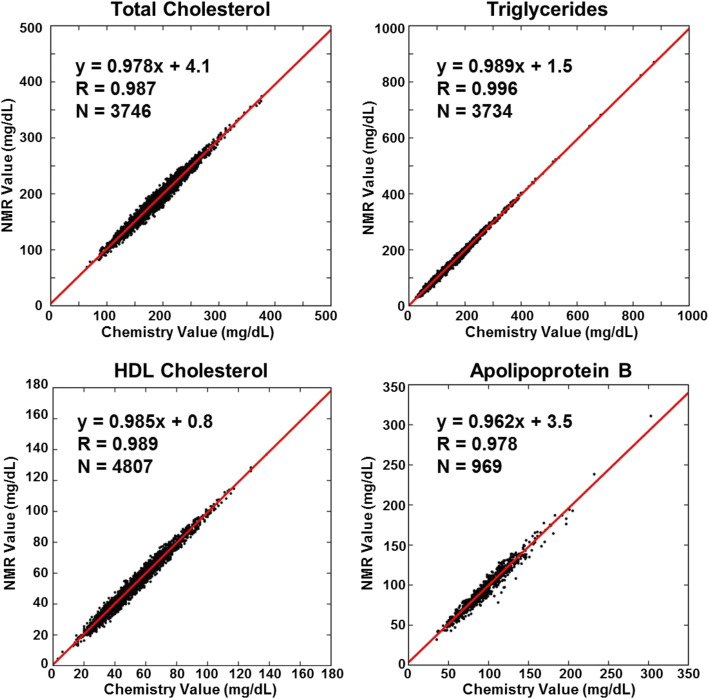
Partial least squares regression models, using as input a defined region of proton NMR spectra of plasma or serum, were created to simultaneously quantify TC, TG, HDL-C, and apoB. Large training sets (n > ~ 1000) of patient sera analyzed independently for lipids and apoB by chemical methods were employed to ensure prediction models reflect the wide lipid compositional diversity of the population. The analytical performance of the NMR ELP assay was comprehensively evaluated.
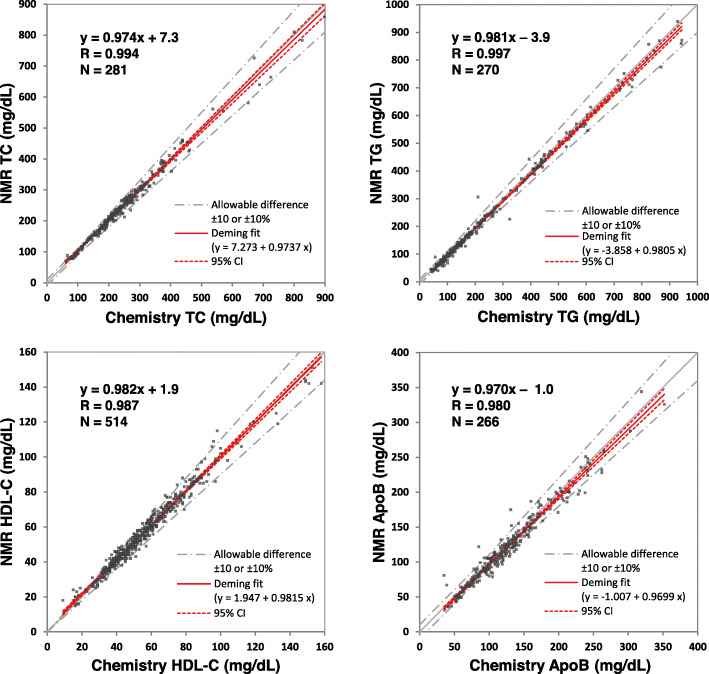
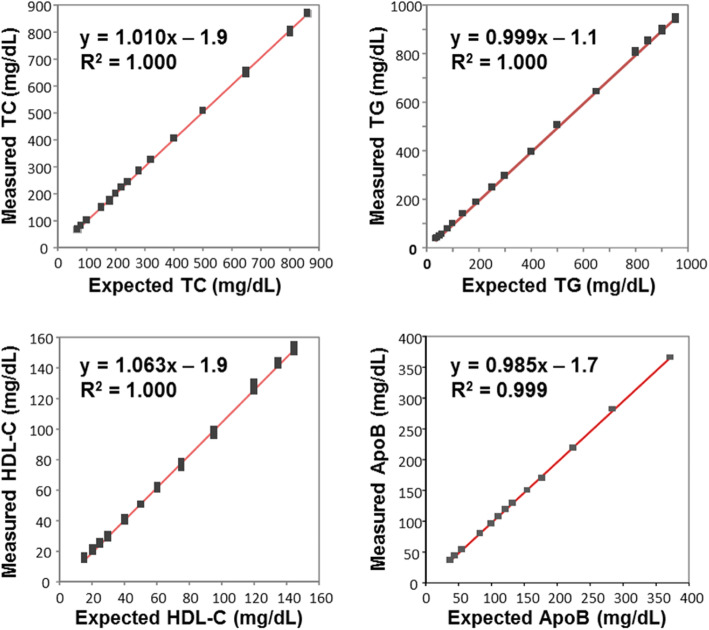
Excellent agreement was demonstrated between chemically-measured and ELP assay values of TC, TG, HDL-C and apoB with correlation coefficients ranging from 0.980 to 0.997. Within-run precision studies measured using low, medium, and high level serum pools gave coefficients of variation for the 4 analytes ranging from 1.0 to 3.8% for the low, 1.0 to 1.7% for the medium, and 0.9 to 1.3% for the high pools. Corresponding values for within-lab precision over 20 days were 1.4 to 3.6%, 1.2 to 2.3%, and 1.0 to 1.9%, respectively. Independent testing at three sites over 5 days produced highly consistent assay results. No major interference was observed from 38 endogenous or exogenous substances tested.
Extensive assay performance evaluations validate that the NMR ELP assay is efficient, robust, and substantially equivalent to standard chemistry assays for the clinical measurement of lipids and apoB. Routine reporting of apoB alongside standard lipid measures could facilitate more widespread utilization of apoB for clinical decision-making.
采用化学/酶法的标准脂质分析检测可测量总胆固醇 (TC)、甘油三酯 (TG) 和高密度脂蛋白胆固醇 (HDL-C),并由此计算出低密度脂蛋白胆固醇 (LDL-C) 的估算值。这些脂质指标普遍用于指导动脉粥样硬化性心血管疾病风险的管理。载脂蛋白 B (apoB) 通常被认为优于 LDL-C,适用于降脂治疗决策,但由于分析成本增加,apoB 免疫测定的实施频率相对较低。本研究旨在开发和验证一种快速、高通量、无试剂的分析仪,该分析仪使用已临床部署用于脂蛋白颗粒和其他检测的 Vantera®核磁共振 (NMR) 分析平台,生成包含 apoB 的“扩展脂质分析”(ELP)。
采用偏最小二乘回归模型,以血浆或血清中质子 NMR 光谱的特定区域作为输入,同时定量 TC、TG、HDL-C 和 apoB。使用化学方法独立分析的患者血清的大型训练集 (n>~1000) 用于脂质和 apoB,以确保预测模型反映人群中广泛的脂质组成多样性。全面评估了 NMR ELP 分析的分析性能。
化学方法和 ELP 分析检测的 TC、TG、HDL-C 和 apoB 值之间显示出极好的一致性,相关系数范围为 0.980 至 0.997。使用低、中、高水平血清池进行的批内精密度研究得出,4 种分析物的变异系数分别为低水平池 1.0%至 3.8%、中水平池 1.0%至 1.7%和高水平池 0.9%至 1.3%。相应的 20 天内实验室间精密度值分别为 1.4%至 3.6%、1.2%至 2.3%和 1.0%至 1.9%。在三个地点进行的为期 5 天的独立测试产生了高度一致的分析结果。在测试的 38 种内源性或外源性物质中,未观察到明显干扰。
广泛的分析性能评估验证了 NMR ELP 分析对于临床测量脂质和 apoB 是高效、稳健的,与标准化学分析基本等效。与标准脂质测量一起报告 apoB 可能有助于更广泛地将 apoB 用于临床决策。