Habibian Maryam, McKinlay Colin, Blake Timothy R, Kietrys Anna M, Waymouth Robert M, Wender Paul A, Kool Eric T
Department of Chemistry, Stanford University 450 Serra Mall Stanford CA 94305 USA.
Chem Sci. 2019 Dec 2;11(4):1011-1016. doi: 10.1039/c9sc03639c.
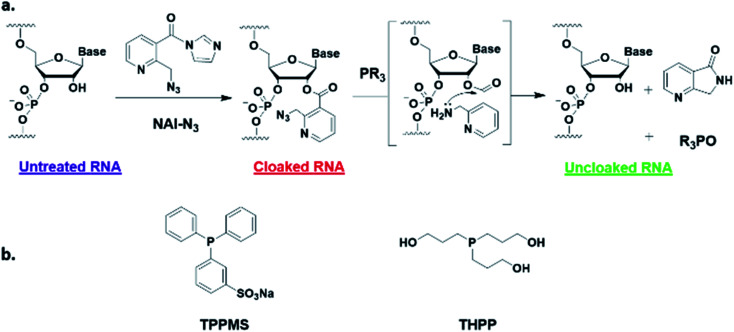
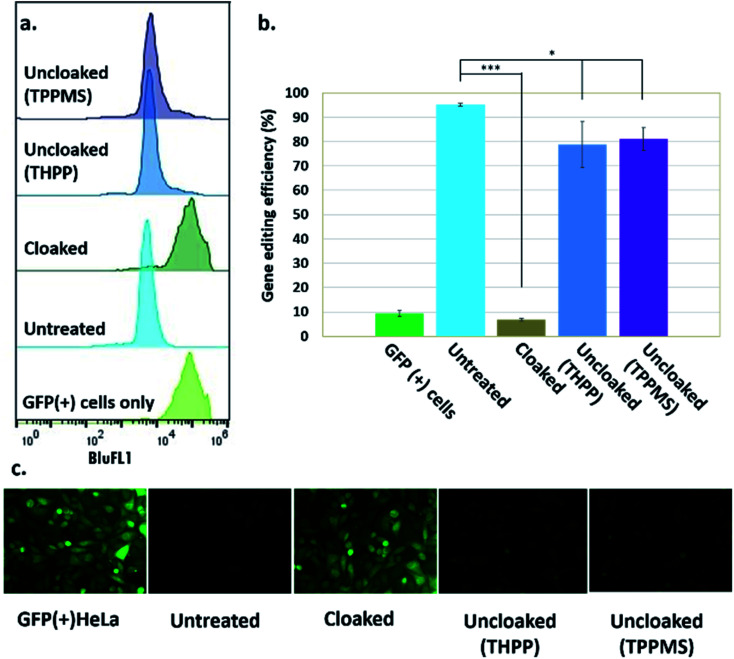
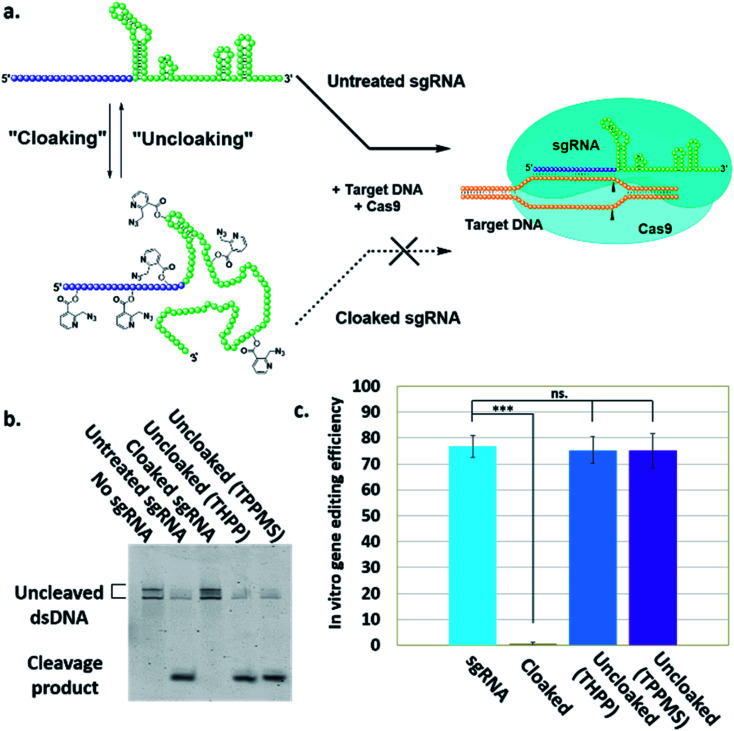
We report the development of post-transcriptional chemical methods that enable control over CRISPR-Cas9 gene editing activity both in assays and in living cells. We show that an azide-substituted acyl imidazole reagent (NAI-N) efficiently acylates CRISPR single guide RNAs (sgRNAs) in 20 minutes in buffer. Poly-acylated ("cloaked") sgRNA was completely inactive in DNA cleavage with Cas9 , and activity was quantitatively restored after phosphine treatment. Delivery of cloaked sgRNA and Cas9 mRNA into HeLa cells was enabled by the use of charge-altering releasable transporters (CARTs), which outperformed commercial transfection reagents in transfecting sgRNA co-complexed with Cas9 encoding functional mRNA. Genomic DNA cleavage in the cells by CRISPR-Cas9 was efficiently restored after treatment with phosphine to remove the blocking acyl groups. Our results highlight the utility of reversible RNA acylation as a novel method for temporal control of genome-editing function.
我们报道了转录后化学方法的开发,该方法能够在体外实验和活细胞中控制CRISPR-Cas9基因编辑活性。我们表明,一种叠氮取代的酰基咪唑试剂(NAI-N)在缓冲液中20分钟内可有效酰化CRISPR单向导RNA(sgRNA)。多酰化(“隐形”)sgRNA在与Cas9进行DNA切割时完全无活性,用膦处理后活性可定量恢复。通过使用电荷改变可释放转运体(CARTs),能够将隐形sgRNA和Cas9 mRNA递送至HeLa细胞,在转染与编码功能性mRNA的Cas9共复合的sgRNA方面,CARTs优于商业转染试剂。用膦处理以去除阻断酰基后,CRISPR-Cas9在细胞中的基因组DNA切割得以有效恢复。我们的结果突出了可逆RNA酰化作为一种用于基因组编辑功能的时间控制的新方法的实用性。