Mehta Daryush D, Kobler James B, Zeitels Steven M, Zañartu Matías, Erath Byron D, Motie-Shirazi Mohsen, Peterson Sean D, Petrillo Robert H, Hillman Robert E
Center for Laryngeal Surgery and Voice Rehabilitation, Massachusetts General Hospital, Boston, MA 02114, USA.
Department of Surgery, Massachusetts General Hospital-Harvard Medical School, Boston, MA 02114, USA.
Appl Sci (Basel). 2019 Oct 2;9(20). doi: 10.3390/app9204360. Epub 2019 Oct 16.
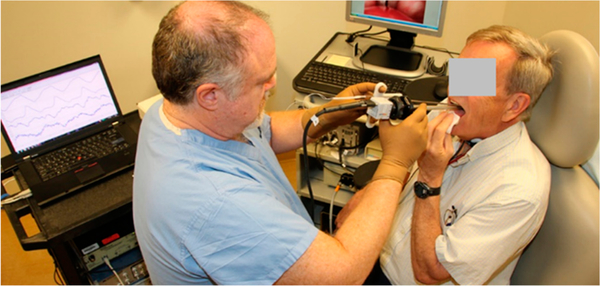
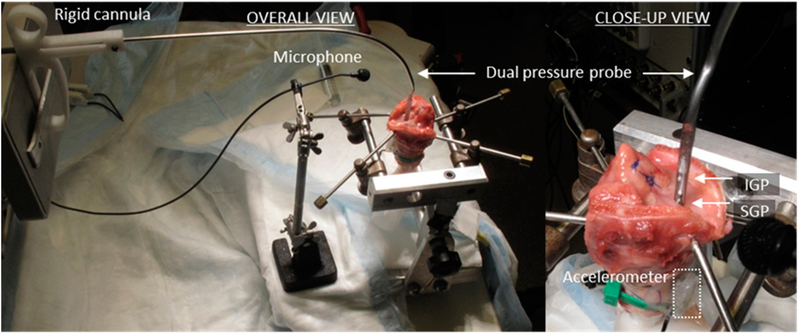
A critical element in understanding voice production mechanisms is the characterization of vocal fold collision, which is widely considered a primary etiological factor in the development of common phonotraumatic lesions such as nodules and polyps. This paper describes the development of a transoral, dual-sensor intraglottal/subglottal pressure probe for the simultaneous measurement of vocal fold collision and subglottal pressures during phonation using two miniature sensors positioned 7.6 mm apart at the distal end of a rigid cannula. Proof-of-concept testing was performed using excised whole-mount and hemilarynx human tissue aerodynamically driven into self-sustained oscillation, with systematic variation of the superior-inferior positioning of the vocal fold collision sensor. In the hemilarynx experiment, signals from the pressure sensors were synchronized with an acoustic microphone, a tracheal-surface accelerometer, and two high-speed video cameras recording at 4000 frames per second for top-down and en face imaging of the superior and medial vocal fold surfaces, respectively. As expected, the intraglottal pressure signal exhibited an impulse-like peak when vocal fold contact occurred, followed by a broader peak associated with intraglottal pressure build-up during the de-contacting phase. As subglottal pressure was increased, the peak amplitude of the collision pressure increased and typically reached a value below that of the average subglottal pressure. Results provide important baseline vocal fold collision pressure data with which computational models of voice production can be developed and in vivo measurements can be referenced.
理解发声机制的一个关键要素是声带碰撞的特征描述,声带碰撞被广泛认为是诸如小结和息肉等常见发声创伤性病变发展的主要病因。本文描述了一种经口的双传感器声门内/声门下压力探头的研制,该探头使用两个相距7.6毫米的微型传感器,位于刚性插管末端,用于在发声过程中同时测量声带碰撞和声门下压力。使用切除的全喉和半喉人体组织进行了概念验证测试,这些组织通过空气动力学驱动进入自持振荡状态,并对声带碰撞传感器的上下位置进行了系统变化。在半喉实验中,压力传感器的信号与一个声学麦克风、一个气管表面加速度计以及两台以每秒4000帧的速度记录的高速摄像机同步,分别用于对声带上表面和内侧表面进行自上而下和正面成像。正如预期的那样,当声带接触发生时,声门内压力信号呈现出类似脉冲的峰值,随后是一个更宽的峰值,与脱接触阶段声门内压力的积聚有关。随着声门下压力的增加,碰撞压力的峰值幅度增加,通常达到低于平均声门下压力的值。研究结果提供了重要的声带碰撞压力基线数据,可据此开发发声计算模型并参考体内测量结果。