Fiani Brian, Reardon Taylor, Selvage Jacob, Dahan Alden, El-Farra Mohamed H, Endres Philine, Taka Taha, Suliman Yasmine, Rose Alexander
Department of Neurosurgery, Desert Regional Medical Center, Palm Springs, California, United States.
Kentucky College of Osteopathic Medicine, University of Pikeville, Pikeville, Kentucky, United States.
Surg Neurol Int. 2021 May 10;12:222. doi: 10.25259/SNI_153_2021. eCollection 2021.
Awake surgery is performed in multiple surgical specialties, but historically, awake surgery in the field of neurosurgery was limited to craniotomies. Over the past two decades, spinal surgeons have pushed for techniques that only require regional anesthesia as they may provide reduced financial burdens on patients, faster recovery times, and better outcomes. The list of awake spine surgeries that have been found in the literature include: laminectomies/discectomies, anterior cervical discectomy and fusions (ACDFs), lumbar fusions, and dorsal column (DC) stimulator placement.
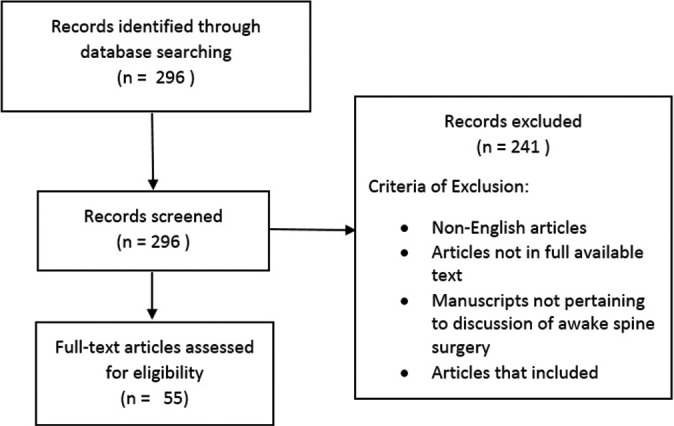
An extensive review of the published literature was conducted through PubMed database with articles containing the search term "awake spine surgery." No date restrictions were used.
The search yielded 293 related articles. Cross-checking of articles was conducted to exclude of duplicate articles. The articles were screened for their full text and English language availability. We finalized those articles pertaining to the topic. Findings have shown that lumbar laminectomies performed with local anesthesia have shown shorter operating time, less postoperative nausea, lower incidence of urinary retention and spinal headache, and shorter hospital stays when compared to those performed under general anesthesia. Lumbar fusions with local anesthesia showed similar outcomes as patients reported better postoperative function and fewer side effects of general anesthesia. DC stimulator placement performed with local anesthesia is advantageous as it allows real time patient feedback for surgeons as they directly test affected nerves. However, spontaneous movement during the placement of DC stimulators is associated with higher failure rates when compared to general anesthesia (29.7% vs. 14.9%). Studies have shown that the use of local anesthesia during ACDFs has no significant differences when compared to general anesthesia, and patient's report better tolerated pain with general anesthesia.
The use of awake spine surgery is beneficial for those who cannot undergo general anesthesia. However, it is limited to patients who can tolerate prone positioning with no central airway (i.e., normal BMI with a healthy airway), have no pre-existing mental health conditions (e.g., anxiety), and require a minimally invasive procedure with a short operating time. Future studies should focus on long-term efficacies of these procedures that provide further insight on the indications and limitations of awake spine surgery.
清醒手术在多个外科专业中都有开展,但从历史上看,神经外科领域的清醒手术仅限于开颅手术。在过去二十年中,脊柱外科医生一直在推动仅需区域麻醉的技术,因为这些技术可能会减轻患者的经济负担、缩短恢复时间并带来更好的治疗效果。文献中发现的清醒脊柱手术包括:椎板切除术/椎间盘切除术、颈椎前路椎间盘切除融合术(ACDF)、腰椎融合术以及背柱(DC)刺激器植入术。
通过PubMed数据库对已发表的文献进行广泛检索,检索词为“清醒脊柱手术”。未设置日期限制。
检索结果为293篇相关文章。对文章进行交叉核对以排除重复文章。筛选文章的全文及英文可用性。我们最终确定了与该主题相关的文章。研究结果表明,与全身麻醉下进行的腰椎椎板切除术相比,局部麻醉下进行的腰椎椎板切除术手术时间更短、术后恶心更少、尿潴留和脊柱头痛的发生率更低,住院时间也更短。局部麻醉下的腰椎融合术显示出相似的结果,因为患者术后功能更好,全身麻醉的副作用更少。局部麻醉下进行DC刺激器植入术具有优势,因为在外科医生直接测试受影响神经时,它能让患者实时反馈。然而,与全身麻醉相比,DC刺激器植入过程中的自发运动失败率更高(29.7%对14.9%)。研究表明,ACDF手术中使用局部麻醉与全身麻醉相比无显著差异,且患者报告全身麻醉时疼痛耐受性更好。
清醒脊柱手术对那些无法接受全身麻醉的患者有益。然而,它仅限于能够耐受无中央气道的俯卧位(即正常体重指数且气道健康)、没有既往心理健康问题(如焦虑)且需要进行手术时间短的微创手术的患者。未来的研究应关注这些手术的长期疗效,以便进一步深入了解清醒脊柱手术的确切适应症和局限性。