Al-Mouqdad Mountasser Mohammad, Abdelrahim Adli, Abdalgader Ayman Tagelsir, Alyaseen Nowf, Khalil Thanaa Mustafa, Taha Muhammed Yassen, Asfour Suzan Suhail
Neonatal Intensive Care Unit, Hospital of Paediatrics, King Saud Medical City, Riyadh, Saudi Arabia.
General Paediatrics Department, Hospital of Paediatrics, King Saud Medical City, Riyadh, Saudi Arabia.
Int J Pediatr Adolesc Med. 2021 Jun;8(2):76-81. doi: 10.1016/j.ijpam.2019.11.005. Epub 2019 Nov 25.
Intraventricular hemorrhage (IVH) is a serious complication of premature (<32 weeks) deliveries, especially in very-low-birth-weight (VLBW; <1500 g) neonates. Infants developing severe IVH are more prone to long-term developmental disabilities. Although 62%-79% of women in Saudi Arabia receive antenatal steroids, IVH incidence remains high. We analyzed the risk factors for IVH in preterm VLBW neonates in the central region of Saudi Arabia.
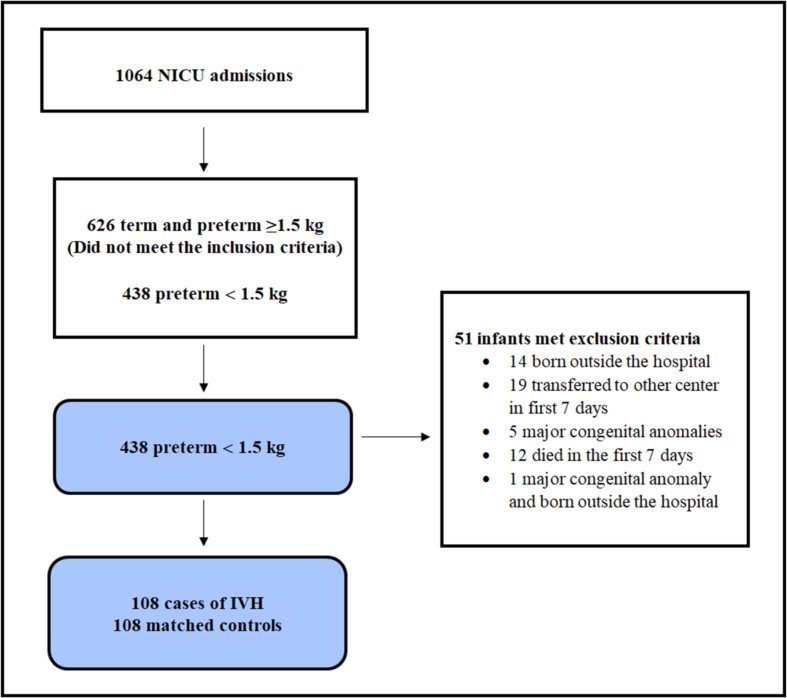
We included premature infants with IVH (n = 108) and gestational age- and birth weight-matched control group infants (n = 108) admitted to our neonatal intensive care unit. Cases were divided into mild (grades I and II; n = 56) and severe (grades III and IV; n = 52) IVH groups. Association of IVH with risk factors in the first week of life was investigated.
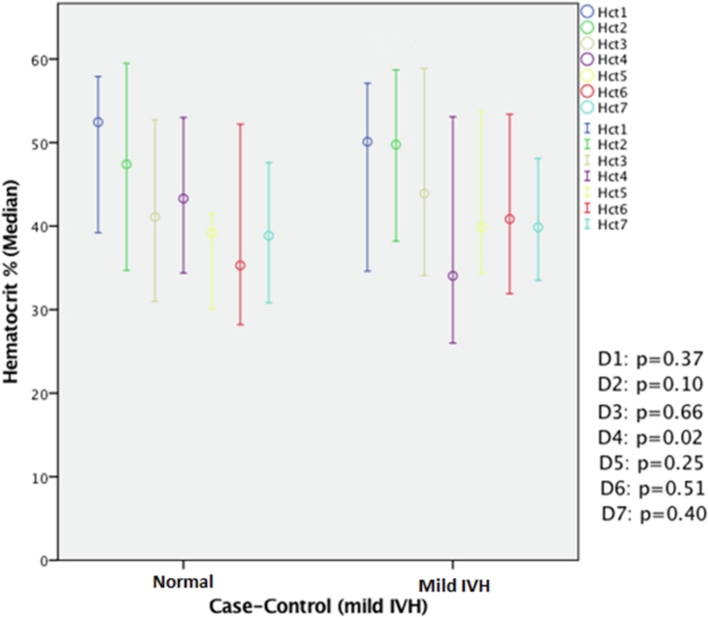
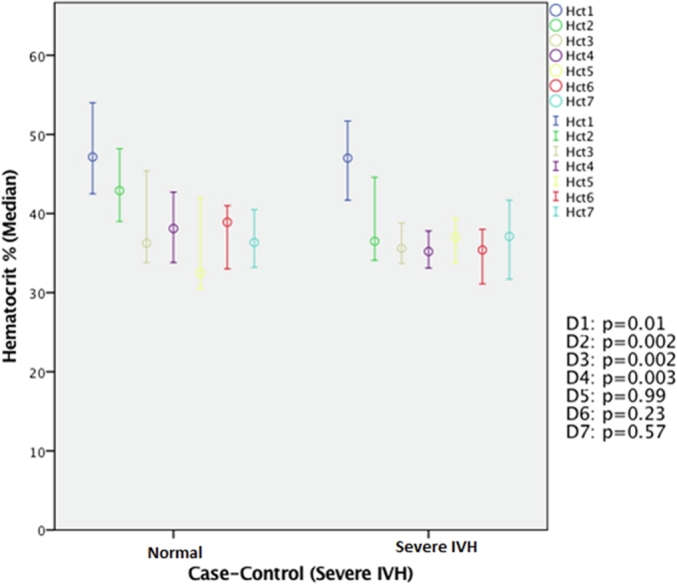
The following risk factors were associated with severe IVH: lack of antenatal steroid administration ( < .001), pulmonary hemorrhage ( = .023), inotrope use ( = .032), neonatal hydrocortisone administration ( = .001), and patent ductus arteriosus (PDA) ( = .005). Multivariable logistic regression analysis revealed the following to be significant: lack of antenatal dexamethasone (adjusted odds ratio [aOR]: 0.219, 95% confidence interval [95% CI] 0.087-0.546), neonatal hydrocortisone administration (aOR: 3.519, 95% CI 1.204-10.281), and PDA (aOR: 2.718, 95% CI 1.024-7.210). Low hematocrit in the first 3 days of life was significantly associated with severe IVH (all < .01).
Failure to receive antenatal dexamethasone, PDA, hydrocortisone administration for neonatal hypotension, and low hematocrit in the first 3 days of life was associated with severe IVH in VLBW neonates. Clinicians and healthcare policy makers should consider these factors during decision-making.
脑室内出血(IVH)是早产(<32周)分娩的严重并发症,尤其是在极低出生体重(VLBW;<1500克)的新生儿中。发生严重IVH的婴儿更容易出现长期发育障碍。尽管沙特阿拉伯62%-79%的女性接受了产前类固醇治疗,但IVH的发生率仍然很高。我们分析了沙特阿拉伯中部地区早产VLBW新生儿IVH的危险因素。
我们纳入了入住我们新生儿重症监护病房的患有IVH的早产儿(n = 108)以及孕周和出生体重匹配的对照组婴儿(n = 108)。病例分为轻度(I级和II级;n = 56)和重度(III级和IV级;n = 52)IVH组。研究了出生后第一周内IVH与危险因素的相关性。
以下危险因素与严重IVH相关:未接受产前类固醇治疗(P <.001)、肺出血(P =.023)、使用血管活性药物(P =.032)、给予新生儿氢化可的松(P =.001)和动脉导管未闭(PDA)(P =.005)。多变量逻辑回归分析显示以下因素具有显著性:未接受产前地塞米松治疗(调整后的优势比[aOR]:0.219,95%置信区间[95%CI] 0.087-0.546)、给予新生儿氢化可的松(aOR:3.519,95%CI 1.204-10.281)和PDA(aOR:2.718,95%CI 1.024-7.210)。出生后前3天的低血细胞比容与严重IVH显著相关(所有P <.01)。
未接受产前地塞米松治疗、PDA、因新生儿低血压给予氢化可的松治疗以及出生后前3天的低血细胞比容与VLBW新生儿的严重IVH相关。临床医生和医疗政策制定者在决策时应考虑这些因素。