Wei J C, Catalano R, Profit J, Gould J B, Lee H C
University of California, Berkeley School of Public Health, Berkeley, CA, USA.
Division of Neonatal and Developmental Medicine, Department of Pediatrics, Stanford University, Stanford, CA, USA.
J Perinatol. 2016 May;36(5):352-6. doi: 10.1038/jp.2016.38. Epub 2016 Mar 24.
To determine the association between antenatal steroids administration and intraventricular hemorrhage rates.
We used cross-sectional data from the California Perinatal Quality Care Collaborative during 2007 to 2013 for infants ⩽32 weeks gestational age. Using multivariable logistic regression, we evaluated the effect of antenatal steroids on intraventricular hemorrhage, stratified by gestational age.
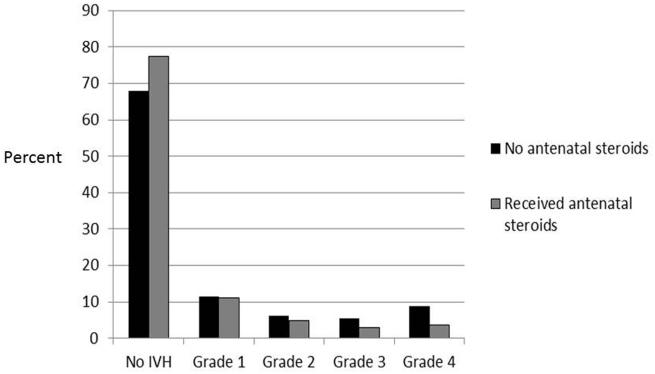
In 25 979 very-low-birth weight infants, antenatal steroid use was associated with a reduction in incidence of any grade of intraventricular hemorrhage (odds ratio=0.68, 95% confidence interval: 0.62, 0.75) and a reduction in incidence of severe intraventricular hemorrhage (odds ratio=0.51, 95% confidence interval: 0.45, 0.58). This association was seen across gestational ages ranging from 22 to 29 weeks.
Although current guidelines recommend coverage for preterm birth at 24 to 34 weeks gestation, our results suggest that treatment with antenatal steroids may be beneficial even before 24 weeks of gestational age.
确定产前使用类固醇与脑室内出血发生率之间的关联。
我们使用了2007年至2013年加利福尼亚围产期质量保健协作组中胎龄小于等于32周婴儿的横断面数据。通过多变量逻辑回归分析,我们按胎龄分层评估了产前使用类固醇对脑室内出血的影响。
在25979例极低出生体重儿中,产前使用类固醇与任何级别的脑室内出血发生率降低相关(比值比=0.68,95%置信区间:0.62,0.75),且与严重脑室内出血发生率降低相关(比值比=0.51,95%置信区间:0.45,0.58)。在22至29周的各个胎龄中均观察到这种关联。
尽管当前指南建议对妊娠24至34周的早产进行干预,但我们的结果表明,产前使用类固醇治疗甚至在妊娠24周之前可能也是有益的。