Department of Hematology, Catholic Hematology Hospital, Seoul St. Mary's Hospital, College of Medicine, The Catholic University of Korea, Seoul, Republic of Korea.
Leukemia Research Institute, College of Medicine, The Catholic University of Korea, Seoul, Republic of Korea.
Blood Cancer J. 2021 Jun 4;11(6):109. doi: 10.1038/s41408-021-00500-9.
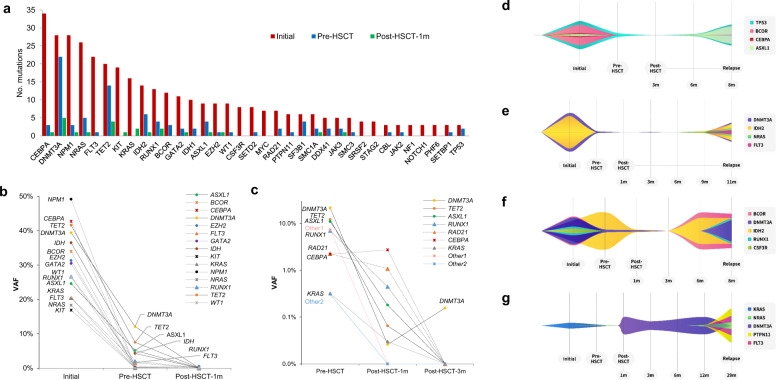
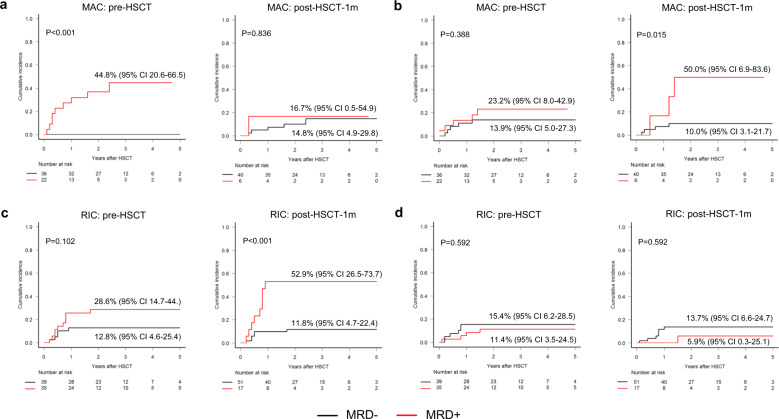
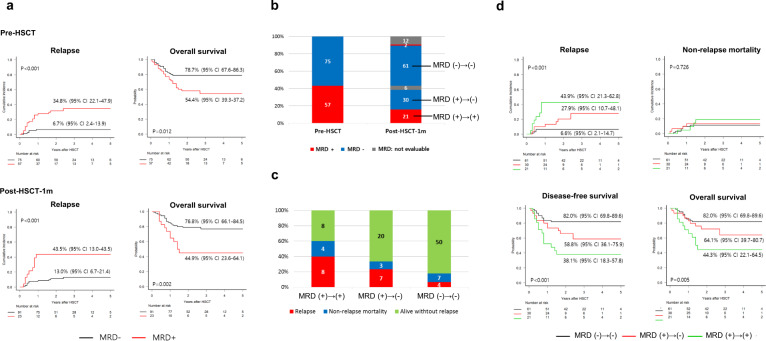
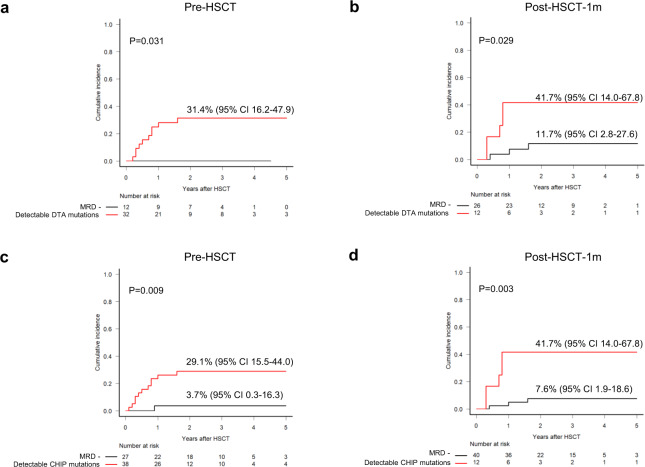
Given limited studies on next-generation sequencing-based measurable residual disease (NGS-MRD) in acute myeloid leukemia (AML) patients after allogeneic hematopoietic stem cell transplantation (allo-HSCT), we longitudinally collected samples before and after allo-HSCT from two independent prospective cohorts (n = 132) and investigated the prognostic impact of amplicon-based NGS assessment. Persistent mutations were detected pre-HSCT (43%) and 1 month after HSCT (post-HSCT-1m, 20%). All persistent mutations at both pre-HSCT and post-HSCT-1m were significantly associated with post-transplant relapse and worse overall survival. Changes in MRD status from pre-HSCT to post-HSCT-1m indicated a higher risk for relapse and death. Isolated detectable mutations in genes associated with clonal hematopoiesis were also significant predictors of post-transplant relapse. The optimal time point of NGS-MRD assessment depended on the conditioning intensity (pre-HSCT for myeloablative conditioning and post-HSCT-1m for reduced-intensity conditioning). Serial NGS-MRD monitoring revealed that most residual clones at both pre-HSCT and post-HSCT-1m in patients who never relapsed disappeared after allo-HSCT. Reappearance of mutant clones before overt relapse was detected by the NGS-MRD assay. Taken together, NGS-MRD detection has a prognostic value at both pre-HSCT and post-HSCT-1m, regardless of the mutation type, depending on the conditioning intensity. Serial NGS-MRD monitoring was feasible to compensate for the limited performance of the NGS-MRD assay.
在异基因造血干细胞移植(allo-HSCT)后,急性髓系白血病(AML)患者基于下一代测序的可测量残留疾病(NGS-MRD)的研究有限,我们从两个独立的前瞻性队列(n=132)中纵向收集了 allo-HSCT 前后的样本,并研究了基于扩增子的 NGS 评估的预后影响。在 HSCT 前(43%)和 HSCT 后 1 个月(post-HSCT-1m,20%)检测到持续性突变。HSCT 前和 post-HSCT-1m 时所有持续性突变均与移植后复发和总体生存较差显著相关。从 HSCT 前到 post-HSCT-1m 的 MRD 状态变化表明复发和死亡的风险更高。与克隆性造血相关的基因中孤立的可检测突变也是移植后复发的显著预测因子。NGS-MRD 评估的最佳时间点取决于调理强度(对于清髓性调理为 HSCT 前,对于强度降低的调理为 post-HSCT-1m)。连续的 NGS-MRD 监测显示,在从未复发的患者中,HSCT 前和 post-HSCT-1m 时的大多数残留克隆在 allo-HSCT 后消失。通过 NGS-MRD 检测检测到在明显复发前突变克隆的重现。总之,无论突变类型如何,基于调理强度,NGS-MRD 检测在 HSCT 前和 post-HSCT-1m 时均具有预后价值。连续的 NGS-MRD 监测是可行的,可以弥补 NGS-MRD 检测的有限性能。