San Raffaele Diabetes Research Institute, IRCCS Ospedale San Raffaele, Via Olgettina 60, 20132, Milan, Italy.
Unit of Internal Medicine and Endocrinology, IRCCS Ospedale San Raffaele, Milan, Italy.
Acta Diabetol. 2021 Nov;58(11):1481-1490. doi: 10.1007/s00592-021-01751-5. Epub 2021 Jun 4.
The aim of this study was to understand whether the dysglycemia associated with SARS-CoV-2 infection persists or reverts when the viral infection resolves.
We analyzed fasting blood glucose (FBG) after hospital discharge in a cohort of 621 adult cases with suspected COVID-19 pneumonia.
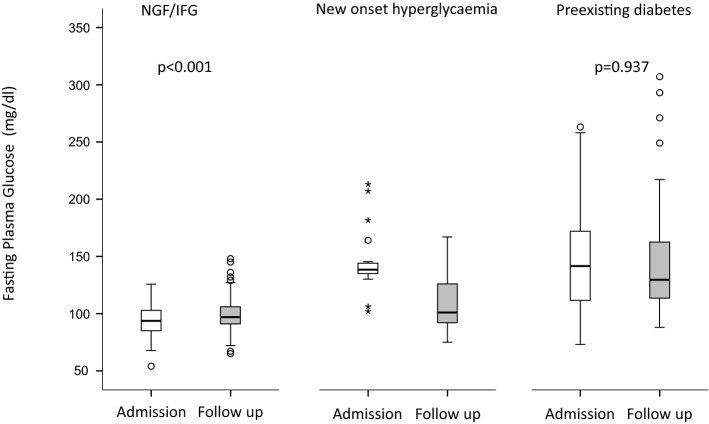
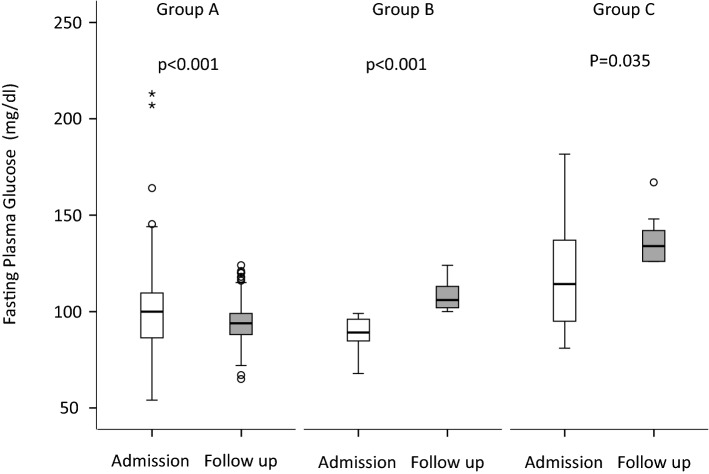
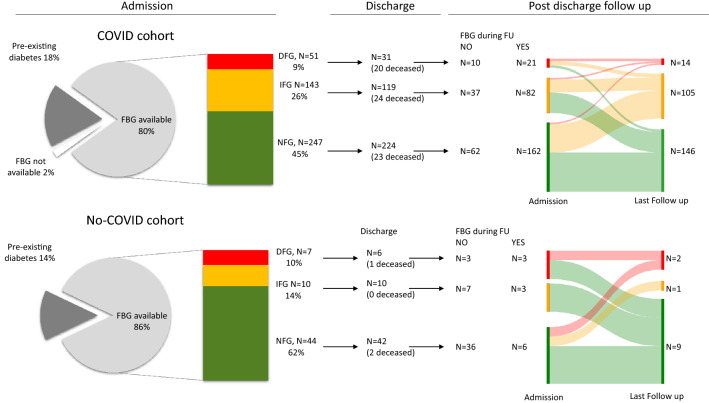
At admission, 18.8% of the patients in our cohort had pre-existing diabetes, 9.3% fasting glucose in the diabetes range without a prior diagnosis (DFG), 26% impaired fasting glucose (IFG), 44.9% normal fasting glucose (NFG), while 2% had no FBG available. FBG categories were similarly distributed in the 71 patients without confirmed COVID-19 pneumonia. During follow-up (median time 6 month) FBG was available for 321 out of the 453 (70.9%) surviving patients and showed a trend to a marginal increase [from 97 (87-116) to 100 (92-114) mg/dL; p = 0.071]. Transitions between FBG categories were analyzed in subjects without pre-existing diabetes (265 out of 321). We identified three groups: (i) patients who maintained or improved FBG during follow-up [Group A, n = 185; from 100 (86-109) to 94 (88-99) mg/dL; p < 0.001]; (ii) patients who moved from the NFG to IFG category [Group B, n = 66: from 89 (85-96) to 106 (102-113) mg/dl; p < 0.001]; (iii) patients who maintained or reached DFG during follow-up [Group C, n = 14: from 114 (94-138) to 134 (126-143) mg/dl; p = 0.035]. Male sex and ICU admission during the hospitalization were more prevalent in Group C compared to Group A or B.
Six months after the SARS-CoV-2 infection DFG was evident in only few patients who experienced severe COVID-19 pneumonia.
本研究旨在了解 SARS-CoV-2 感染相关的糖代谢异常在病毒感染消退后是否持续存在或恢复。
我们分析了 621 例疑似 COVID-19 肺炎成年患者出院后的空腹血糖(FBG)。
在入院时,我们队列中的 18.8%的患者有既往糖尿病,9.3%的患者空腹血糖在糖尿病范围内但无既往诊断(DFG),26%的患者空腹血糖受损(IFG),44.9%的患者空腹血糖正常(NFG),而 2%的患者无 FBG 检测结果。在 71 例未确诊 COVID-19 肺炎的患者中,FBG 分类分布相似。在随访期间(中位时间 6 个月),我们获得了 453 例存活患者中的 321 例的 FBG 检测结果,其显示出边际升高的趋势[从 97(87-116)到 100(92-114)mg/dL;p=0.071]。我们对无既往糖尿病的患者(321 例中的 265 例)进行了 FBG 分类间的转换分析。我们确定了三个组:(i)在随访期间保持或改善 FBG 的患者[组 A,n=185;从 100(86-109)到 94(88-99)mg/dL;p<0.001];(ii)从 NFG 转移到 IFG 类别的患者[组 B,n=66:从 89(85-96)到 106(102-113)mg/dl;p<0.001];(iii)在随访期间保持或达到 DFG 的患者[组 C,n=14:从 114(94-138)到 134(126-143)mg/dl;p=0.035]。与组 A 或 B 相比,组 C 中男性和住院期间入住 ICU 的患者更为常见。
在 SARS-CoV-2 感染后 6 个月,只有少数经历严重 COVID-19 肺炎的患者出现 DFG。