Key Laboratory of Adaptation and Evolution of Plateau Biota, Northwest Institute of Plateau Biology, Chinese Academy of Sciences, Xining, 810001, Qinghai, China.
Medical College of Qinghai University, Xining, 810016, Qinghai, China.
BMC Genomics. 2021 Jun 5;22(1):413. doi: 10.1186/s12864-021-07731-x.
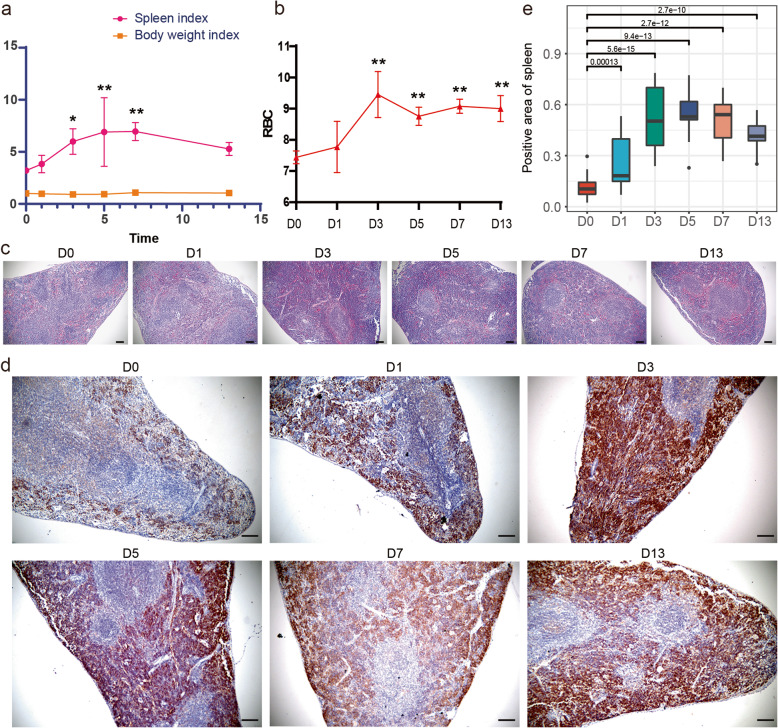
The spleen is the largest secondary lymphoid organ and the main site where stress erythropoiesis occurs. It is known that hypoxia triggers the expansion of erythroid progenitors; however, its effects on splenic gene expression are still unclear. Here, we examined splenic global gene expression patterns by time-series RNA-seq after exposing mice to hypoxia for 0, 1, 3, 5, 7 and 13 days.
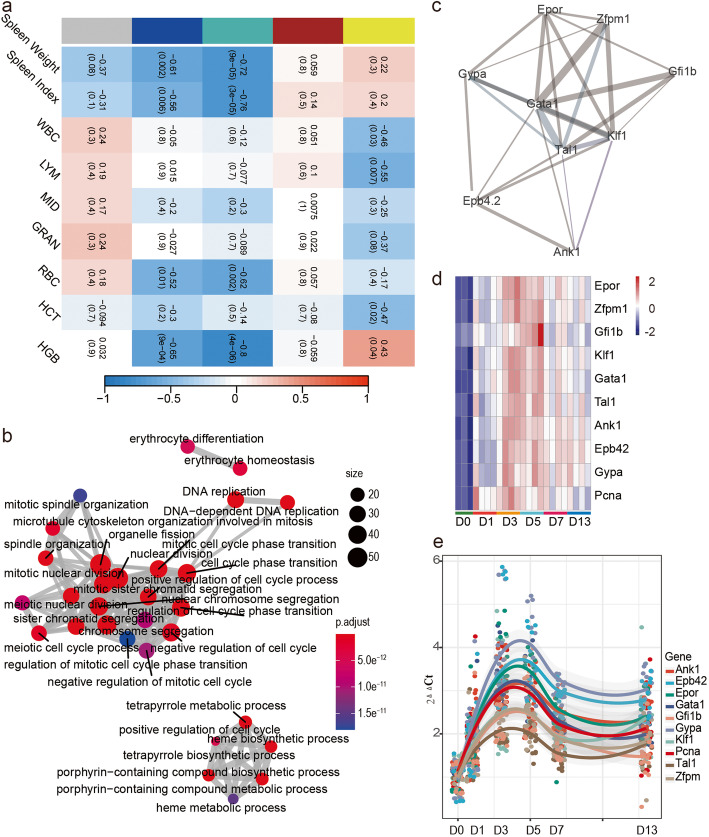
Morphological analysis showed that on the 3rd day there was a significant increase in the spleen index and in the proliferation of erythroid progenitors. RNA-sequencing analysis revealed that the overall expression of genes decreased with increased hypoxic exposure. Compared with the control group, 1380, 3430, 4396, 3026, and 1636 genes were differentially expressed on days 1, 3, 5, 7 and 13, respectively. Clustering analysis of the intersection of differentially expressed genes pointed to 739 genes, 628 of which were upregulated, and GO analysis revealed a significant enrichment for cell proliferation. Enriched GO terms of downregulated genes were associated with immune cell activation. Expression of Gata1, Tal1 and Klf1 was significantly altered during stress erythropoiesis. Furthermore, expression of genes involved in the immune response was inhibited, and NK cells decreased.
The spleen of mice conquer hypoxia exposure in two ways. Stress erythropoiesis regulated by three transcription factors and genes in immune response were downregulated. These findings expand our knowledge of splenic transcriptional changes during hypoxia.
脾脏是最大的次级淋巴器官,也是发生应激性红细胞生成的主要部位。已知缺氧会触发红细胞祖细胞的扩张;然而,其对脾脏基因表达的影响尚不清楚。在这里,我们通过对暴露于缺氧环境中的小鼠进行 0、1、3、5、7 和 13 天的时间序列 RNA-seq 检测,研究了脾脏的全局基因表达模式。
形态学分析表明,在第 3 天,脾脏指数和红细胞祖细胞的增殖显著增加。RNA-seq 分析显示,随着缺氧暴露时间的增加,基因的整体表达水平下降。与对照组相比,第 1、3、5、7 和 13 天分别有 1380、3430、4396、3026 和 1636 个基因差异表达。差异表达基因交集的聚类分析指向 739 个基因,其中 628 个基因上调,GO 分析显示细胞增殖显著富集。下调基因的富集 GO 术语与免疫细胞激活有关。在应激性红细胞生成过程中,Gata1、Tal1 和 Klf1 的表达明显改变。此外,参与免疫反应的基因表达受到抑制,NK 细胞减少。
小鼠脾脏通过两种方式应对缺氧暴露。由三个转录因子和免疫反应相关基因调控的应激性红细胞生成受到抑制。这些发现扩展了我们对缺氧期间脾脏转录变化的认识。