Candiolo Cancer Institute, FPO - IRCCS, Strada Provinciale 142, Km 3.95, 10060, Candiolo, TO, Italy.
Department of Oncology, University of Torino, Strada Provinciale 142, Km 3.95, 10060, Candiolo, TO, Italy.
J Exp Clin Cancer Res. 2021 Jun 5;40(1):185. doi: 10.1186/s13046-021-01981-z.
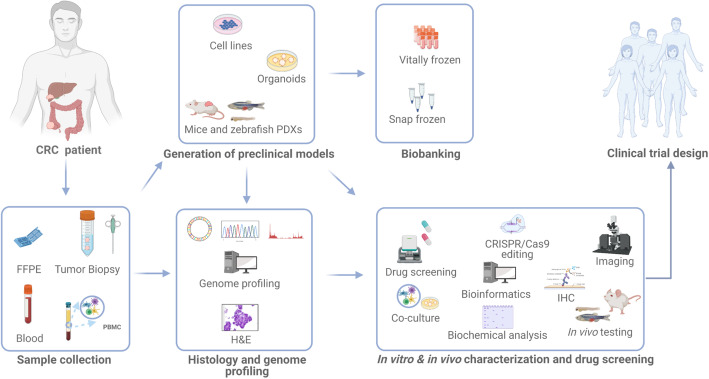
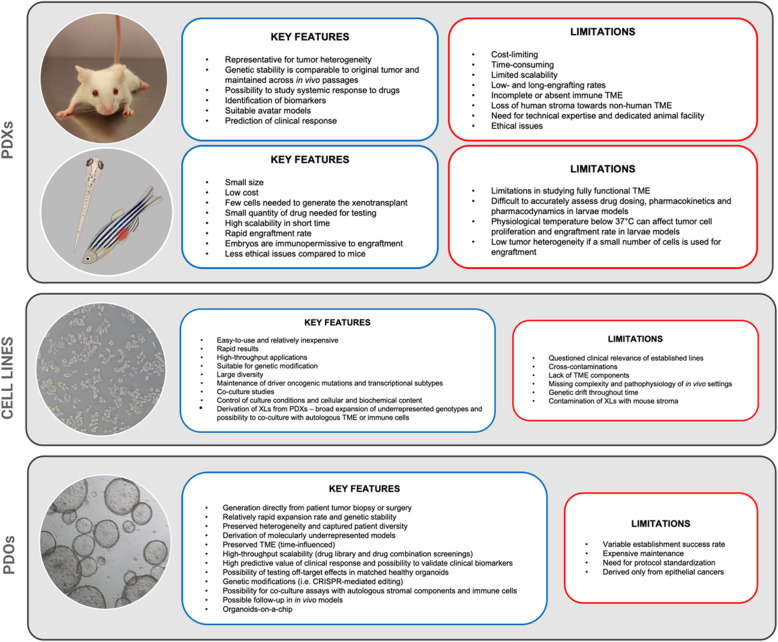
Colorectal cancer (CRC) is a complex and heterogeneous disease, characterized by dismal prognosis and low survival rate in the advanced (metastatic) stage. During the last decade, the establishment of novel preclinical models, leading to the generation of translational discovery and validation platforms, has opened up a new scenario for the clinical practice of CRC patients. To bridge the results developed at the bench with the medical decision process, the ideal model should be easily scalable, reliable to predict treatment responses, and flexibly adapted for various applications in the research. As such, the improved benefit of novel therapies being tested initially on valuable and reproducible preclinical models would lie in personalized treatment recommendations based on the biology and genomics of the patient's tumor with the overall aim to avoid overtreatment and unnecessary toxicity. In this review, we summarize different in vitro and in vivo models, which proved efficacy in detection of novel CRC culprits and shed light into the biology and therapy of this complex disease. Even though cell lines and patient-derived xenografts remain the mainstay of colorectal cancer research, the field has been confidently shifting to the use of organoids as the most relevant preclinical model. Prioritization of organoids is supported by increasing body of evidence that these represent excellent tools worth further therapeutic explorations. In addition, novel preclinical models such as zebrafish avatars are emerging as useful tools for pharmacological interrogation. Finally, all available models represent complementary tools that can be utilized for precision medicine applications.
结直肠癌(CRC)是一种复杂且异质性的疾病,在晚期(转移性)阶段预后不良且生存率低。在过去十年中,新型临床前模型的建立导致了转化发现和验证平台的产生,为 CRC 患者的临床实践开辟了新局面。为了将实验室的研究成果与医疗决策过程联系起来,理想的模型应该易于扩展、能够可靠地预测治疗反应,并能够灵活地适应研究中的各种应用。因此,在有价值且可重复的临床前模型上对新型疗法进行初步测试,可以为患者肿瘤的生物学和基因组学提供个性化的治疗建议,从而避免过度治疗和不必要的毒性。在这篇综述中,我们总结了不同的体外和体内模型,这些模型在检测新型 CRC 罪魁祸首方面证明了其有效性,并揭示了这种复杂疾病的生物学和治疗方法。尽管细胞系和患者来源的异种移植物仍然是结直肠癌研究的主要方法,但该领域已经自信地转向使用类器官作为最相关的临床前模型。类器官是优先考虑的,因为越来越多的证据表明它们是值得进一步治疗探索的优秀工具。此外,新型临床前模型,如斑马鱼替身,也正在成为药理学研究的有用工具。最后,所有可用的模型都是互补的工具,可以用于精准医学应用。