From the Department of Global Health.
Center for Studies in Demography and Ecology, University of Washington, Seattle, WA.
Sex Transm Dis. 2021 Dec 1;48(12):973-980. doi: 10.1097/OLQ.0000000000001485.
We examined condom use patterns and potential population-level effects of a hypothetical condom intervention on human immunodeficiency virus (HIV) transmission among adolescent sexual minority males (ASMM).
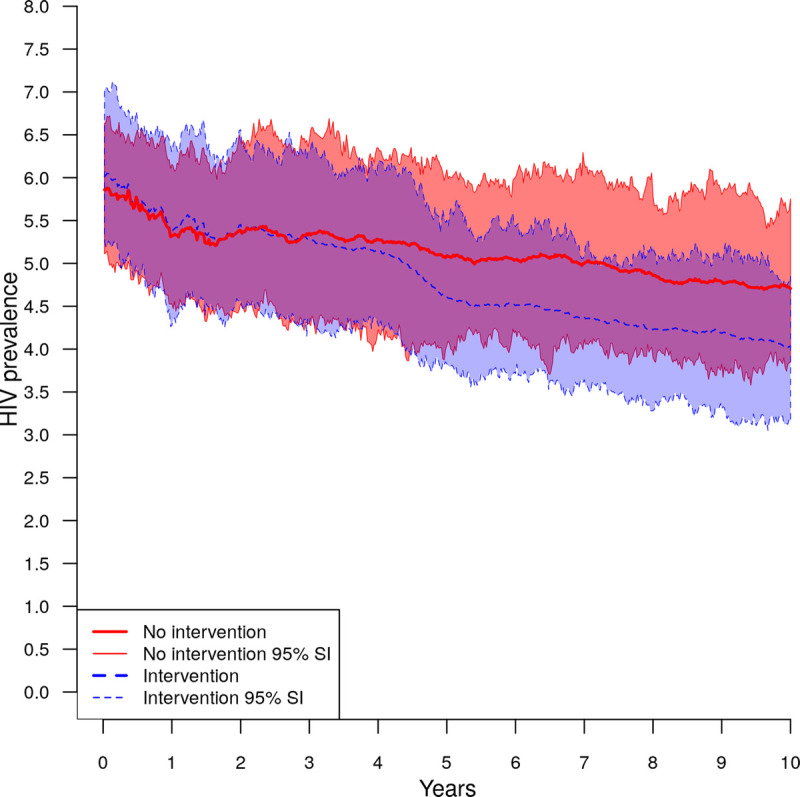
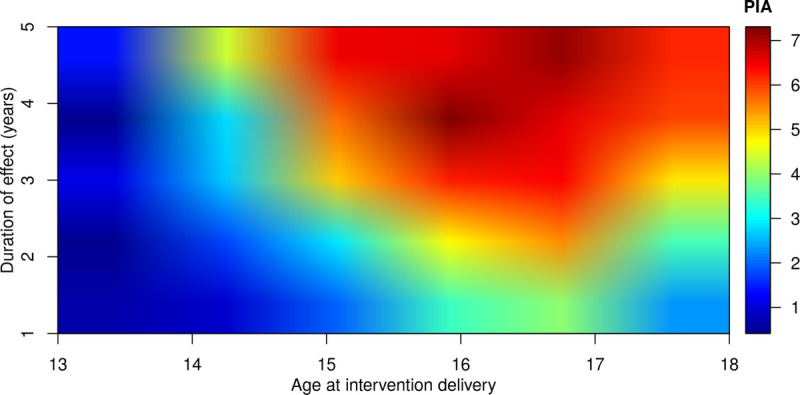
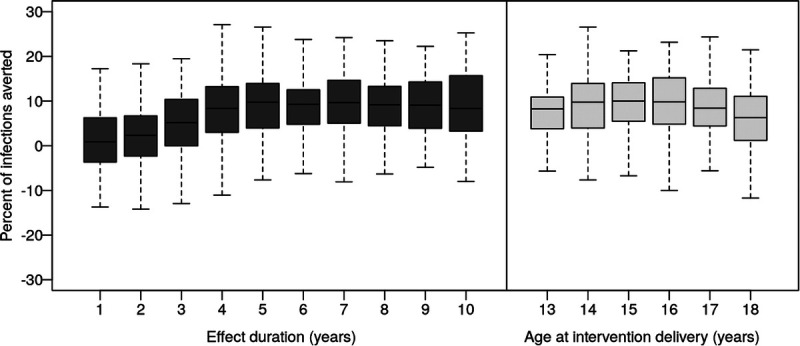
Using 3 data sets: national Youth Risk Behavior Survey 2015 to 2017 (YRBS-National), local YRBS data from 8 jurisdictions with sex of partner questions from 2011 to 2017 (YRBS-Trends), and American Men's Internet Survey (AMIS) 2014 to 2017, we assessed associations of condom use with year, age, and race/ethnicity among sexually active ASMM. Using a stochastic agent-based network epidemic model, structured and parameterized based on the above analyses, we calculated the percent of HIV infections averted over 10 years among ASMM ages 13 to 18 years by an intervention that increased condom use by 37% for 5 years and was delivered to 62% of ASMM at age 14 years.
In YRBS, 51.8% (95% confidence interval [CI], 41.3-62.3%) and 37.9% (95% CI, 32.7-42.3%) reported condom use at last sexual intercourse in national and trend data sets, respectively. In AMIS, 47.3% (95% CI, 44.6-49.9%) reported condom use at last anal sex with a male partner. Temporal trends were not observed in any data set (P > 0.1). Condom use varied significantly by age in YRBS-National (P < 0.0001) and YRBS-Trends (P = 0.032) with 13- to 15-year-olds reporting the lowest use in both; age differences were not significant in AMIS (P = 0.919). Our hypothetical intervention averted a mean of 9.0% (95% simulation interval, -5.4% to 21.2%) of infections among ASMM.
Condom use among ASMM is low and appears to have remained stable during 2011 to 2017. Modeling suggests that condom use increases, consistent with previous interventions, have potential to avert 1 in 11 new HIV infections among ASMM.
我们研究了假设的 condom 干预措施对青少年性少数男性(ASMM)人群中人类免疫缺陷病毒(HIV)传播的 condom 使用模式和潜在的人群水平效应。
我们使用了 3 个数据集:2015 年至 2017 年全国青少年风险行为调查(YRBS-National)、2011 年至 2017 年 8 个司法管辖区的本地 YRBS 数据(YRBS-Trends),以及 2014 年至 2017 年的美国男性互联网调查(AMIS),评估了 condom 使用与活跃 ASMM 的年份、年龄和种族/族裔之间的关联。使用基于上述分析构建和参数化的随机代理网络传染病模型,我们计算了如果干预措施将 condom 使用增加 37%并持续 5 年,并向 14 岁的 62%的 ASMM 提供,那么在 13 至 18 岁的 ASMM 中可预防多少百分比的 HIV 感染。
在 YRBS 中,分别有 51.8%(95%置信区间[CI],41.3-62.3%)和 37.9%(95%CI,32.7-42.3%)在全国和趋势数据集中报告了上次性行为中的 condom 使用情况。在 AMIS 中,47.3%(95%CI,44.6-49.9%)报告了与男性伴侣进行肛交时使用 condom。任何数据集中都没有观察到时间趋势(P>0.1)。在 YRBS-National(P<0.0001)和 YRBS-Trends(P=0.032)中, condom 使用情况因年龄而异,13 至 15 岁的青少年报告的使用量最低;在 AMIS 中,年龄差异不显著(P=0.919)。我们的假设性干预措施平均可预防 ASMM 中的 9.0%(95%模拟区间,-5.4%至 21.2%)感染。
ASMM 中的 condom 使用率较低,并且在 2011 年至 2017 年期间似乎保持稳定。建模表明, condom 使用的增加与之前的干预措施一致,有可能预防 ASMM 中每 11 例新 HIV 感染中的 1 例。