Philipp-Muller Aaron Emile, Reshetukha Taras, Vazquez Gustavo, Milev Roumen, Armstrong Dawn, Jagayat Jasleen, Alavi Nazanin
Centre for Neuroscience Studies, Queen's University, Kingston, ON, Canada.
Department of Psychiatry, Queen's University, Kingston, ON, Canada.
JMIR Res Protoc. 2021 Jul 20;10(7):e30334. doi: 10.2196/30334.
Over one third of patients with posttraumatic stress disorder (PTSD) do not respond to current interventions. Ketamine presents a potential treatment option; however, its effects are temporary. Administering ketamine alongside psychotherapy is one potential means of prolonging its effects; however, only a few studies have investigated this treatment method to date, and none have tested ketamine with internet-based or electronically delivered cognitive behavioral therapy (e-CBT).
This open-label randomized controlled trial aims to assess the efficacy of a combined treatment method of subanesthetic intravenous ketamine and e-CBT for treating patients with PTSD.
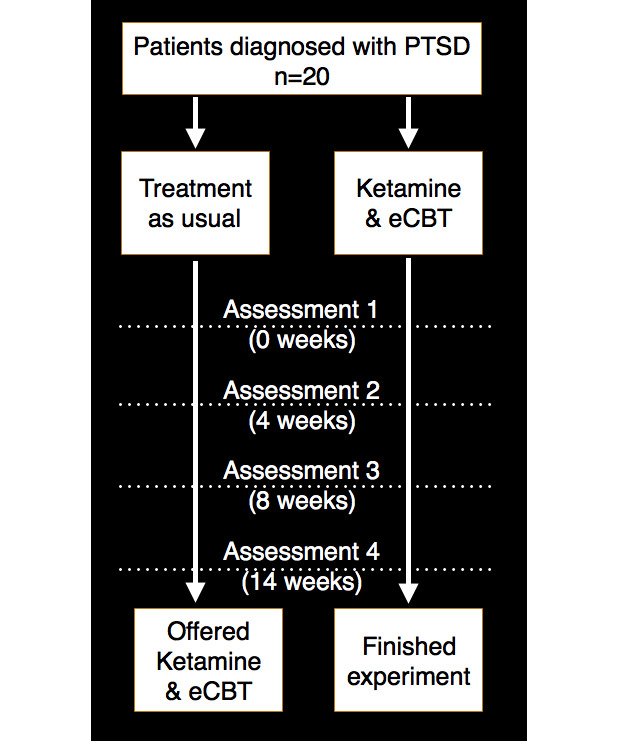
In total, 20 patients with refractory PTSD recruited from a community clinic will be randomly assigned to either an experimental group (n=10), receiving a combination of ketamine and therapist-administered e-CBT over 14 weeks, or a waitlist control group (n=10), receiving the experimental treatment after 14 weeks. Both groups will be assessed for the symptoms of PTSD and comorbid disorders before treatment, at two midway points, and at the end of the experiment.
PTSD symptoms of participants in the experimental group are expected to improve significantly more than those of participants in the waitlist control group (P=.05) with a large effect size (η=0.14).
This is the first study to assess the relationship between e-CBT and ketamine and their combined ability to treat refractory PTSD. If successful, this study will open web-based, asynchronous therapeutic options for patients with PTSD and will provide new insights into the functional role of glutamate in trauma-related disorders as well as in learning, memory, and fear extinction.
ClinicalTrials.gov NCT04771767; https://clinicaltrials.gov/ct2/show/NCT04771767.
INTERNATIONAL REGISTERED REPORT IDENTIFIER (IRRID): PRR1-10.2196/30334.
超过三分之一的创伤后应激障碍(PTSD)患者对当前的干预措施没有反应。氯胺酮是一种潜在的治疗选择;然而,其效果是暂时的。将氯胺酮与心理治疗同时使用是延长其效果的一种潜在方法;然而,迄今为止只有少数研究调查了这种治疗方法,而且没有一项研究测试过氯胺酮与基于互联网或电子交付的认知行为疗法(e-CBT)联合使用的情况。
这项开放标签随机对照试验旨在评估亚麻醉剂量静脉注射氯胺酮与e-CBT联合治疗方法对PTSD患者的疗效。
总共20名从社区诊所招募的难治性PTSD患者将被随机分配到实验组(n = 10),在14周内接受氯胺酮与治疗师实施的e-CBT联合治疗,或等待名单对照组(n = 10),在14周后接受实验治疗。两组在治疗前、两个中间点和实验结束时都将接受PTSD症状和共病障碍的评估。
预计实验组参与者的PTSD症状改善程度将显著高于等待名单对照组参与者(P = 0.05),效应量较大(η = 0.14)。
这是第一项评估e-CBT与氯胺酮之间的关系及其联合治疗难治性PTSD能力的研究。如果成功,这项研究将为PTSD患者开启基于网络的异步治疗选择,并将为谷氨酸在创伤相关障碍以及学习、记忆和恐惧消退中的功能作用提供新的见解。
ClinicalTrials.gov NCT04771767;https://clinicaltrials.gov/ct2/show/NCT04771767。
国际注册报告识别码(IRRID):PRR1-10.2196/30334。