Bera Biswajit, Bhattacharjee Sumana, Shit Pravat Kumar, Sengupta Nairita, Saha Soumik
Department of Geography, Sidho-Kanho-Birsha University, Sainik School, Ranchi Road, P.O., Purulia, 723104 India.
Department of Geography, University of Calcutta, 35, Ballygunge Circular Road, Ballygunge, Kolkata, 700019 India.
Stoch Environ Res Risk Assess. 2022;36(2):409-427. doi: 10.1007/s00477-021-02033-w. Epub 2021 May 29.
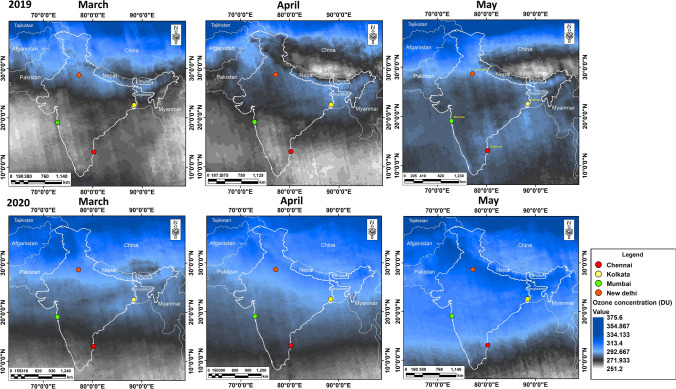
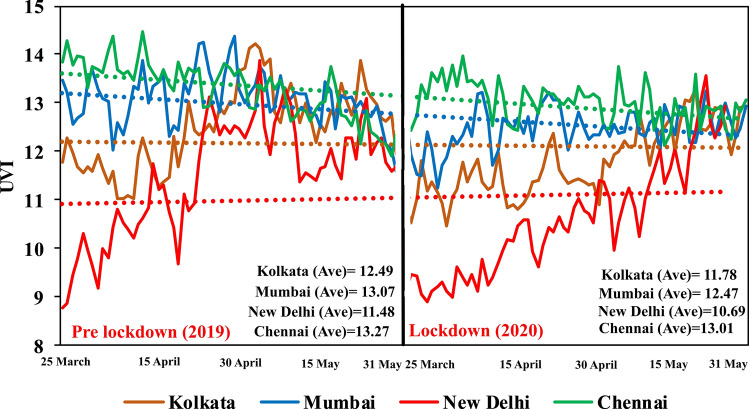
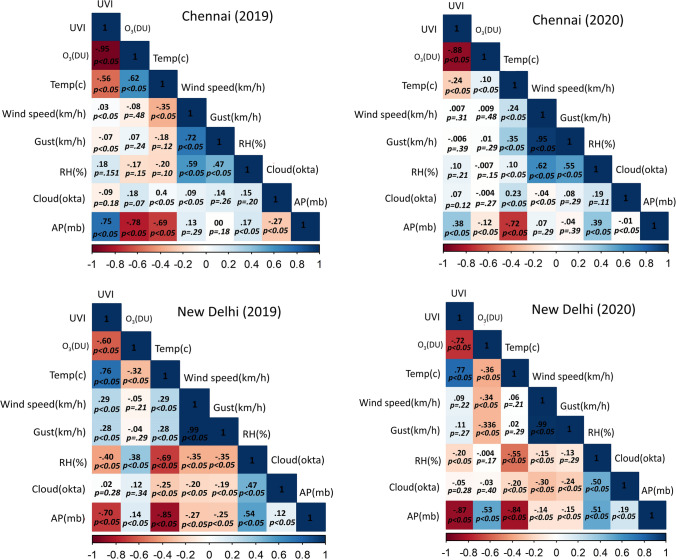
Worldwide spread out of COVID-19 in a short-time has brought a significant decline of road traffic, tourist flow and industrial ventures. During this emergency period, the restricted human dealings with nature have appeared as blessing for health of the total environment. The variation of atmospheric O may modulate the range of UV index (UVI) at any region of the earth. The objective of the study is to examine the variation of UV index over the megacities of India with respect to tropospheric O level modification during COVID-19 lockdown. The meteorological or environmental data (temperature in °C, gust in km/h, wind speed km/h, relative humidity in %, air pressure in mb and cloud cover in okta) of four selective megacities of India (Kolkata, Chennai, Delhi, Mumbai) during and pre lockdown period have been obtained to comprehend about the variation of UV index and tropospheric O. The descriptive statistical applications i.e. standard deviation, standard errors and K-means clustering have been done through standard statistical software. In the present study, t-test has been used to understand level of significance of surface O and UVI during pre-lockdown (2019) and lockdown (2020) phase. The result shows that the four major megacities in India namely New Delhi, Mumbai, Kolkata and Chennai have experienced the vibrant diminution in terms of the concentration of UV index with slightly increasing the tropospheric O level during the lockdown phase. The higher accumulation of O during the lockdown in the lower atmosphere of four megacities does not exceed the permissible limit. The excess amount of O has remarkably contributed to trap the harmful UV radiation which has lowered the UVI in these worst polluted megacities of India. In the meantime, the prominent reduction of NO during the lockdown period decreases the titration impact to O and this mechanism helps to revitalize the ozone concentration level. The uniqueness of the current study is highlighted the ground reality regarding reduction of UV index and amplification of tropospheric O concentration during lockdown phase. This study definitely assists to make new environmental policy, act and law for recover the health of the total environment.
新型冠状病毒肺炎(COVID-19)在短时间内的全球传播导致道路交通、旅游流量和工业活动显著下降。在这个紧急时期,人类与自然接触的受限对整个环境的健康而言已成为幸事。大气臭氧(O)的变化可能会调节地球任何区域的紫外线指数(UVI)范围。本研究的目的是研究在COVID-19封锁期间,印度大城市的紫外线指数随对流层臭氧水平变化的情况。获取了印度四个选定大城市(加尔各答、钦奈、德里、孟买)在封锁期间及之前的气象或环境数据(温度单位为摄氏度、阵风单位为千米/小时、风速单位为千米/小时、相对湿度单位为百分比、气压单位为毫巴、云量单位为奥克他),以了解紫外线指数和对流层臭氧的变化。描述性统计应用,即标准差、标准误差和K均值聚类,已通过标准统计软件完成。在本研究中,使用t检验来了解在封锁前(2019年)和封锁(2020年)阶段地表臭氧和紫外线指数的显著水平。结果表明,印度的四个主要大城市,即新德里、孟买、加尔各答和钦奈,在封锁阶段紫外线指数浓度显著下降,对流层臭氧水平略有上升。四个大城市在封锁期间低层大气中臭氧的较高积累未超过允许限值。过量的臭氧显著有助于捕获有害的紫外线辐射,这降低了印度这些污染最严重大城市的紫外线指数。与此同时,封锁期间一氧化氮(NO)的显著减少降低了对臭氧的滴定影响,这一机制有助于恢复臭氧浓度水平。本研究的独特之处在于突出了封锁阶段紫外线指数降低和对流层臭氧浓度增加的实际情况。这项研究无疑有助于制定新的环境政策、行动和法律,以恢复整个环境的健康。