
家族性克雅氏病临床前期的白质完整性受累:一项扩散张量成像研究
White Matter Integrity Involvement in the Preclinical Stage of Familial Creutzfeldt-Jakob Disease: A Diffusion Tensor Imaging Study.
作者信息
Jing Donglai, Chen Yaojing, Xie Kexin, Cui Yue, Cui Chunlei, Liu Li, Lu Hui, Ye Jing, Gao Ran, Wang Lin, Liang Zhigang, Zhang Zhanjun, Wu Liyong
机构信息
Department of Neurology, Xuanwu Hospital, Capital Medical University, Beijing, China.
Department of Neurology, Rongcheng People's Hospital, Hebei, China.
出版信息
Front Aging Neurosci. 2021 May 19;13:655667. doi: 10.3389/fnagi.2021.655667. eCollection 2021.
OBJECTIVE
The objective of the study was to explore patterns of white matter (WM) alteration in preclinical stage familial Creutzfeldt-Jakob disease (fCJD) using diffusion tensor imaging (DTI).
METHODS
Seven asymptomatic carriers of the G114V mutation and six non-carriers were recruited from the same fCJD kindred and follow-up obtained from all asymptomatic carriers and two non-carriers 2 years later. Overlapping WM patterns were also explored in asymptomatic carriers and symptomatic CJD patients. All participants underwent clinical and neuropsychological assessments and DTI at baseline and follow-up. DTI data were subjected to whole-brain voxel-wise analysis of fractional anisotropy (FA) and mean diffusivity (MD) in WM using tract-based spatial statistics. Three comparisons were conducted: baseline carriers against non-carriers (baseline analysis), changes after 2 years in carriers (follow-up analysis), and differences between patients with symptomatic CJD and healthy controls (CJD patient analysis).
RESULTS
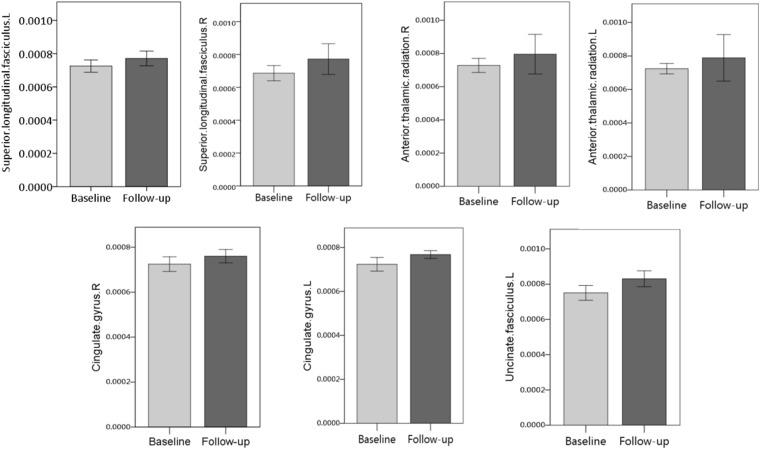
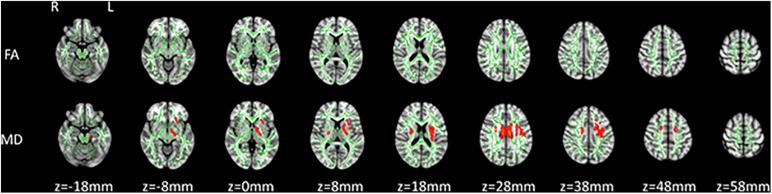
Neither carriers nor non-carriers developed any neurological symptoms during 2 years of follow-up. Baseline analysis showed no differences between the carrier and non-carrier groups in MD and FA. Follow-up analysis showed significantly increased MD in multiple WM tracts, among which increased MD in the bilateral superior longitudinal fasciculus, bilateral anterior thalamic radiation, bilateral cingulate gyrus, and left uncinate fasciculus overlapped the patterns observed in patients with symptomatic CJD.
CONCLUSION
Changes in integrity within multiple WM tracts can be detected during the preclinical stage of fCJD.
目的
本研究的目的是使用扩散张量成像(DTI)探索临床前期家族性克雅氏病(fCJD)中白质(WM)改变的模式。
方法
从同一个fCJD家族中招募了7名G114V突变的无症状携带者和6名非携带者,并在2年后对所有无症状携带者和2名非携带者进行随访。还在无症状携带者和有症状的CJD患者中探索了重叠白质模式。所有参与者在基线和随访时均接受了临床和神经心理学评估以及DTI检查。使用基于束的空间统计学方法对DTI数据进行全脑体素水平的白质分数各向异性(FA)和平均扩散率(MD)分析。进行了三项比较:基线时携带者与非携带者的比较(基线分析)、携带者2年后的变化(随访分析)以及有症状CJD患者与健康对照之间的差异(CJD患者分析)。
结果
在2年的随访期间,携带者和非携带者均未出现任何神经系统症状。基线分析显示,携带者组和非携带者组在MD和FA方面没有差异。随访分析显示,多个白质束中的MD显著增加,其中双侧上纵束、双侧丘脑前辐射、双侧扣带回和左侧钩束中MD的增加与有症状CJD患者中观察到的模式重叠。
结论
在fCJD的临床前期阶段可以检测到多个白质束完整性的变化。


 Zotero 插件