Department of Trauma and Orthopaedics, Health Education North West, Manchester, UK.
Lancashire Teaching Hospitals, Royal Preston Hospital, Preston, UK.
Clin Orthop Surg. 2021 Jun;13(2):135-143. doi: 10.4055/cios20286. Epub 2021 May 18.
Increased 30-day mortality rates have been reported for patients with hip fractures and a concurrent diagnosis of coronavirus disease 19 (COVID-19) infection. Due to nosocomial spread of infection and the variable incubation period with the virus, follow-up past 30 days after injury is required to evaluate the true mortality amongst these patients. We aim to assess 120-day mortality rates in hip fracture patients with COVID-19 infection and compare this to hip fracture patients without COVID-19 infection presenting during the same time period.
This is a retrospective multicenter review of all patients aged ≥ 60 years admitted with a fractured neck of femur between March 5 and April 5, 2020, at nine U.K. trauma units. COVID-19 status, demographic data, comorbidities, and date of death (if applicable) were collected.
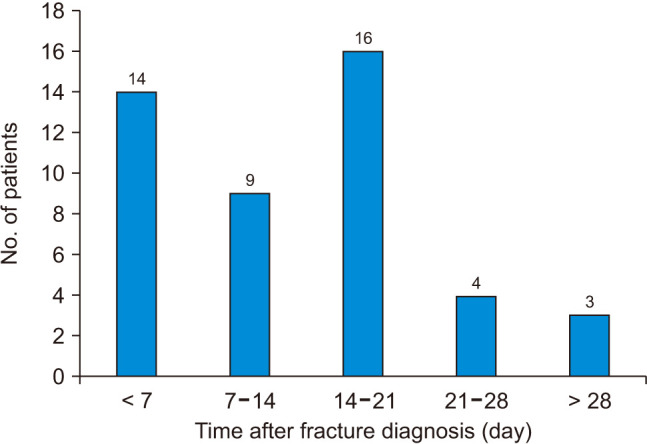
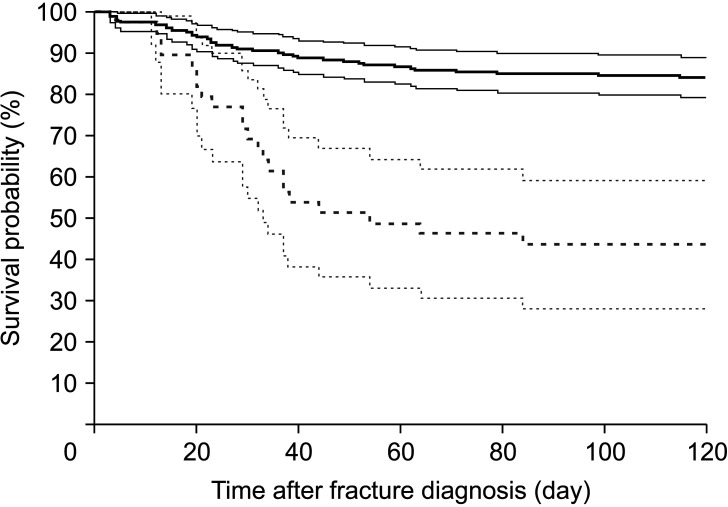
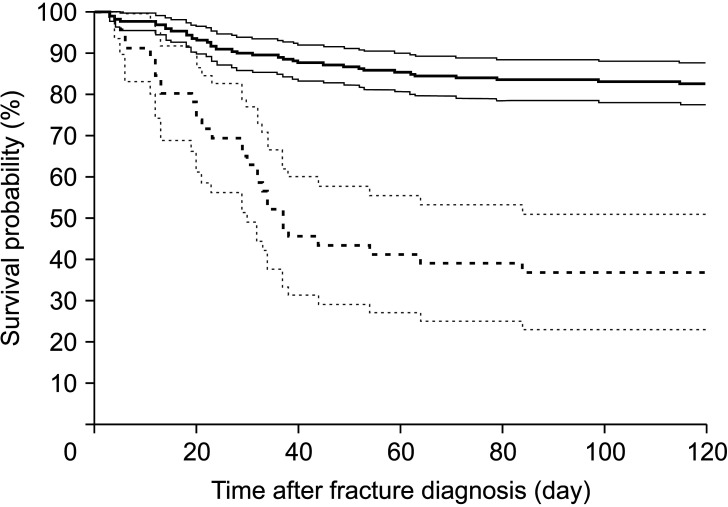
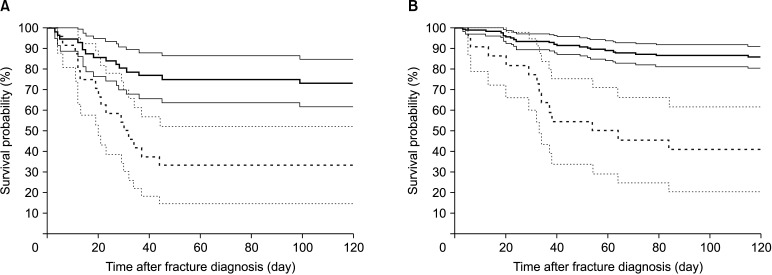
Data were collected for 265 hip fracture patients. Forty-six patients (17.4%) tested positive for COVID-19 infection. There were no significant differences in age or Charlson comorbidity score between those with or without COVID-19. Those with COVID-19 infection were more likely to be male ( = 0.01). Patients with COVID-19 had a 30-day mortality of 35% versus 10% in patients without ( < 0.01). One hundred twenty-day mortality was also greater in those with COVID-19 infection at 63% compared to those without at 17% ( < 0.01). Previous history of myocardial infarction was the only independent factor that showed to increase mortality rate ( = 0.03). Subgroup analysis also revealed significantly increased mortality rates at 120 days in men (27% vs. 67%), women (14% vs. 59%), and those undergoing surgery (56% vs. 30%).
We report a significantly increased mortality rate at 30 and 120 days after injury in an already high-risk cohort of surgical patients. With nearly half of patients being diagnosed with COVID-19 at 14 days or greater following admission, this study highlights the importance of taking appropriate measures to decrease the incidence of nosocomial infection with severe acute respiratory syndrome coronavirus 2 (SARS-CoV-2) in hip fracture patients.
患有髋部骨折和同时诊断为 2019 年冠状病毒病(COVID-19)感染的患者报告 30 天死亡率增加。由于感染的医院内传播和病毒的潜伏期不同,需要在受伤后超过 30 天进行随访,以评估这些患者的真实死亡率。我们旨在评估 COVID-19 感染的髋部骨折患者的 120 天死亡率,并将其与同期无 COVID-19 感染的髋部骨折患者进行比较。
这是对 2020 年 3 月 5 日至 4 月 5 日期间在英国 9 个创伤单位因股骨颈骨折入院的所有年龄≥60 岁患者的回顾性多中心研究。收集 COVID-19 状态、人口统计学数据、合并症和死亡日期(如适用)。
共收集了 265 例髋部骨折患者的数据。46 例(17.4%)COVID-19 检测呈阳性。有或没有 COVID-19 的患者在年龄或 Charlson 合并症评分方面无显著差异。感染 COVID-19 的患者更可能是男性(=0.01)。COVID-19 感染患者的 30 天死亡率为 35%,无 COVID-19 感染患者的死亡率为 10%(<0.01)。COVID-19 感染患者的 120 天死亡率也更高,为 63%,无 COVID-19 感染患者的死亡率为 17%(<0.01)。既往心肌梗死史是唯一显示死亡率增加的独立因素(=0.03)。亚组分析还显示,120 天时男性(27%比 67%)、女性(14%比 59%)和接受手术的患者(56%比 30%)的死亡率显著增加。
我们报告了在已经是高危手术患者队列中,受伤后 30 天和 120 天的死亡率显著增加。近一半的患者在入院后 14 天或更长时间被诊断为 COVID-19,这表明在髋部骨折患者中采取适当措施降低严重急性呼吸综合征冠状病毒 2(SARS-CoV-2)医院内感染发生率的重要性。