Clinical Biostatistics Unit, Hospital Universitario Ramón y Cajal- IRYCIS, Madrid, Spain.
CIBER of Epidemiology and Public Health, Madrid, Spain.
PLoS One. 2020 Dec 10;15(12):e0242958. doi: 10.1371/journal.pone.0242958. eCollection 2020.
A false-negative case of severe acute respiratory syndrome coronavirus 2 (SARS-CoV-2) infection is defined as a person with suspected infection and an initial negative result by reverse transcription-polymerase chain reaction (RT-PCR) test, with a positive result on a subsequent test. False-negative cases have important implications for isolation and risk of transmission of infected people and for the management of coronavirus disease 2019 (COVID-19). We aimed to review and critically appraise evidence about the rate of RT-PCR false-negatives at initial testing for COVID-19.
We searched MEDLINE, EMBASE, LILACS, as well as COVID-19 repositories, including the EPPI-Centre living systematic map of evidence about COVID-19 and the Coronavirus Open Access Project living evidence database. Two authors independently screened and selected studies according to the eligibility criteria and collected data from the included studies. The risk of bias was assessed using the Quality Assessment of Diagnostic Accuracy Studies (QUADAS-2) tool. We calculated the proportion of false-negative test results using a multilevel mixed-effect logistic regression model. The certainty of the evidence about false-negative cases was rated using the GRADE approach for tests and strategies. All information in this article is current up to July 17, 2020.
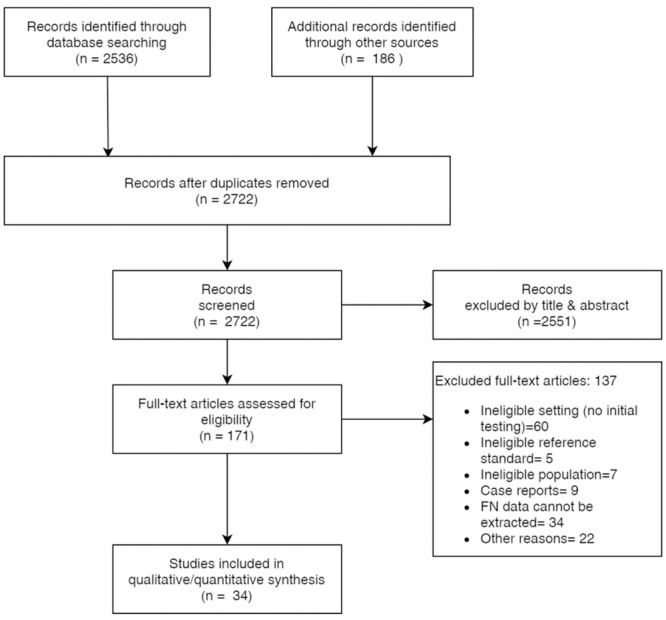
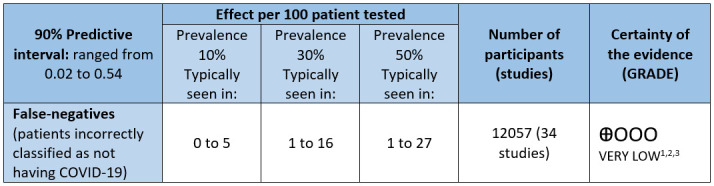
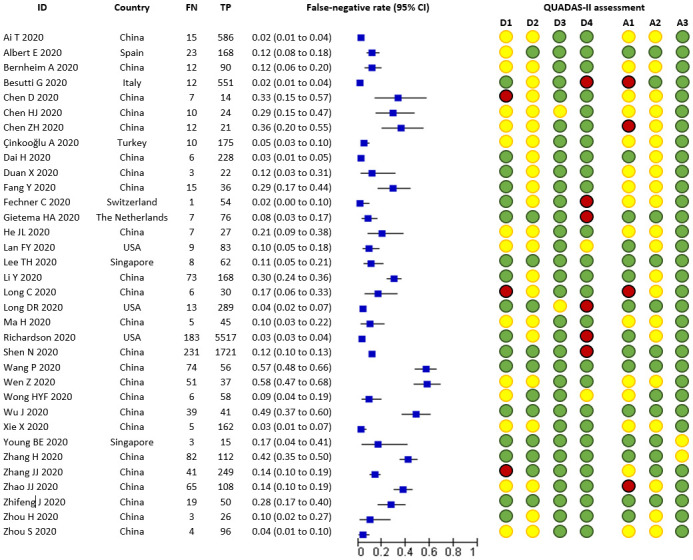
We included 34 studies enrolling 12,057 COVID-19 confirmed cases. All studies were affected by several risks of bias and applicability concerns. The pooled estimate of false-negative proportion was highly affected by unexplained heterogeneity (tau-squared = 1.39; 90% prediction interval from 0.02 to 0.54). The certainty of the evidence was judged as very low due to the risk of bias, indirectness, and inconsistency issues.
There is substantial and largely unexplained heterogeneity in the proportion of false-negative RT-PCR results. The collected evidence has several limitations, including risk of bias issues, high heterogeneity, and concerns about its applicability. Nonetheless, our findings reinforce the need for repeated testing in patients with suspicion of SARS-Cov-2 infection given that up to 54% of COVID-19 patients may have an initial false-negative RT-PCR (very low certainty of evidence).
Protocol available on the OSF website: https://tinyurl.com/vvbgqya.
严重急性呼吸综合征冠状病毒 2(SARS-CoV-2)感染的假阴性病例定义为疑似感染且反转录-聚合酶链反应(RT-PCR)检测初始结果为阴性,随后检测结果为阳性的患者。假阴性病例对感染患者的隔离和传播风险以及对 2019 年冠状病毒病(COVID-19)的管理具有重要意义。我们旨在回顾和批判性评估关于 COVID-19 初始 RT-PCR 检测假阴性率的证据。
我们检索了 MEDLINE、EMBASE、LILACS 以及 COVID-19 数据库,包括 EPPI-Centre 新冠病毒系统评价证据地图和冠状病毒开放获取项目实时证据数据库。两位作者根据纳入标准独立筛选和选择研究,并从纳入的研究中收集数据。使用诊断准确性研究的质量评估(QUADAS-2)工具评估偏倚风险。我们使用多水平混合效应逻辑回归模型计算假阴性检测结果的比例。使用针对测试和策略的 GRADE 方法对假阴性病例的证据确定性进行评级。本文所有信息截至 2020 年 7 月 17 日。
我们纳入了 34 项研究,共纳入了 12057 例 COVID-19 确诊病例。所有研究均受到多种偏倚和适用性问题的影响。假阴性比例的汇总估计值受未解释的异质性影响较大(tau-squared = 1.39;90%预测区间为 0.02 至 0.54)。由于偏倚、间接性和不一致性问题,证据的确定性被判断为非常低。
RT-PCR 结果假阴性比例存在大量且主要未解释的异质性。所收集的证据存在多个局限性,包括偏倚问题、高度异质性和适用性问题。尽管如此,我们的发现还是强调了在疑似 SARS-CoV-2 感染的患者中进行重复检测的必要性,因为多达 54%的 COVID-19 患者可能存在初始 RT-PCR 假阴性(证据确定性非常低)。
方案可在 OSF 网站上获取:https://tinyurl.com/vvbgqya。