Lobachevsky Pavel, Forrester Helen B, Ivashkevich Alesia, Mason Joel, Stevenson Andrew W, Hall Chris J, Sprung Carl N, Djonov Valentin G, Martin Olga A
Research Division, Peter MacCallum Cancer Centre, Melbourne, VIC, Australia.
Advanced Analytical Technologies, Melbourne, VIC, Australia.
Front Oncol. 2021 May 21;11:685598. doi: 10.3389/fonc.2021.685598. eCollection 2021.
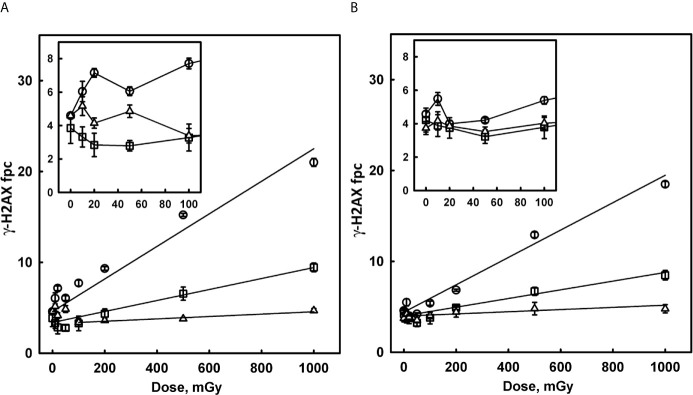
Synchrotron radiation, especially microbeam radiotherapy (MRT), has a great potential to improve cancer radiotherapy, but non-targeted effects of synchrotron radiation have not yet been sufficiently explored. We have previously demonstrated that scattered synchrotron radiation induces measurable -H2AX foci, a biomarker of DNA double-strand breaks, at biologically relevant distances from the irradiated field that could contribute to the apparent accumulation of bystander DNA damage detected in cells and tissues outside of the irradiated area. Here, we quantified an impact of scattered radiation to DNA damage response in "naïve" cells sharing the medium with the cells that were exposed to synchrotron radiation. To understand the effect of genetic alterations in naïve cells, we utilised p53-null and p53-wild-type human colon cancer cells HCT116. The cells were grown in two-well chamber slides, with only one of nine zones (of equal area) of one well irradiated with broad beam or MRT. -H2AX foci per cell values induced by scattered radiation in selected zones of the unirradiated well were compared to the commensurate values from selected zones in the irradiated well, with matching distances from the irradiated zone. Scattered radiation highly impacted the DNA damage response in both wells and a pronounced distance-independent bystander DNA damage was generated by broad-beam irradiations, while MRT-generated bystander response was negligible. For p53-null cells, a trend for a reduced response to scattered irradiation was observed, but not to bystander signalling. These results will be taken into account for the assessment of genotoxic effects in surrounding non-targeted tissues in preclinical experiments designed to optimise conditions for clinical MRT and for cancer treatment in patients.
同步辐射,尤其是微束放射疗法(MRT),在改善癌症放射治疗方面具有巨大潜力,但同步辐射的非靶向效应尚未得到充分探索。我们之前已经证明,散射的同步辐射在距照射区域具有生物学相关性的距离处诱导可测量的γ-H2AX焦点,这是DNA双链断裂的生物标志物,可能导致在照射区域外的细胞和组织中检测到的旁观者DNA损伤明显积累。在这里,我们量化了散射辐射对与暴露于同步辐射的细胞共享培养基的“未处理”细胞中DNA损伤反应的影响。为了了解未处理细胞中基因改变的影响,我们使用了p53基因敲除和p53野生型人类结肠癌细胞HCT116。细胞在两孔培养载玻片上生长,其中一个孔的九个区域(面积相等)中只有一个区域用宽束或MRT照射。将未照射孔的选定区域中由散射辐射诱导的每细胞γ-H2AX焦点值与照射孔中选定区域的相应值进行比较,这些区域与照射区域的距离匹配。散射辐射对两个孔中的DNA损伤反应都有很大影响,宽束照射产生了明显的与距离无关的旁观者DNA损伤,而MRT产生的旁观者反应可以忽略不计。对于p53基因敲除细胞,观察到对散射照射反应降低的趋势,但对旁观者信号传导没有观察到这种趋势。在旨在优化临床MRT条件和患者癌症治疗的临床前实验中,评估周围非靶向组织中的遗传毒性效应时将考虑这些结果。