Department of Pediatrics, Xin Hua Hospital Affiliated To Shanghai Jiao Tong University School of Medicine, Shanghai, China.
Clinical Research Unit, Xin Hua Hospital Affiliated To Shanghai Jiao Tong University School of Medicine, Shanghai, China.
World J Pediatr. 2021 Jun;17(3):317-325. doi: 10.1007/s12519-021-00433-0. Epub 2021 Jun 7.
To quantify the associations between the under-five mortality rate (U5MR) and measures of pediatric human resources, including pediatricians per thousand children (PPTC) and the geographical distribution of pediatricians.
We analyzed data from a national survey in 2015-2016 in 2636 counties, accounting for 31 mainland provinces of China. We evaluated the associations between measures of pediatric human resources and the risk of a high U5MR (≥ 18 deaths per 1000 live births) using logistic regression and restricted cubic spline regression models with adjustments for potential confounders. PPTC and pediatricians per 10,000 km were categorized into quartiles. The highest quartiles were used as reference.
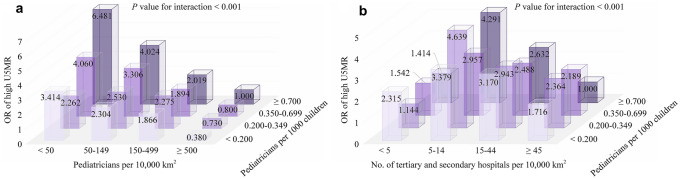
The median values of PPTC and pediatricians per 10,000 km were 0.35 (0.20-0.70) and 150 (50-500), respectively. Compared to the counties with the highest PPTC (≥ 0.7), those with the lowest PPTC (< 0.2) had a 52% higher risk of a high U5MR, with an L-shaped relationship. An inverted J-shaped relationship was found that the risk of a high U5MR was 3.74 [95% confidence interval (CI) 2.55-5.48], 3.07 (95% CI 2.11-4.47), and 2.25 times (95% CI 1.52-3.31) higher in counties with < 50, 50-149, and 150-499 pediatricians per 10,000 km, respectively, than in counties with ≥ 500 physicians per 10,000 km. The joint association analyses show a stronger association with the risk of a high U5MR in geographical pediatrician density than PPTC.
Both population and geographical pediatrician density should be considered when planning child health care services, even in areas with high numbers of PPTC.
为了量化五岁以下儿童死亡率(U5MR)与儿科人力资源指标之间的关联,包括每千名儿童的儿科医生人数(PPTC)和儿科医生的地理分布。
我们分析了 2015-2016 年在中国 2636 个县进行的全国调查数据,这些县覆盖了中国大陆的 31 个省份。我们使用逻辑回归和受限立方样条回归模型,在调整了潜在混杂因素后,评估了儿科人力资源指标与高 U5MR(≥18 例每 1000 例活产死亡)风险之间的关联。PPTC 和每 10000 公里的儿科医生人数分为四分位组。最高四分位数组作为参考。
PPTC 和每 10000 公里的儿科医生人数的中位数分别为 0.35(0.20-0.70)和 150(50-500)。与 PPTC 最高的县(≥0.7)相比,PPTC 最低的县(<0.2)高 U5MR 的风险高 52%,呈 L 型关系。发现了一种倒 J 型关系,即每 10000 公里的儿科医生人数<50、50-149 和 150-499 的县,高 U5MR 的风险分别是每 10000 公里的儿科医生人数≥500 的县的 3.74 倍(95%置信区间[CI] 2.55-5.48)、3.07 倍(95% CI 2.11-4.47)和 2.25 倍(95% CI 1.52-3.31)。联合关联分析表明,儿科医生地理密度与高 U5MR 风险的关联比 PPTC 更强。
在规划儿童保健服务时,即使在儿科医生人数较多的地区,也应考虑人口和地理上的儿科医生密度。