From the Pediatric Emergency Department, Department of Pediatrics, Vall d'Hebron University Hospital, Barcelona, Spain.
Department of Microbiology, Vall d'Hebron University Hospital, Barcelona, Spain.
Pediatr Infect Dis J. 2021 Jul 1;40(7):628-633. doi: 10.1097/INF.0000000000003114.
Between April and June 2016, an outbreak of rhombencephalitis (RE) caused by enterovirus (EV) A71 was detected in Catalonia, Spain-the first documented in Western Europe. The clinical characteristics and outcome of patients with this condition differed from those reported in outbreaks occurring in Southeast Asia.
Observational, multicenter study analyzing characteristics, treatment and outcome of patients with EV-A71 rhombencephalitis diagnosed in 6 publicly funded hospitals within the Catalonian Health Institute. A review of clinical characteristics, diagnosis, treatment and outcome of these patients was conducted.
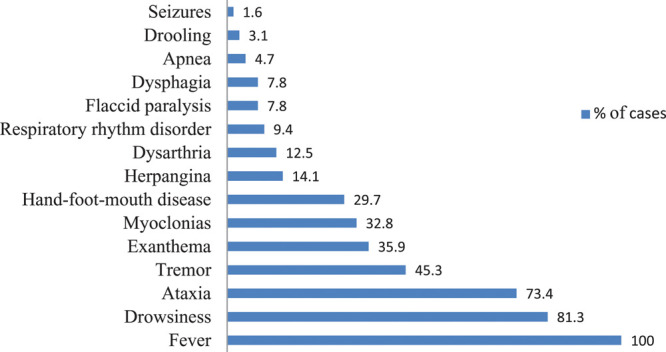
Sixty-four patients met the clinical and virologic criteria for rhombencephalitis caused by EV-A71. All patients had symptoms suggesting viral disease, mainly fever, lethargy, ataxia and tremor, with 30% of hand-foot-mouth disease. Intravenous immunoglobulin therapy was given to 44/64 (69%) patients and methylprednisolone to 27/64 (42%). Six patients (9%) required pediatric intensive care unit admission. Three patients had acute flaccid paralysis of 1 limb, and another had autonomic nervous system (ANS) dysfunction with cardiorespiratory arrest. Outcome in all patients (except the patient with hypoxic-ischemic encephalopathy) was good, with complete resolution of the symptoms.
During the 2016 outbreak, rhombencephalitis without ANS symptoms was the predominant form of presentation and most patients showed no hand-foot-mouth disease. These findings contrast with those of other patient series reporting associated ANS dysfunction (10%-15%) and hand-foot-mouth disease (60%-80%). Complete recovery occurred in almost all cases. In light of the favorable outcome in untreated mild cases, therapies for this condition should be reserved for patients with moderate-severe infection. The main relevance of this study is to provide useful information for setting priorities, management approaches and adequate use of resources in future EV-A71 associated rhombencephalitis outbreaks.
2016 年 4 月至 6 月期间,西班牙加泰罗尼亚地区爆发了由肠道病毒 A71(EV-A71)引起的脑脊髓炎(RE),这是在西欧首次记录到的病例。该病患者的临床特征和结局与在东南亚爆发的病例不同。
这是一项观察性、多中心研究,分析了在加泰罗尼亚卫生研究所下属的 6 家公立医院诊断为 EV-A71 脑脊髓炎的患者的特征、治疗和结局。对这些患者的临床特征、诊断、治疗和结局进行了回顾。
64 例患者符合 EV-A71 引起的脑脊髓炎的临床和病毒学标准。所有患者均有提示病毒感染的症状,主要表现为发热、乏力、共济失调和震颤,30%有手足口病。44/64(69%)例患者接受了静脉免疫球蛋白治疗,27/64(42%)例患者接受了甲基强的松龙治疗。6 例(9%)患者需要入住儿科重症监护病房。3 例患者有 1 肢急性弛缓性瘫痪,另 1 例患者有自主神经系统(ANS)功能障碍伴心肺骤停。除 1 例缺氧缺血性脑病患者外,所有患者的结局均良好,症状完全缓解。
在 2016 年的暴发中,无 ANS 症状的脑脊髓炎是主要表现形式,大多数患者无手足口病。这些发现与其他报道有相关 ANS 功能障碍(10%-15%)和手足口病(60%-80%)的患者系列报道不同。几乎所有病例均完全康复。鉴于轻症未治疗患者的良好结局,对于中重度感染的患者,应保留该疾病的治疗。本研究的主要意义在于为未来 EV-A71 相关脑脊髓炎暴发提供优先级设置、管理方法和资源合理利用的有用信息。