Center for Health Services Research, Institute for Health, Health Care Policy and Aging Research, Rutgers, the State University of New Jersey, 112 Paterson St. 3rd Floor, New Brunswick, NJ 08901, United States of America.
Center for Health Services Research, Institute for Health, Health Care Policy and Aging Research, Rutgers, the State University of New Jersey, 112 Paterson St. 3rd Floor, New Brunswick, NJ 08901, United States of America.
J Subst Abuse Treat. 2022 Jan;132:108514. doi: 10.1016/j.jsat.2021.108514. Epub 2021 May 31.
The COVID-19 pandemic led to unprecedented temporary federal and state regulatory flexibilities that rapidly transformed medication for opioid use disorder (MOUD) treatment delivery. This study aimed to understand changes in treatment providers' care during COVID-19, provider experiences with the adaptations, and perceptions of which changes should be sustained long-term.
We conducted in-depth, semi-structured interviews with 20 New Jersey MOUD providers, purposively sampled to reflect diversity in provider setting, specialty, and other characteristics. Using a rapid analysis approach, we summarized content within interview domains and analyzed domains across participants for recurring concepts and themes.
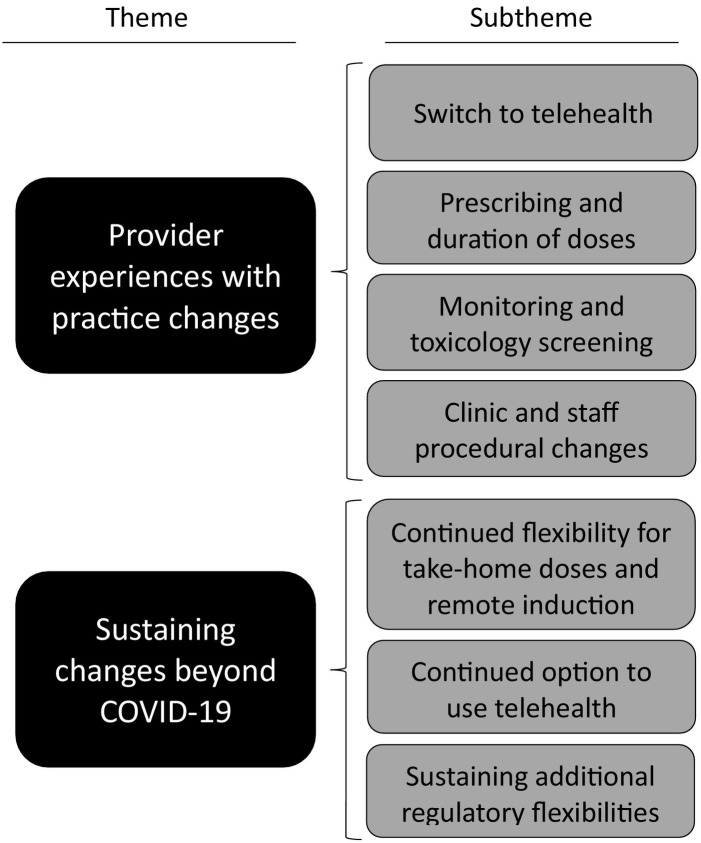
MOUD treatment practice changes taking place during the COVID-19 pandemic included a rapid shift from in-person care to telehealth, reduction in frequency of toxicology testing and psychosocial/counseling services, and modifications to prescription durations and take-home methadone supplies. Modifications to practice were positively received and reinforced a sense of autonomy for providers as well as enhancing the ability to provide patient-centered care. All respondents expressed support for making temporary regulatory flexibilities permanent, but differed in their implementation of the flexibilities and the extent to which they planned to modify their own practices long-term.
Findings support sustaining temporary regulatory and payment changes to MOUD practice, which may have improved treatment access and allowed for more flexible, individually tailored patient care. Few negative, unintended consequences were reported by providers, but more research is needed to evaluate the patient experience with changes to practice during the COVID-19 pandemic.
新冠疫情导致了前所未有的联邦和州临时监管灵活性,迅速改变了阿片类药物使用障碍(MOUD)治疗的提供方式。本研究旨在了解在新冠疫情期间治疗提供者护理方面的变化、提供者对这些调整的体验,以及对哪些变化应该长期维持的看法。
我们对 20 名新泽西州 MOUD 提供者进行了深入的、半结构化访谈,这些提供者是通过目的性抽样选择的,以反映提供者的设置、专业和其他特征的多样性。我们使用快速分析方法,总结了访谈领域内的内容,并对各参与者的领域进行了分析,以发现重复出现的概念和主题。
在新冠疫情期间,MOUD 治疗实践发生了变化,包括从面对面护理迅速转向远程医疗,减少毒理学检测和心理社会/咨询服务的频率,以及修改处方持续时间和可带回家的美沙酮供应。实践中的修改得到了积极的反馈,增强了提供者的自主权,并增强了提供以患者为中心的护理的能力。所有受访者都表示支持将临时监管灵活性永久化,但在实施灵活性方面存在差异,以及他们计划在长期内对自己的实践进行修改的程度。
研究结果支持维持 MOUD 实践的临时监管和支付变化,这可能提高了治疗的可及性,并允许更灵活、更个性化的患者护理。提供者报告的负面、意外后果很少,但需要更多的研究来评估患者在新冠疫情期间对实践变化的体验。