Jones Hayley E, Mulchandani Ranya, Taylor-Phillips Sian, Ades A E, Shute Justin, Perry Keith R, Chandra Nastassya L, Brooks Tim, Charlett Andre, Hickman Matthew, Oliver Isabel, Kaptoge Stephen, Danesh John, Di Angelantonio Emanuele, Wyllie David
Population Health Sciences, Bristol Medical School, University of Bristol, UK; NIHR Health Protection Research Unit (HPRU) in Behavioural Science and Evaluation, University of Bristol, UK.
Public Health England, UK.
EBioMedicine. 2021 Jun;68:103414. doi: 10.1016/j.ebiom.2021.103414. Epub 2021 Jun 4.
SARS-CoV-2 antibody tests are used for population surveillance and might have a future role in individual risk assessment. Lateral flow immunoassays (LFIAs) can deliver results rapidly and at scale, but have widely varying accuracy.
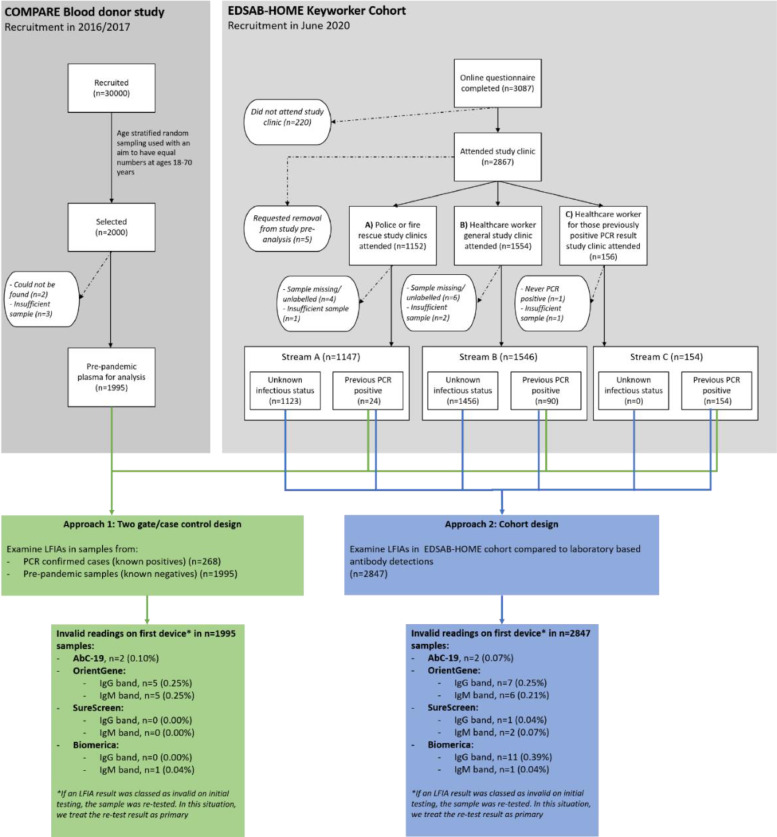
In a laboratory setting, we performed head-to-head comparisons of four LFIAs: the Rapid Test Consortium's AbC-19 Rapid Test, OrientGene COVID IgG/IgM Rapid Test Cassette, SureScreen COVID-19 Rapid Test Cassette, and Biomerica COVID-19 IgG/IgM Rapid Test. We analysed blood samples from 2,847 key workers and 1,995 pre-pandemic blood donors with all four devices.
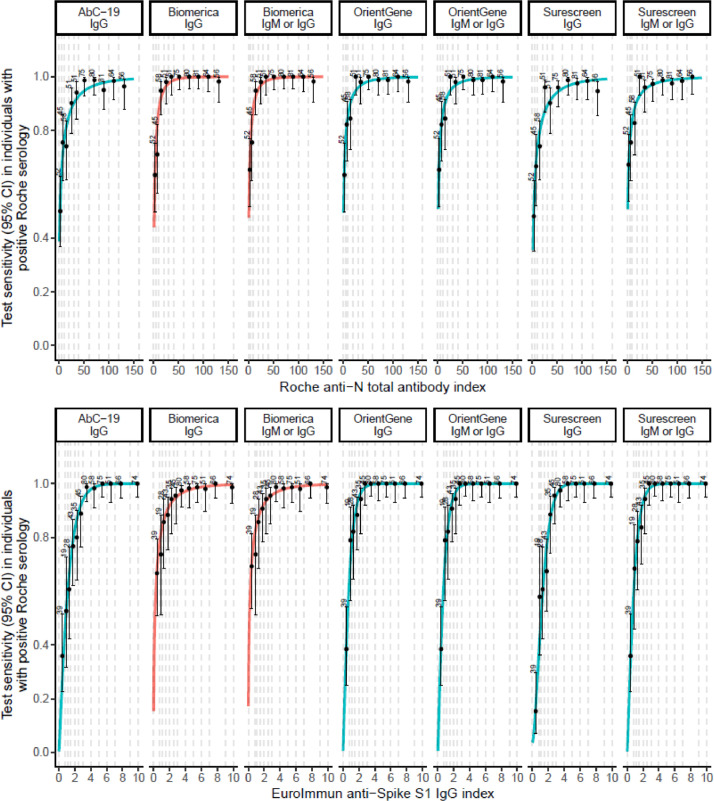
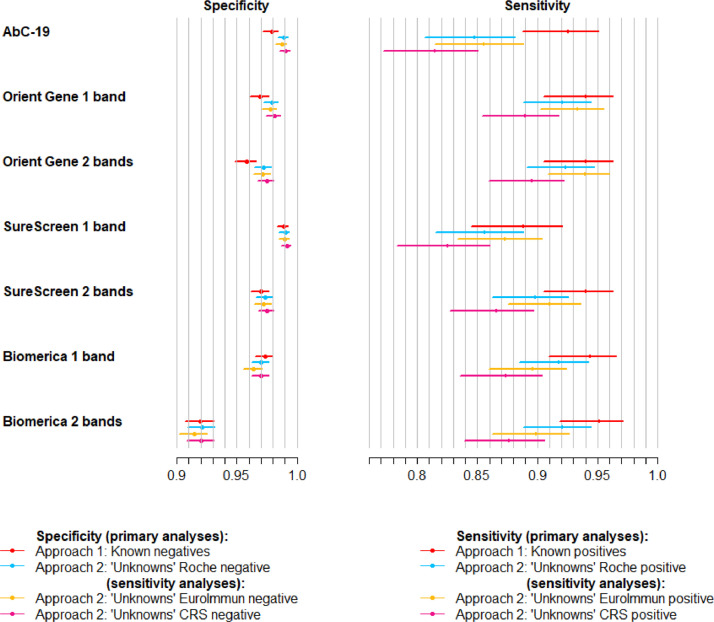
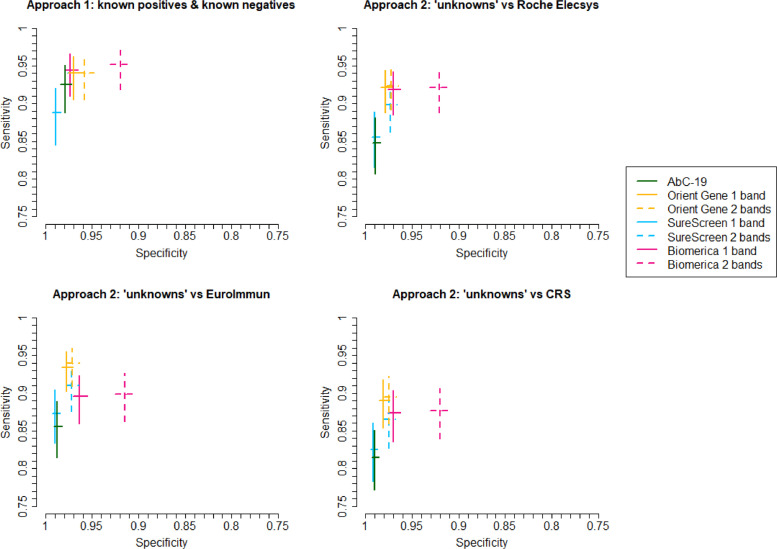
We observed a clear trade-off between sensitivity and specificity: the IgG band of the SureScreen device and the AbC-19 device had higher specificities but OrientGene and Biomerica higher sensitivities. Based on analysis of pre-pandemic samples, SureScreen IgG band had the highest specificity (98.9%, 95% confidence interval 98.3 to 99.3%), which translated to the highest positive predictive value across any pre-test probability: for example, 95.1% (95% uncertainty interval 92.6, 96.8%) at 20% pre-test probability. All four devices showed higher sensitivity at higher antibody concentrations ("spectrum effects"), but the extent of this varied by device.
The estimates of sensitivity and specificity can be used to adjust for test error rates when using these devices to estimate the prevalence of antibody. If tests were used to determine whether an individual has SARS-CoV-2 antibodies, in an example scenario in which 20% of individuals have antibodies we estimate around 5% of positive results on the most specific device would be false positives.
Public Health England.
严重急性呼吸综合征冠状病毒2(SARS-CoV-2)抗体检测用于人群监测,未来可能在个体风险评估中发挥作用。侧向流动免疫分析(LFIA)能够快速且大规模地提供检测结果,但准确性差异很大。
在实验室环境中,我们对四种LFIA进行了直接比较:快速检测联盟的AbC-19快速检测、东方基因新冠IgG/IgM快速检测试剂盒、SureScreen新冠-19快速检测试剂盒和Biomerica新冠-19 IgG/IgM快速检测。我们使用这四种检测设备对2847名关键岗位工作人员和1995名疫情前献血者的血样进行了分析。
我们观察到灵敏度和特异性之间存在明显的权衡:SureScreen检测设备和AbC-19检测设备的IgG条带具有较高的特异性,但东方基因和Biomerica的灵敏度更高。根据对疫情前样本的分析,SureScreen IgG条带具有最高的特异性(98.9%,95%置信区间98.3%至99.3%),这转化为在任何检测前概率下最高的阳性预测值:例如,在20%的检测前概率下为95.1%(95%不确定区间92.6%,96.8%)。所有四种检测设备在抗体浓度较高时均显示出更高的灵敏度(“谱效应”),但不同设备的这种差异程度有所不同。
在使用这些检测设备估计抗体流行率时,灵敏度和特异性的估计值可用于调整检测错误率。如果使用检测来确定个体是否具有SARS-CoV-2抗体,在一个示例场景中,即20%的个体具有抗体,我们估计在最具特异性的检测设备上约5%的阳性结果将为假阳性。
英国公共卫生部。