King's College London Institute of Psychiatry Psychology and Neuroscience, London, UK.
South London and Maudsley NHS Foundation Trust, London, UK.
BMC Public Health. 2022 Aug 9;22(1):1514. doi: 10.1186/s12889-022-13889-0.
Researchers conducting cohort studies may wish to investigate the effect of episodes of COVID-19 illness on participants. A definitive diagnosis of COVID-19 is not always available, so studies have to rely on proxy indicators. This paper seeks to contribute evidence that may assist the use and interpretation of these COVID-indicators.
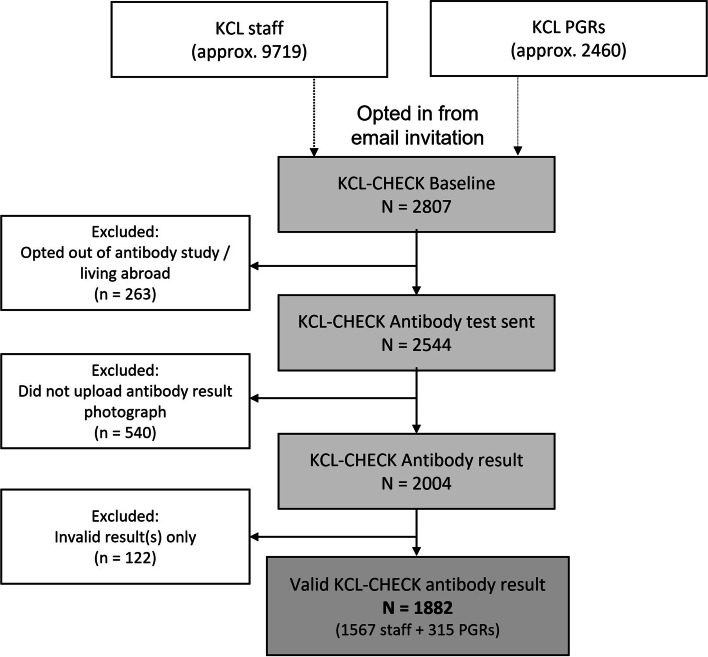
We described five potential COVID-indicators: self-reported core symptoms, a symptom algorithm; self-reported suspicion of COVID-19; self-reported external results; and home antibody testing based on a 'lateral flow' antibody (IgG/IgM) test cassette. Included were staff and postgraduate research students at a large London university who volunteered for the study and were living in the UK in June 2020. Excluded were those who did not return a valid antibody test result. We provide descriptive statistics of prevalence and overlap of the five indicators.
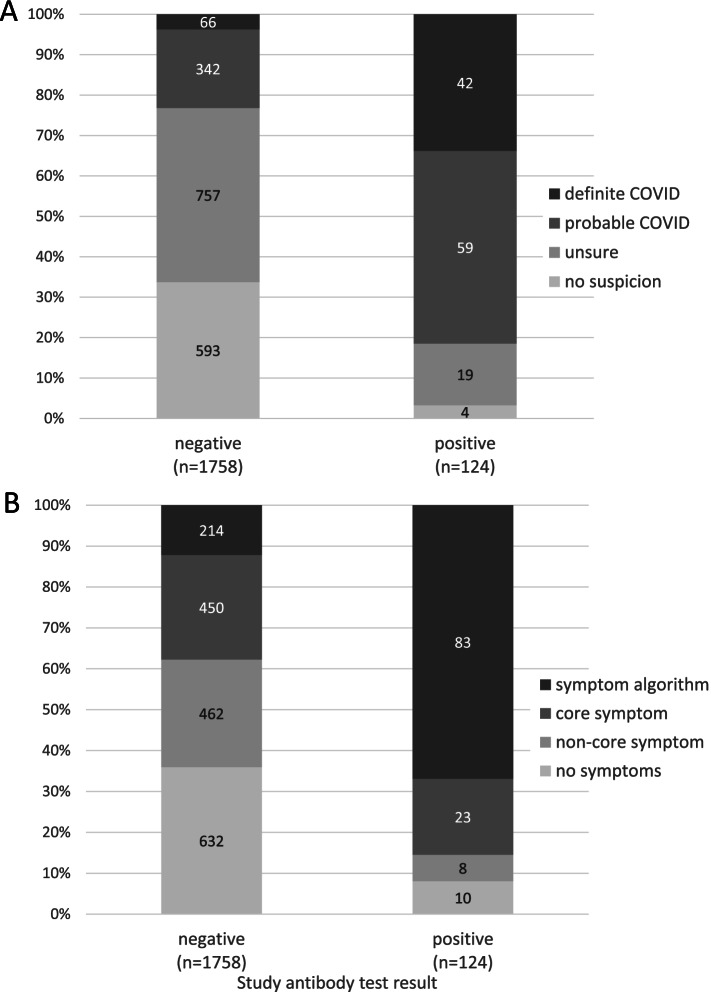
Core symptoms were the most common COVID-indicator (770/1882 participants positive, 41%), followed by suspicion of COVID-19 (n = 509/1882, 27%), a positive symptom algorithm (n = 298/1882, 16%), study antibody lateral flow positive (n = 124/1882, 7%) and a positive external test result (n = 39/1882, 2%), thus a 20-fold difference between least and most common. Meeting any one indicator increased the likelihood of all others, with concordance between 65 and 94%. Report of a low suspicion of having had COVID-19 predicted a negative antibody test in 98%, but positive suspicion predicted a positive antibody test in only 20%. Those who reported previous external antibody tests were more likely to have received a positive result from the external test (24%) than the study test (15%).
Our results support the use of proxy indicators of past COVID-19, with the caveat that none is perfect. Differences from previous antibody studies, most significantly in lower proportions of participants positive for antibodies, may be partly due to a decline in antibody detection over time. Subsequent to our study, vaccination may have further complicated the interpretation of COVID-indicators, only strengthening the need to critically evaluate what criteria should be used to define COVID-19 cases when designing studies and interpreting study results.
进行队列研究的研究人员可能希望研究 COVID-19 疾病发作对参与者的影响。COVID-19 的明确诊断并非总是可用,因此研究必须依赖替代指标。本文旨在提供有助于使用和解释这些 COVID 指标的证据。
我们描述了五个潜在的 COVID 指标:自我报告的核心症状、症状算法;自我报告的 COVID-19 怀疑;自我报告的外部结果;以及基于“横向流动”抗体(IgG/IgM)检测盒的家庭抗体检测。参与者包括 2020 年 6 月自愿参加伦敦一所大型大学研究并居住在英国的工作人员和研究生。未返回有效抗体检测结果的人员被排除在外。我们提供了五个指标的流行率和重叠的描述性统计数据。
核心症状是最常见的 COVID 指标(770/1882 名参与者阳性,41%),其次是 COVID-19 怀疑(n=509/1882,27%),阳性症状算法(n=298/1882,16%),研究抗体横向流动阳性(n=124/1882,7%)和外部测试阳性结果(n=39/1882,2%),因此最少和最常见之间存在 20 倍的差异。满足任何一个指标都会增加所有其他指标的可能性,一致性在 65%至 94%之间。报告低怀疑曾患有 COVID-19 可预测抗体检测阴性的概率为 98%,但阳性怀疑仅预测抗体检测阳性的概率为 20%。报告先前进行过外部抗体检测的人更有可能从外部检测(24%)而不是研究检测(15%)中获得阳性结果。
我们的结果支持使用过去 COVID-19 的替代指标,但需要注意的是,没有一种指标是完美的。与以前的抗体研究相比,最显著的是抗体阳性的参与者比例较低,这可能部分归因于抗体检测随时间的下降。在我们的研究之后,疫苗接种可能进一步使 COVID 指标的解释复杂化,这仅加强了在设计研究和解释研究结果时需要批判性地评估应使用哪些标准来定义 COVID-19 病例的必要性。