Department of Medicine, Metabolism Division, San Francisco Department of Veterans Affairs Medical Center, San Francisco, CA, USA.
Department of Medicine and Department of Surgery, University of California, San Francisco, CA, USA.
Sci Rep. 2021 Jun 7;11(1):11872. doi: 10.1038/s41598-021-90458-2.
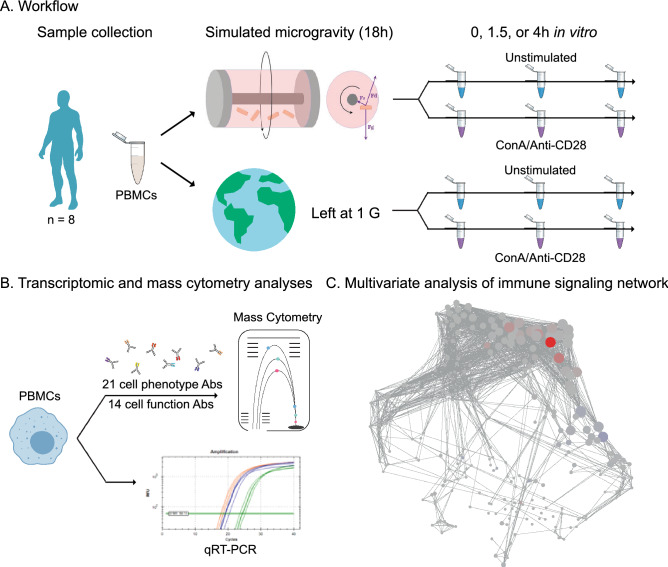
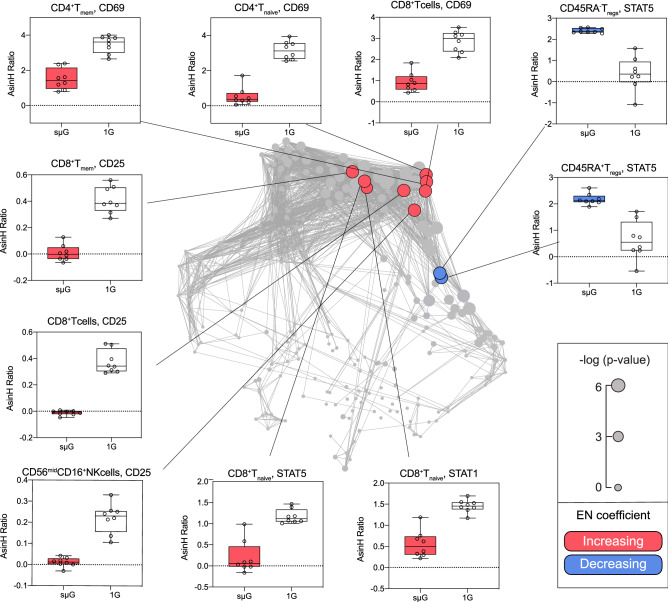
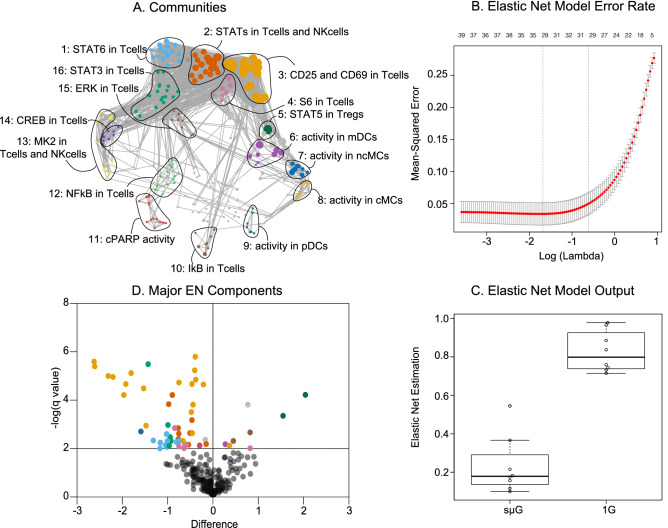
Exposure to microgravity (µG) during space flights produces a state of immunosuppression, leading to increased viral shedding, which could interfere with long term missions. However, the cellular mechanisms that underlie the immunosuppressive effects of µG are ill-defined. A deep understanding of human immune adaptations to µG is a necessary first step to design data-driven interventions aimed at preserving astronauts' immune defense during short- and long-term spaceflights. We employed a high-dimensional mass cytometry approach to characterize over 250 cell-specific functional responses in 18 innate and adaptive immune cell subsets exposed to 1G or simulated (s)µG using the Rotating Wall Vessel. A statistically stringent elastic net method produced a multivariate model that accurately stratified immune responses observed in 1G and sµG (p value 2E-4, cross-validation). Aspects of our analysis resonated with prior knowledge of human immune adaptations to µG, including the dampening of Natural Killer, CD4 and CD8 T cell responses. Remarkably, we found that sµG enhanced STAT5 signaling responses of immunosuppressive T. Our results suggest µG exerts a dual effect on the human immune system, simultaneously dampening cytotoxic responses while enhancing T function. Our study provides a single-cell readout of sµG-induced immune dysfunctions and an analytical framework for future studies of human immune adaptations to human long-term spaceflights.
暴露在微重力(µG)环境中会导致免疫抑制,增加病毒脱落,这可能会干扰长期任务。然而,µG 对免疫抑制作用的细胞机制尚未明确。深入了解人类对µG 的免疫适应是设计数据驱动干预措施的必要前提,这些干预措施旨在保护宇航员在短期和长期太空飞行中的免疫防御。我们采用高维质谱细胞术方法,通过旋转壁容器(Rotating Wall Vessel),在 18 个先天和适应性免疫细胞亚群中,对超过 250 个细胞特异性功能反应进行了特征描述,这些亚群分别暴露于 1G 或模拟(s)µG 环境中。采用严格的弹性网络统计方法,生成了一个多元模型,可准确分层 1G 和 sµG 中观察到的免疫反应(p 值为 2E-4,交叉验证)。我们分析的某些方面与人类对µG 的免疫适应的已有知识相吻合,包括自然杀伤细胞、CD4 和 CD8 T 细胞反应的抑制。值得注意的是,我们发现 sµG 增强了抑制性 T 细胞的 STAT5 信号反应。我们的研究结果表明,µG 对人类免疫系统产生双重影响,同时抑制细胞毒性反应,同时增强 T 细胞功能。我们的研究提供了 sµG 诱导免疫功能障碍的单细胞读数,并为未来研究人类对人类长期太空飞行的免疫适应提供了分析框架。