Department of Surgery, Seoul Metropolitan Government Seoul National University Boramae Medical Center, 39, Boramae-Gil, Dongjak-gu, Seoul, 156-707, Republic of Korea.
Department of Pathology, Seoul Metropolitan Government Seoul National University Boramae Medical Center, Seoul, Republic of Korea.
Sci Rep. 2021 Jun 7;11(1):11942. doi: 10.1038/s41598-021-90506-x.
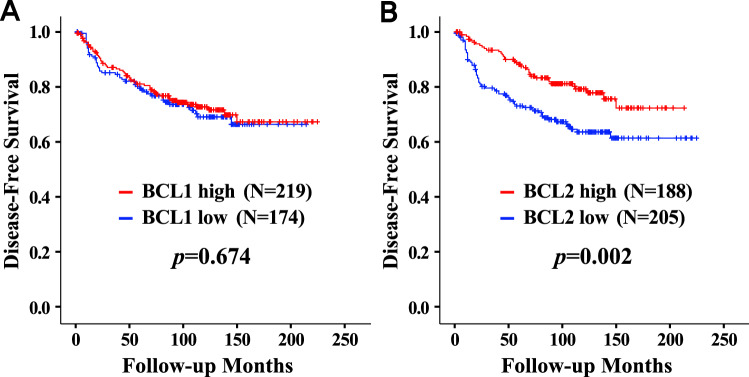
We investigated the prognostic influences of BCL1 and BCL2 expression on disease-free survival in breast cancer patients. BCL1 and BCL2 expression statuses were assessed by immunohistochemistry using tissue microarrays from 393 breast cancer patients. The Kaplan-Meier estimator and log-rank test were used for survival analyses. The Cox proportional hazards model was used to calculate hazard ratio (HR) and the 95% confidence interval (CI) of survival analyses. BCL1 expression revealed no impact on survival. The high BCL2 group showed superior disease-free survival compared with the low BCL2 group (p = 0.002), especially regarding local recurrence-free survival (p = 0.045) and systemic recurrence-free survival (p = 0.002). BCL2 expression was a significant prognostic factor by univariable analysis (HR, 0.528; 95% CI, 0.353-0.790; p = 0.002) and by multivariable analysis (HR, 0.547; 95% CI, 0.362-0.826; p = 0.004). High BCL2 expression was associated with higher disease-free survival in the hormone receptor (HRc)-positive and human epidermal growth factor receptor 2 (HER2)-negative (HRc(+)/HER2(-)) subtype only (p = 0.002). The high BCL2 group was associated with positive estrogen receptor (ER), positive progesterone receptor (PR), low histologic grade, and age ≤ 50 years. BCL1 expression had no prognostic impact, but BCL2 expression was a significant independent prognostic factor. High BCL2 expression was associated with higher disease-free survival, especially regarding local recurrence and systemic recurrence. The prognostic effect of BCL2 expression was effective only in the HRc(+)/HER2(-) subtype. Favorable clinicopathologic features and a strong association with the ER/PR status could partly explain the superior prognosis of the high BCL2 group. BCL2 expression could be utilized to assess the prognosis of breast cancer patients in clinical settings.
我们研究了 BCL1 和 BCL2 表达对乳腺癌患者无病生存的预后影响。使用来自 393 例乳腺癌患者的组织微阵列通过免疫组织化学评估 BCL1 和 BCL2 表达状态。使用 Kaplan-Meier 估计器和对数秩检验进行生存分析。使用 Cox 比例风险模型计算生存分析的风险比 (HR) 和 95%置信区间 (CI)。BCL1 表达对生存没有影响。高 BCL2 组的无病生存率优于低 BCL2 组(p=0.002),尤其是局部无复发生存率(p=0.045)和全身无复发生存率(p=0.002)。BCL2 表达是单变量分析的显著预后因素(HR,0.528;95%CI,0.353-0.790;p=0.002)和多变量分析(HR,0.547;95%CI,0.362-0.826;p=0.004)。高 BCL2 表达仅与激素受体(HRc)阳性和人表皮生长因子受体 2(HER2)阴性(HRc(+)/HER2(-))亚型相关(p=0.002)。高 BCL2 组与雌激素受体(ER)阳性、孕激素受体(PR)阳性、组织学分级低和年龄≤50 岁有关。BCL1 表达无预后影响,但 BCL2 表达是独立的显著预后因素。高 BCL2 表达与无病生存率较高相关,尤其是局部复发和全身复发。BCL2 表达的预后作用仅在 HRc(+)/HER2(-) 亚型中有效。良好的临床病理特征和与 ER/PR 状态的强关联部分解释了高 BCL2 组的良好预后。BCL2 表达可用于评估临床环境中乳腺癌患者的预后。