University Hospital of Psychiatry II, Medical University of Innsbruck, Innsbruck, Austria.
Oncotyrol - Center for Personalized Cancer Medicine, Innsbruck, Austria.
J Med Internet Res. 2021 Jun 8;23(6):e26022. doi: 10.2196/26022.
Patient portals offer the possibility to assess patient-reported outcome measures (PROMs) remotely, and first evidence has demonstrated their potential benefits.
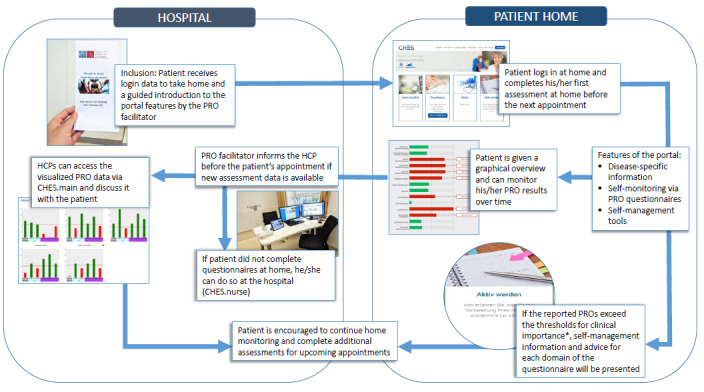
In this study, we evaluated patient use of a web-based patient portal that provides patient information and allows online completion of PROMs. A particular focus was on patient motivation for (not) using the portal. The portal was developed to supplement routine monitoring at the Department of Internal Medicine V in Innsbruck.
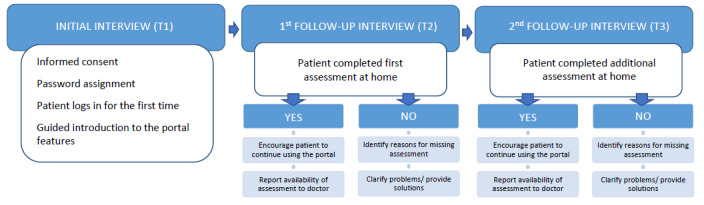
We included patients with multiple myeloma and chronic lymphocytic leukemia who were already participating in routine monitoring at the hospital for use of the patient portal. Patients were introduced to the portal and asked to complete questionnaires prior to their next hospital visits. We used system access logs and 3 consecutive semistructured interviews to analyze patient use and evaluation of the portal.
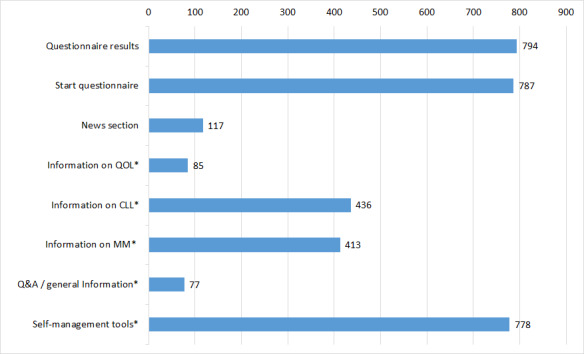
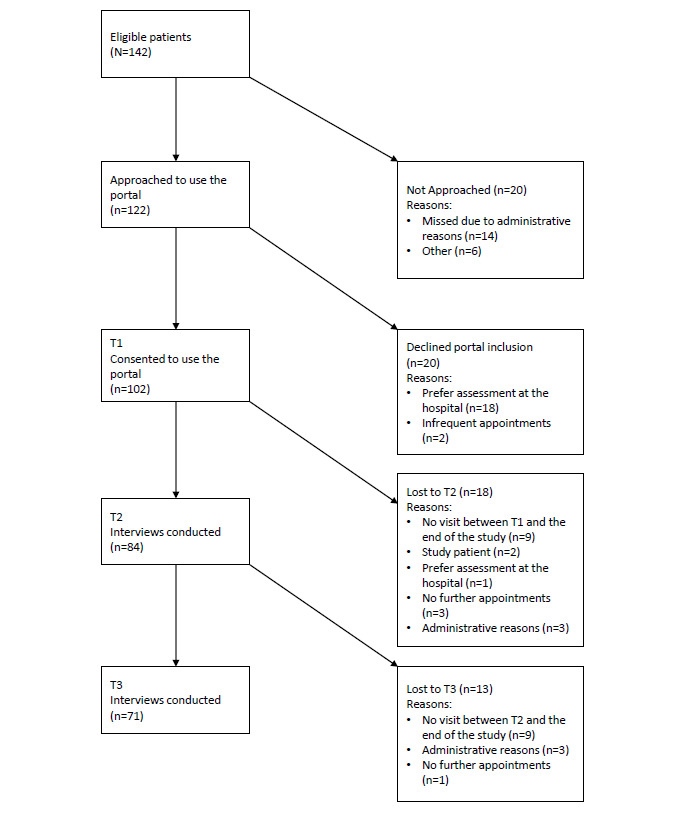
Between July 2017 and August 2020, we approached 122 patients for participation in the study, of whom 83.6% (102/122) consented to use the patient portal. Patients were on average 60 (SD 10.4) years old. Of patients providing data at all study time points, 37% (26/71) consistently used the portal prior to their hospital visits. The main reason for not completing PROMs was forgetting to do so in between visits (25/84, 29%). During an average session, patients viewed 5.3 different pages and spent 9.4 minutes logged on to the portal. Feedback from interviews was largely positive with no patients reporting difficulties navigating the survey and 50% of patients valuing the self-management tools provided in the portal. Regarding the portal content, patients were interested in reviewing their own results and reported high satisfaction with the dynamic self-management advice, also reflected in the high number of clicks on those pages.
Patient portals can contribute to patient empowerment by offering sought-after information and self-management advice. In our study, the majority of our patients were open to using the portal. The low number of technical complaints and average time spent in the portal demonstrate the feasibility of our patient portal. While initial interest was high, long-term use was considerably lower and identified as the main area for improvement. In a next step, we will improve several aspects of the patient portal (eg, including a reminder to visit the portal before the next appointment and closer PROM symptom monitoring via an onconurse).
患者门户提供了远程评估患者报告的结果测量(PROM)的可能性,并且已经有初步证据表明了其潜在的益处。
本研究评估了一种基于网络的患者门户的患者使用情况,该门户提供患者信息并允许在线完成 PROM。特别关注的是患者使用(不)门户的动机。该门户是为了补充因斯布鲁克第五内科部门的常规监测而开发的。
我们纳入了已经参加医院常规监测的多发性骨髓瘤和慢性淋巴细胞白血病患者,以使用患者门户。在下次就诊前,患者会被介绍给门户并被要求完成问卷。我们使用系统访问日志和连续 3 次半结构化访谈来分析患者对门户的使用和评估。
在 2017 年 7 月至 2020 年 8 月期间,我们向 122 名患者提出了参与研究的邀请,其中 83.6%(102/122)同意使用患者门户。患者的平均年龄为 60 岁(标准差 10.4)。在所有研究时间点提供数据的患者中,37%(26/71)在就诊前一直使用门户。未完成 PROM 的主要原因是就诊期间忘记完成(25/84,29%)。在一次平均就诊中,患者浏览了 5.3 个不同的页面,在门户上登录了 9.4 分钟。访谈反馈基本上是积极的,没有患者报告在浏览调查时有困难,50%的患者重视门户中提供的自我管理工具。关于门户内容,患者对查看自己的结果感兴趣,并对动态自我管理建议表示高度满意,这也反映在对这些页面的高点击率上。
患者门户可以通过提供所需的信息和自我管理建议,为患者赋权。在我们的研究中,大多数患者都愿意使用门户。技术投诉数量低,在门户上花费的平均时间表明我们的患者门户是可行的。虽然最初的兴趣很高,但长期使用的情况要低得多,这是需要改进的主要领域。下一步,我们将改进患者门户的几个方面(例如,在下次预约前包括访问门户的提醒,通过 oncource 更密切地监测 PROM 症状)。