Teratology Information, Department of Emergency Medicine Services, Helsinki University and Helsinki University Hospital, Tukholmankatu 17, 00029 HUS, Helsinki, Finland.
Information Services Department, Data and Analytics, Finnish Institute for Health and Welfare, PB 30, 00271, Helsinki, Finland.
Eur J Clin Pharmacol. 2021 Nov;77(11):1737-1745. doi: 10.1007/s00228-021-03169-y. Epub 2021 Jun 8.
To study if second-generation antipsychotic (S-GA) use during the first trimester of pregnancy is associated with an increased risk of major congenital malformations (MCM).
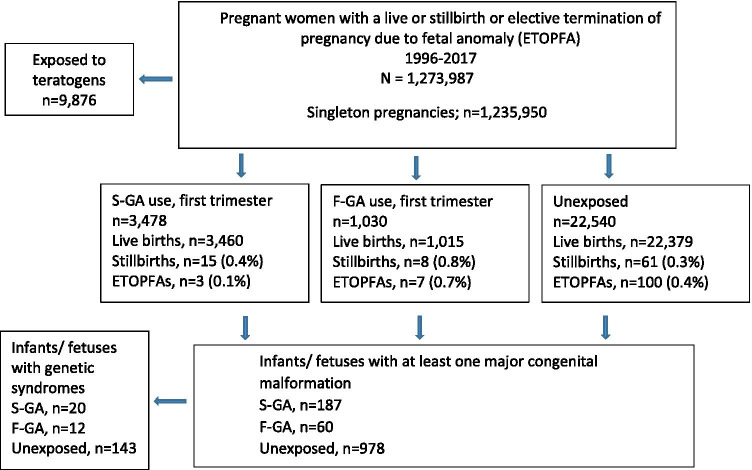
A population-based birth cohort study using national register data extracted from the Drugs and Pregnancy database in Finland, years 1996-2017. The sampling frame included 1,273,987 pregnant women. We included singleton pregnancies ending in live or stillbirth or termination of pregnancy due to severe malformation. Pregnancies with exposure to known teratogens were excluded. Women were categorized into three groups: exposed to S-GAs (n = 3478), exposed to first-generation antipsychotics (F-GAs) (n = 1030), and unexposed (no purchases of S-GAs or F-GAs during pregnancy, n = 22,540). We excluded genetic conditions and compared the prevalence of MCMs in S-GA users to the two comparison groups using multiple logistic regression models.
Use of S-GAs during early pregnancy was not associated with an increased risk of overall MCMs compared to unexposed (adjusted odds ratio, OR 0.92; 95% CI 0.72-1.19) or to F-GA users (OR 0.82; 95% CI 0.56-1.20). Of individual S-GAs, olanzapine use was associated with an increased risk of overall MCMs (OR 2.12; 95% CI 1.19-3.76), and specifically, an increased risk of musculoskeletal malformations (OR 3.71; 95% CI 1.35-10.1) when compared to unexposed, while comparisons to F-GA users did not show significant results.
Olanzapine use is associated with an increased risk of major congenital malformations and specifically, musculoskeletal malformations. Use during pregnancy should be restricted to situations where no safer alternatives exist.
研究第二代抗精神病药物(S-GA)在妊娠早期使用是否与重大先天性畸形(MCM)风险增加有关。
这是一项基于人群的出生队列研究,使用芬兰药物和妊娠数据库中的全国登记数据,时间范围为 1996 年至 2017 年。抽样框架包括 1273987 名孕妇。我们纳入了以活产或死产或因严重畸形而终止妊娠的单胎妊娠。排除了暴露于已知致畸物的妊娠。将孕妇分为三组:暴露于 S-GA(n=3478)、暴露于第一代抗精神病药物(F-GA)(n=1030)和未暴露(怀孕期间未购买 S-GA 或 F-GA,n=22540)。我们排除了遗传疾病,并使用多因素逻辑回归模型比较了 S-GA 使用者与两个对照组之间 MCM 的发生率。
与未暴露组相比(调整后的优势比 OR 0.92;95%置信区间 CI 0.72-1.19)或与 F-GA 使用者相比(OR 0.82;95% CI 0.56-1.20),妊娠早期使用 S-GA 与整体 MCM 风险增加无关。在个别 S-GA 中,与未暴露组相比,奥氮平的使用与整体 MCM 风险增加相关(OR 2.12;95% CI 1.19-3.76),特别是肌肉骨骼畸形的风险增加(OR 3.71;95% CI 1.35-10.1),而与 F-GA 使用者相比,未显示出显著结果。
奥氮平的使用与重大先天性畸形风险增加相关,特别是肌肉骨骼畸形。应限制在没有更安全替代品的情况下使用。