Department of Neurology, Medical University of South Carlina, Charleston, SC, USA.
Department of Psychiatry, Medical University of South Carolina, Charleston, SC, USA.
Parkinsonism Relat Disord. 2021 Jul;88:28-33. doi: 10.1016/j.parkreldis.2021.05.028. Epub 2021 Jun 1.
Freezing of gait (FOG) is a debilitating feature of Parkinson's disease (PD). Evidence suggests patients with FOG have increased cortical control of gait. The supplementary motor area (SMA) may be a key structure due to its connectivity with locomotor and cognitive networks. The objectives of this study were to determine (1) if SMA connectivity is disrupted in patients with FOG and (2) if "inhibitory" repetitive transcranial magnetic stimulation can decrease maladaptive SMA connectivity.
Two experiments were performed. In experiment 1 resting-state (T2* BOLD imaging) was compared between 38 PD freezers and 17 PD controls. In experiment 2, twenty PD patients with FOG were randomized to either 10 sessions of real or sham rTMS to the SMA (1 Hz, 110% motor threshold, 1200 pulses/session) combined with daily gait training.
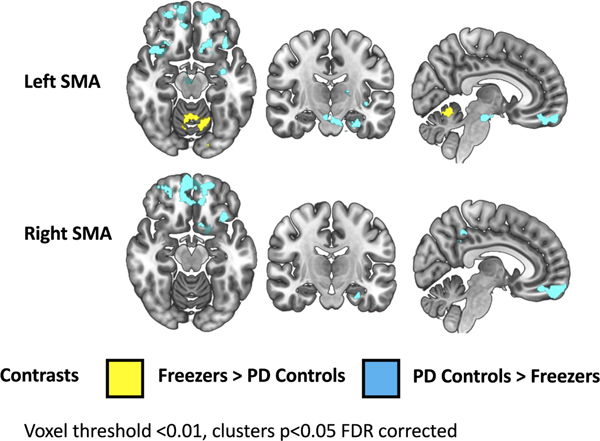
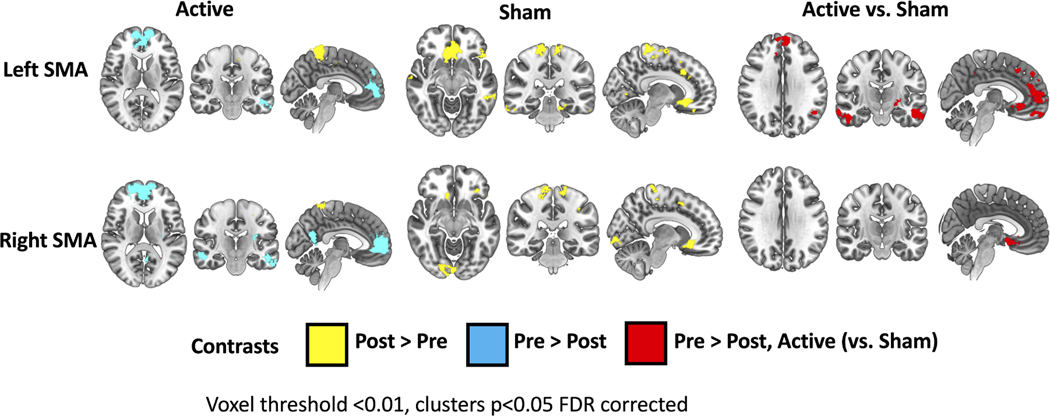
(Experiment 1) Freezers had increased connectivity between the left SMA and the vermis of the cerebellum and decreased connectivity between the SMA and the orbitofrontal cortex (p <0.05). (Experiment 2) 10 sessions of active TMS reduced SMA connectivity with the anterior cingulate, angular gyrus and the medial temporal cortex, whereas sham TMS did not reduce SMA connectivity. From a behavioral perspective, both groups showed nFOG-Q improvements (F(4, 25.7) = 3.87, p = 0.014).
The SMA in freezers is hyper-connected to the cerebellum, a key locomotor region which may represent maladaptive compensation. In this preliminary study, 1 Hz rTMS reduced SMA connectivity however, this was not specific to the locomotor regions. Intervention outcomes may be improved with subject specific targeting of SMA.
冻结步态(FOG)是帕金森病(PD)的一种使人虚弱的特征。有证据表明,FOG 患者的步态皮质控制增加。辅助运动区(SMA)可能是一个关键结构,因为它与运动和认知网络有连接。本研究的目的是确定(1)FOG 患者的 SMA 连接是否中断,以及(2)“抑制性”重复经颅磁刺激是否可以减少 SMA 的适应性连接。
进行了两项实验。在实验 1 中,38 名 PD 冻结者和 17 名 PD 对照者之间进行了静息状态(T2* BOLD 成像)比较。在实验 2 中,20 名患有 FOG 的 PD 患者被随机分为真刺激或假刺激 rTMS 组,刺激 SMA(1 Hz,110%运动阈值,1200 脉冲/秒),同时结合每日步态训练。
(实验 1)冻结者的左侧 SMA 与小脑的蚓部之间的连接增加,而 SMA 与眶额皮质之间的连接减少(p <0.05)。(实验 2)10 次的真刺激 rTMS 减少了 SMA 与前扣带回、角回和内侧颞叶皮质的连接,而假刺激 rTMS 则没有减少 SMA 连接。从行为学的角度来看,两组的 nFOG-Q 都有所改善(F(4, 25.7) = 3.87,p = 0.014)。
冻结者的 SMA 与小脑的连接过度,小脑是一个关键的运动区域,可能代表了适应性的代偿。在这项初步研究中,1 Hz rTMS 减少了 SMA 的连接,但这不是针对运动区域的特异性改变。干预结果可能会通过 SMA 的特定靶向改善。