Clinical Neurosciences Group, Institut de Recerca Biomèdica de Lleida (IRBLleida), Lleida, Spain.
Stroke Unit, Department of Neurology, Hospital Universitari Arnau de Vilanova, Lleida, Spain.
PLoS One. 2021 Jun 9;16(6):e0252351. doi: 10.1371/journal.pone.0252351. eCollection 2021.
COVID-19 may predispose to both venous and arterial thromboembolism event (TEE). Reports on the prevalence and prognosis of thrombotic complications are still emerging.
To describe the rate of TEE complications and its influence in the prognosis of hospitalized patients with COVID-19 after a cross-sectional study.
We evaluated the prevalence of TEE and its relationship with in-hospital death among hospitalized patients with COVID-19 who were admitted between 1st March to 20th April 2020 in a multicentric network of sixteen Hospitals in Spain. TEE was defined by the occurrence of venous thromboembolism (VTE), acute ischemic stroke (AIS), systemic arterial embolism or myocardial infarction (MI).
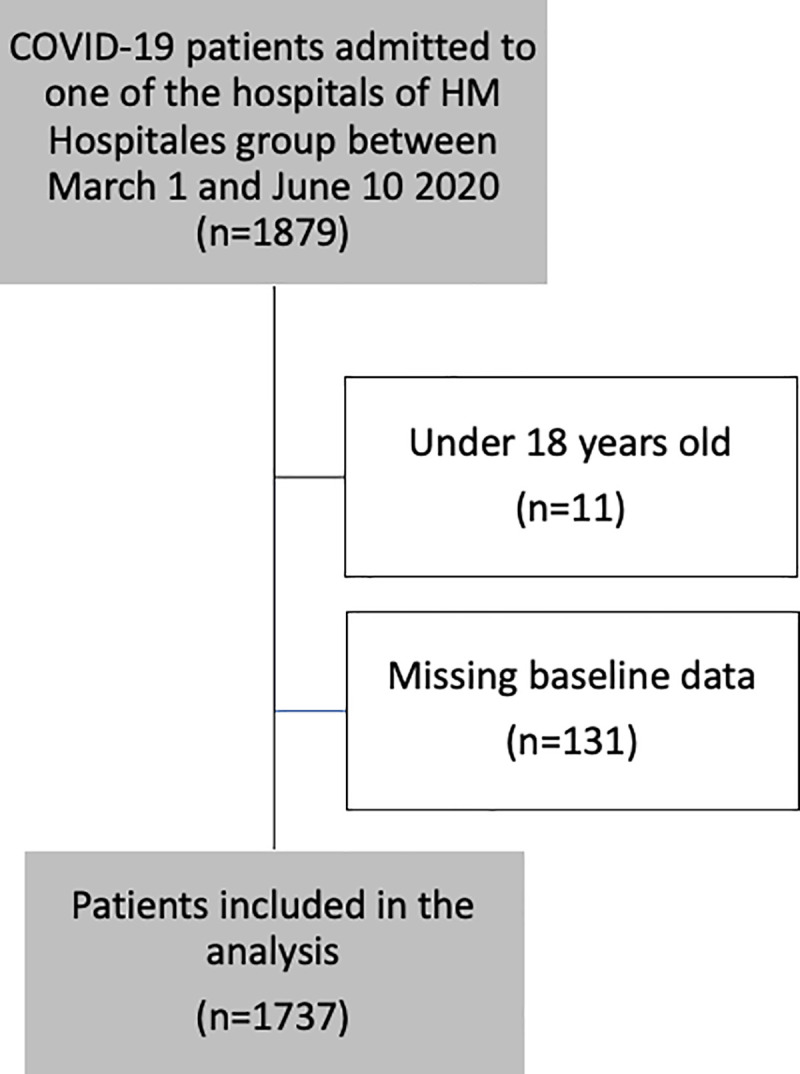
We studied 1737 patients with proven COVID-19 infection of whom 276 died (15.9%). TEE were presented in 64 (3.7%) patients: 49 (76.6%) patients had a VTE, 8 (12.5%) patients had MI, 6 (9.4%%) patients had AIS, and one (1.5%) patient a thrombosis of portal vein. TEE patients exhibited a diffuse profile: older, high levels of D-dimer protein and a tendency of lower levels of prothrombin. The multivariate regression models, confirmed the association between in-hospital death and age (odds ratio [OR] 1.12 [95% CI 1.10-1.14], p<0.001), diabetes (OR 1.49 [95% CI 1.04-2.13], p = 0.029), chronic obstructive pulmonary disease (OR 1.61 [95% CI 1.03-2.53], p = 0.039), ICU care (OR 9.39 [95% CI 5.69-15.51], p<0.001), and TTE (OR 2.24 [95% CI 1.17-4.29], p = 0.015).
Special attention is needed among hospitalized COVID-19 patients with TTE and other comorbidities as they have an increased risk of in-hospital death.
COVID-19 可能导致静脉和动脉血栓栓塞事件(TEE)。关于血栓并发症的患病率和预后的报告仍在不断出现。
通过横断面研究描述住院 COVID-19 患者 TEE 并发症的发生率及其对预后的影响。
我们评估了 2020 年 3 月 1 日至 4 月 20 日期间在西班牙 16 家医院组成的多中心网络中住院的 COVID-19 患者中 TEE 的发生率及其与院内死亡的关系。TEE 通过静脉血栓栓塞症(VTE)、急性缺血性中风(AIS)、全身动脉栓塞或心肌梗死(MI)的发生来定义。
我们研究了 1737 例确诊为 COVID-19 感染的患者,其中 276 例死亡(15.9%)。64 例(3.7%)患者出现 TEE:49 例(76.6%)患者发生 VTE,8 例(12.5%)患者发生 MI,6 例(9.4%)患者发生 AIS,1 例(1.5%)患者发生门静脉血栓形成。TEE 患者表现出弥漫性特征:年龄较大,D-二聚体蛋白水平较高,凝血酶原水平较低。多变量回归模型证实,与院内死亡相关的因素包括年龄(比值比[OR] 1.12 [95%置信区间 1.10-1.14],p<0.001)、糖尿病(OR 1.49 [95%置信区间 1.04-2.13],p = 0.029)、慢性阻塞性肺疾病(OR 1.61 [95%置信区间 1.03-2.53],p = 0.039)、重症监护病房(OR 9.39 [95%置信区间 5.69-15.51],p<0.001)和 TTE(OR 2.24 [95%置信区间 1.17-4.29],p = 0.015)。
在住院 COVID-19 患者中,特别是在伴有 TTE 和其他合并症的患者中,需要特别注意,因为他们有更高的院内死亡风险。