I Clinica Medica, Department of Clinical Internal, Anaesthesiologic and Cardiovascular Sciences, Sapienza University of Rome, Viale del Policlinico 155, 00161, Roma, Italy.
Mediterranea Cardiocentro, Naples, Italy.
Intern Emerg Med. 2021 Aug;16(5):1231-1237. doi: 10.1007/s11739-020-02621-8. Epub 2021 Jul 4.
Patients with coronavirus disease 2019 (Covid-19) may experience venous thrombosis while data regarding arterial thrombosis are sparse.
Prospective multicenter study in 5 hospitals including 373 patients with Covid-19-related pneumonia. Demographic data, laboratory findings including coagulation tests and comorbidities were reported. During the follow-up any arterial or venous thrombotic events and death were registered.
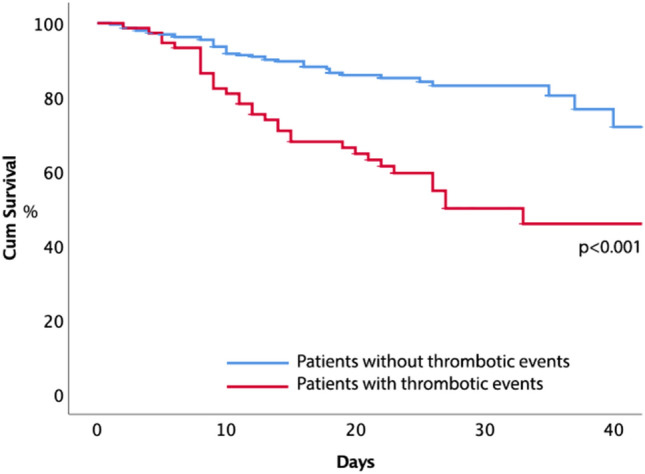
Among 373 patients, 75 (20%) had a thrombotic event and 75 (20%) died. Thrombotic events included 41 venous thromboembolism and 34 arterial thrombosis. Age, cardiovascular disease, intensive care unit treatment, white blood cells, D-dimer, albumin and troponin blood levels were associated with thrombotic events. In a multivariable regression logistic model, intensive care unit treatment (Odds Ratio [OR]: 6.0; 95% Confidence Interval [CI] 2.8-12.6; p < 0.001); coronary artery disease (OR: 2.4; 95% CI 1.4-5.0; p = 0.022); and albumin levels (OR: 0.49; 95% CI 0.28-0.87; p = 0.014) were associated with ischemic events. Age, sex, chronic obstructive pulmonary disease, diabetes, heart failure, coronary heart disease, intensive care unit treatment, in-hospital thrombotic events, D-dimer, C-reactive protein, troponin, and albumin levels were associated with mortality. A multivariable Cox regression analysis showed that in-hospital thrombotic events (hazard ratio [HR]: 2.72; 95% CI 1.59-4.65; p < 0.001), age (HR: 1.035; 95% CI 1.014-1.057; p = 0.001), and albumin (HR: 0.447; 95% CI 0.277-0.723; p = 0.001) predicted morality.
Covid-19 patients experience an equipollent rate of venous and arterial thrombotic events, that are associated with poor survival. Early identification and appropriate treatment of Covid-19 patients at risk of thrombosis may improve prognosis.
患有 2019 年冠状病毒病(Covid-19)的患者可能会发生静脉血栓形成,而有关动脉血栓形成的数据却很少。
这是一项在 5 家医院进行的前瞻性多中心研究,共纳入 373 例与 Covid-19 相关肺炎的患者。报告了人口统计学数据、实验室检查结果,包括凝血检查和合并症。在随访期间,登记了任何动脉或静脉血栓栓塞事件和死亡。
在 373 例患者中,有 75 例(20%)发生血栓形成事件,有 75 例(20%)死亡。血栓形成事件包括 41 例静脉血栓栓塞和 34 例动脉血栓形成。年龄、心血管疾病、重症监护病房治疗、白细胞、D-二聚体、白蛋白和肌钙蛋白血液水平与血栓形成事件有关。在多变量回归逻辑模型中,重症监护病房治疗(优势比[OR]:6.0;95%置信区间[CI]:2.8-12.6;p<0.001);冠状动脉疾病(OR:2.4;95%CI 1.4-5.0;p=0.022)和白蛋白水平(OR:0.49;95%CI 0.28-0.87;p=0.014)与缺血性事件相关。年龄、性别、慢性阻塞性肺疾病、糖尿病、心力衰竭、冠心病、重症监护病房治疗、住院期间血栓形成事件、D-二聚体、C 反应蛋白、肌钙蛋白和白蛋白水平与死亡率相关。多变量 Cox 回归分析显示,住院期间血栓形成事件(危险比[HR]:2.72;95%CI 1.59-4.65;p<0.001)、年龄(HR:1.035;95%CI 1.014-1.057;p=0.001)和白蛋白(HR:0.447;95%CI 0.277-0.723;p=0.001)预测死亡率。
Covid-19 患者的静脉和动脉血栓形成发生率相等,这与预后不良有关。早期识别和适当治疗有血栓形成风险的 Covid-19 患者可能会改善预后。