Department of Molecular Innovation in Lipidology, National Cerebral and Cardiovascular Center Research Institute.
Department of Cardiovascular Medicine, Osaka University Graduate School of Medicine.
J Atheroscler Thromb. 2022 Jun 1;29(6):906-922. doi: 10.5551/jat.62925. Epub 2021 Jun 10.
Familial hypercholesterolemia (FH) is characterized by high low-density lipoprotein (LDL) cholesterol levels, xanthomas including Achilles tendon thickening, and premature coronary artery disease (CAD). Carotid intima-media thickness (IMT) is a well-established surrogate marker for CAD in FH and Achilles tendon thickening is a specific physical finding in patients with FH. The objective of the present study was to identify factors associated with carotid IMT and Achilles tendon thickness in FH heterozygotes on lipid-lowering therapy. This study also aimed to examine the follow-up changes in carotid IMT and Achilles tendon thickness among them in the current real-world FH practice.
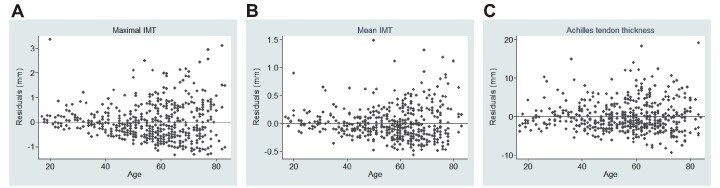
The current study is a subanalysis of the Familial Hypercholesterolemia Expert Forum (FAME) Study. The severity of carotid atherosclerosis was assessed with the maximal and mean IMT using ultrasonography, and Achilles tendon thickness was measured using X-rays. The present study used 571 patients under medical treatment for heterozygous FH who had baseline measurements for maximal IMT (n=511), mean IMT (n=459), or Achilles tendon thickness (n=486). The IMT was measured annually, and Achilles tendon thickness was evaluated every two years.
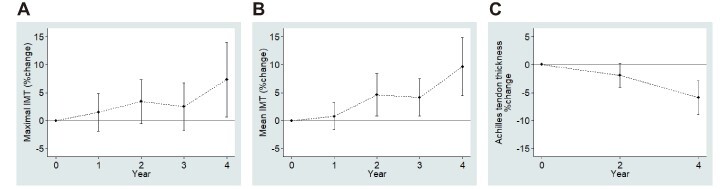
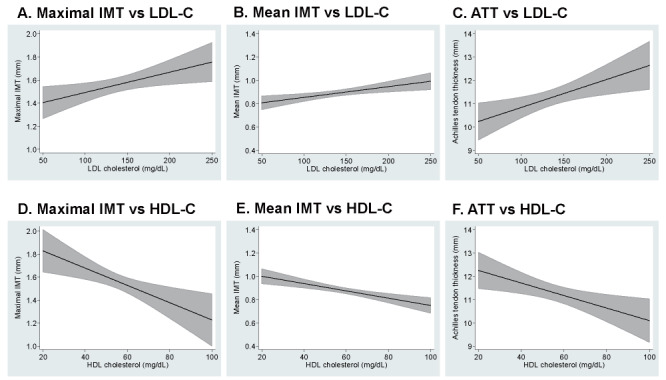
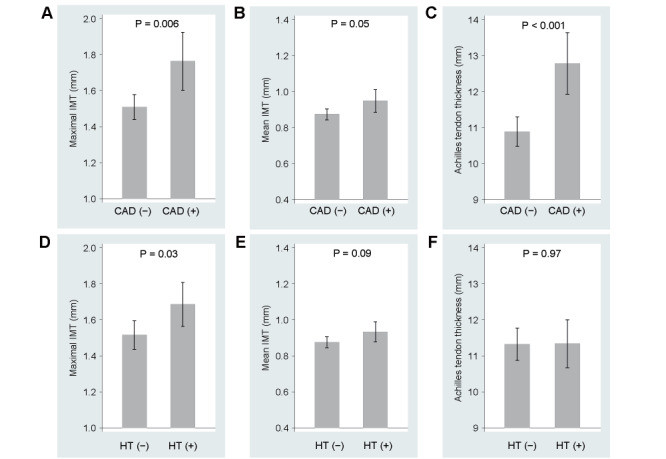
Higher LDL cholesterol (LDL-C) level and lower HDL cholesterol (HDL-C) level were associated with greater maximal and mean IMT as well as greater Achilles tendon thickness. Achilles tendon thickness tended to be greater in patients who had a smoking history than in never-smokers. Maximal IMT and Achilles tendon thickness were significantly greater in patients with CAD than in those without. Additionally, lower HDL-C level and hypertension were associated with higher values of maximal and mean IMT, suggesting the importance of comprehensive risk management including reduced HDL-C and blood pressure control in FH care. In longitudinal observations, percentage changes in maximal IMT and mean IMT gradually increased during the observation period. In contrast, percentage changes in Achilles tendon thickness became progressively thinner throughout the observation period.
We found a positive association between LDL-C levels and severity of carotid atherosclerosis in heterozygous FH patients on treatment. This observation suggests the insufficiency of lipid-lowering therapy and the presence of therapeutic inertia among clinicians in the real-world FH practice.
家族性高胆固醇血症(FH)的特征是低密度脂蛋白(LDL)胆固醇水平升高、包括跟腱增厚在内的黄色瘤,以及早发冠心病(CAD)。颈动脉内膜中层厚度(IMT)是 FH 和跟腱增厚患者 CAD 的一种公认的替代标志物。本研究的目的是确定 FH 杂合子降脂治疗患者颈动脉 IMT 和跟腱厚度相关的因素。本研究还旨在检查目前 FH 实际实践中他们的颈动脉 IMT 和跟腱厚度的随访变化。
本研究是家族性高胆固醇血症专家论坛(FAME)研究的子分析。使用超声评估颈动脉粥样硬化的严重程度,测量最大和平均 IMT;使用 X 射线测量跟腱厚度。本研究使用了 571 名接受 FH 杂合子药物治疗的患者的基线最大 IMT(n=511)、平均 IMT(n=459)或跟腱厚度(n=486)的测量值。IMT 每年测量一次,跟腱厚度每两年评估一次。
较高的 LDL 胆固醇(LDL-C)水平和较低的高密度脂蛋白胆固醇(HDL-C)水平与更大的最大和平均 IMT 以及更大的跟腱厚度相关。有吸烟史的患者的跟腱厚度往往大于从不吸烟者。CAD 患者的最大 IMT 和跟腱厚度明显大于无 CAD 患者。此外,较低的 HDL-C 水平和高血压与最大和平均 IMT 值更高相关,表明在 FH 治疗中包括降低 HDL-C 和控制血压在内的综合风险管理的重要性。在纵向观察中,最大 IMT 和平均 IMT 的百分比变化在观察期间逐渐增加。相比之下,整个观察期间,跟腱厚度的百分比变化逐渐变薄。
我们发现,在接受治疗的 FH 杂合子患者中,LDL-C 水平与颈动脉粥样硬化的严重程度呈正相关。这一观察结果表明,在现实世界的 FH 实践中,降脂治疗不足且存在治疗惰性。