Department of Social & Developmental Psychology, Sapienza University of Rome, Rome, Italy.
Department of Dynamic and Clinical Psychology, and Health Studies, Sapienza University of Rome, Rome, Italy.
New Dir Child Adolesc Dev. 2021 Jul;2021(178):133-155. doi: 10.1002/cad.20427. Epub 2021 Jun 9.
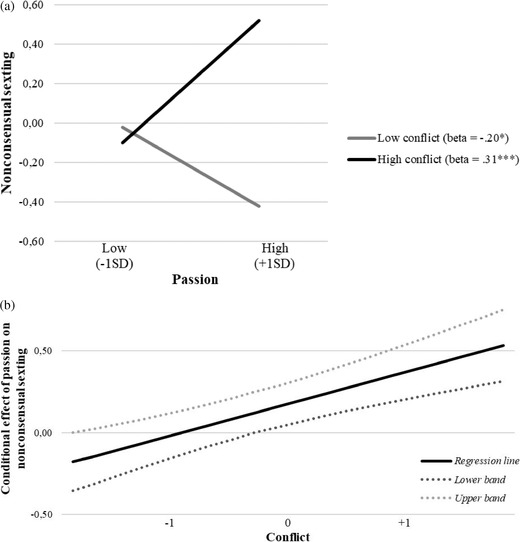
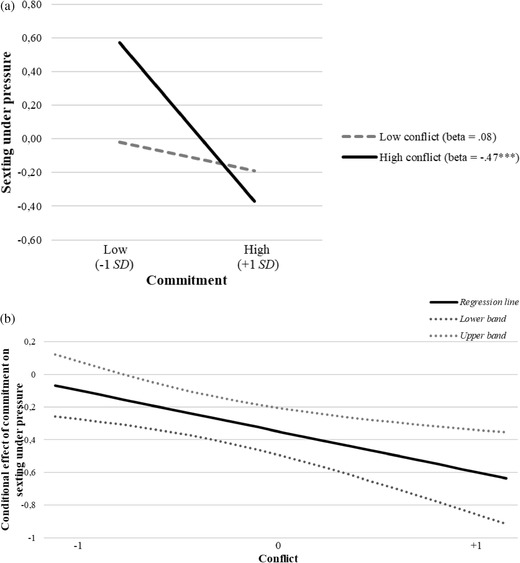
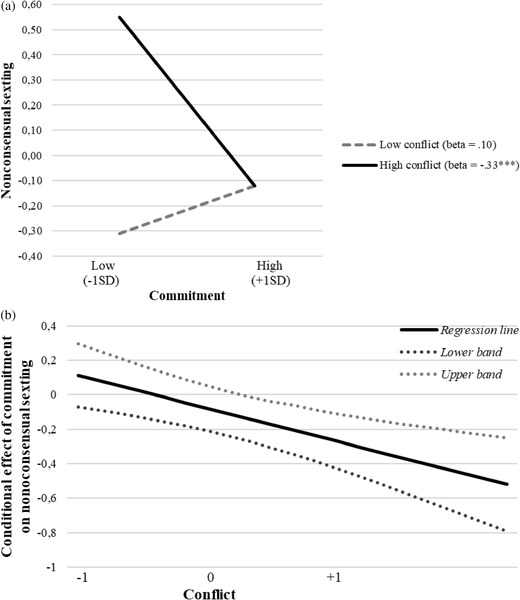
According to the triangular love theory, this study investigated the roles of three components of love (i.e., passion, intimacy, commitment) and the moderating role of conflicts in predicting different forms of sexting (i.e., experimental, nonconsensual, under pressure) in teen dating relationships. Participants were 409 adolescents (M = 17.20, SD = 1.61; 62.6% girls) who completed an online questionnaire. Three moderated regressions were performed. Conflicts positively predicted all forms of sexting. Passion positively predicted experimental sexting. Intimacy negatively predicted experimental and nonconsensual sexting, and positively predicted sexting under pressure. Three interaction effects emerged, pointing out the moderating role of conflicts. Passion positively predicted nonconsensual sexting in the presence of high conflicts, while this relationship became negative when conflicts were low. Commitment negatively predicted nonconsensual sexting and sexting under pressure in the presence of high conflicts, but these relationships were not significant when conflicts were low. Research and applicative implications are discussed.
根据三角爱情理论,本研究调查了爱情的三个组成部分(即激情、亲密和承诺)以及冲突的调节作用,以预测青少年恋爱关系中不同形式的性短信(即实验性、非自愿性、有压力性)。参与者为 409 名青少年(M=17.20,SD=1.61;62.6%为女性),他们完成了在线问卷。进行了三次调节回归。冲突正向预测了所有形式的性短信。激情正向预测实验性性短信。亲密负向预测实验性和非自愿性性短信,正向预测有压力性性短信。三个交互作用出现,指出了冲突的调节作用。在高冲突的情况下,激情正向预测非自愿性性短信,而在低冲突的情况下,这种关系则变为负向。在高冲突的情况下,承诺负向预测非自愿性性短信和有压力性性短信,但在低冲突的情况下,这些关系并不显著。讨论了研究和应用的意义。