Bianchi Dora, Baiocco Roberto, Lonigro Antonia, Pompili Sara, Zammuto Marta, Di Tata Daniele, Morelli Mara, Chirumbolo Antonio, Di Norcia Anna, Cannoni Eleonora, Longobardi Emiddia, Laghi Fiorenzo
Department of Developmental and Social Psychology, Sapienza University of Rome, Rome, Italy.
Department of Human Sciences, European University of Rome, Rome, Italy.
Sex Res Social Policy. 2023;20(2):465-478. doi: 10.1007/s13178-021-00645-z. Epub 2021 Sep 23.
This study investigated the relationships of pandemic-related stress and coping strategies with different kinds of sexting (i.e., experimental, risky, and emotional) during the COVID-19 lockdown in the Italian context.
A sample of 1929 emerging adults ( = 24.17, = 2.75; 71.6% girls) completed an online survey about their sexting behaviors during the national lockdown in Italy. Data were gathered in April/May 2020, from 6th to 11th week of home confinement due to COVID-19 pandemic. Hierarchical regression and mediation analyses were performed.
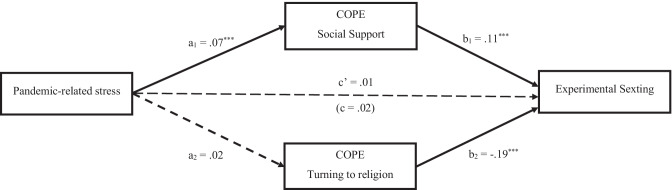
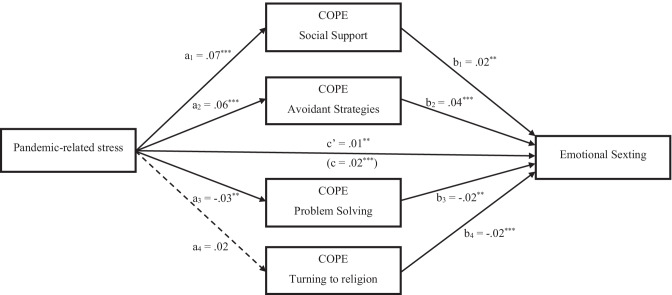
Pandemic-related stress directly predicted only risky and emotional sexting. Experimental and emotional sexting were positively predicted by social support, and negatively predicted by turning to religion. Risky and emotional sexting were positively predicted by avoidance, and negatively predicted by problem solving. Adaptive coping (i.e., social support) mediated the relationships from pandemic-related stress to both experimental and emotional sexting. Maladaptive coping (i.e., avoidance and problem solving) mediated the relationships from pandemic related-stress to risky and emotional sexting.
Sexting was a coping tool during COVID-19 lockdown, showing both adaptive and maladaptive facets.
Findings suggest new directions for implementing programs of sexual education and safer Internet use targeted to young people.
本研究调查了在意大利新冠疫情封锁期间,与大流行相关的压力和应对策略与不同类型的性短信行为(即实验性、风险性和情感性)之间的关系。
选取1929名新兴成年人作为样本(平均年龄=24.17岁,标准差=2.75岁;71.6%为女孩),他们完成了一项关于意大利全国封锁期间性短信行为的在线调查。数据于2020年4月/5月收集,即因新冠疫情居家隔离的第6至11周。进行了分层回归和中介分析。
与大流行相关的压力仅直接预测风险性和情感性性短信行为。社会支持对实验性和情感性性短信行为有正向预测作用,而求助宗教则有负向预测作用。回避对风险性和情感性性短信行为有正向预测作用,而解决问题则有负向预测作用。适应性应对(即社会支持)介导了从与大流行相关的压力到实验性和情感性性短信行为的关系。 maladaptive应对(即回避和解决问题)介导了从与大流行相关的压力到风险性和情感性性短信行为的关系。
在新冠疫情封锁期间,性短信是一种应对工具,呈现出适应性和适应不良两个方面。
研究结果为针对年轻人实施性教育和更安全使用互联网的项目指明了新方向。