Adams Dayvion R, Golnar Andrew J, Hamer Sarah A, Slotman Michel A, Hamer Gabriel L
Department of Entomology, Texas A&M University, 2475 TAMU, College Station, TX, 77843, USA.
Schubot Center for Avian Health, Department of Veterinary Pathobiology, Texas A&M University, 4467 TAMU, College Station, TX, 77843, USA.
Parasitol Res. 2021 Jul;120(7):2343-2350. doi: 10.1007/s00436-021-07196-7. Epub 2021 Jun 10.
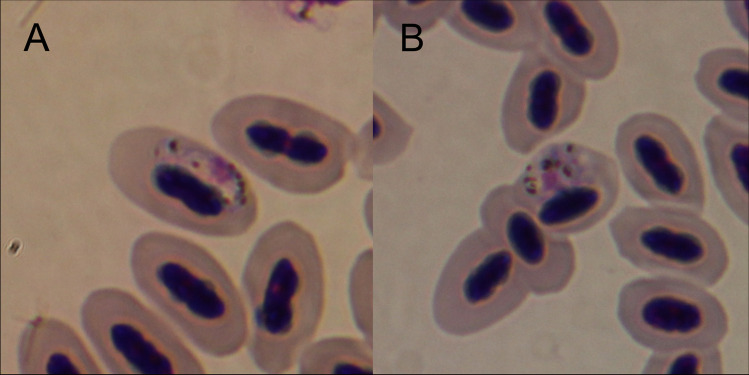
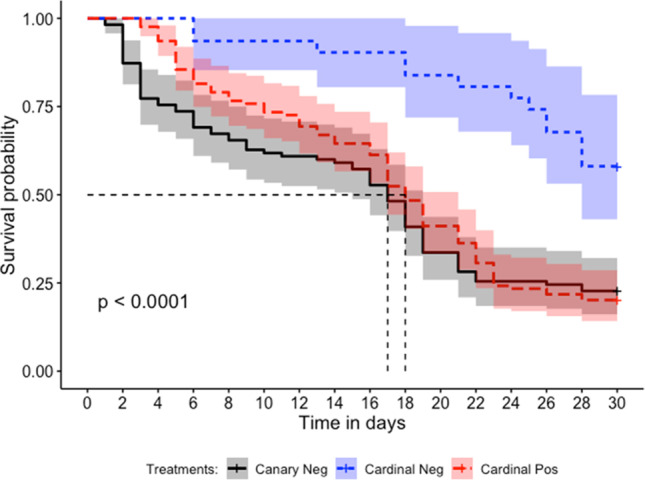
Arthropod vectors are frequently exposed to a diverse assemblage of parasites, but the consequence of these infections on their biology and behavior are poorly understood. We experimentally evaluated whether the ingestion of a common protozoan parasite of avian hosts (Haemoproteus spp.; Haemosporida: Haemoproteidae) impacted the survivorship of Culex quinquefasciatus (Say) (Diptera: Culicidae). Blood was collected from wild northern cardinals (Cardinalis cardinalis) in College Station, Texas, and screened for the presence of Haemoproteus spp. parasites using microscopic and molecular methods. Experimental groups of Cx. quinquefasciatus mosquitoes were offered Haemoproteus-positive cardinal blood through an artificial feeding apparatus, while control groups received Haemoproteus-negative cardinal blood or domestic canary (Serinus canaria domestica) blood. Culex quinquefasciatus mosquitoes exposed to Haemoproteus infected cardinal blood survived significantly fewer days than mosquitoes that ingested Haemoproteus-negative cardinal blood. The survival of mosquitoes fed on positive cardinal blood had a median survival time of 18 days post-exposure and the survival of mosquitoes fed on negative cardinal blood exceeded 50% across the 30 day observation period. Additionally, mosquitoes that fed on canary controls survived significantly fewer days than cardinal negative controls, with canary control mosquitoes having a median survival time of 17 days. This study further supports prior observations that Haemoproteus parasites can be pathogenic to bird-biting mosquitoes, and suggests that Haemoproteus parasites may indirectly suppress the transmission of co-circulating vector-borne pathogens by modulating vector survivorship. Our results also suggest that even in the absence of parasite infection, bloodmeals from different bird species can influence mosquito survivorship.
节肢动物媒介经常接触各种各样的寄生虫,但这些感染对其生物学特性和行为的影响却知之甚少。我们通过实验评估了摄入一种常见的鸟类宿主原生动物寄生虫(血变原虫属;血孢子虫目:血变原虫科)是否会影响致倦库蚊(Say)(双翅目:蚊科)的存活率。从得克萨斯州大学城的野生北美主红雀(主红雀属)采集血液,并用显微镜和分子方法筛查血变原虫属寄生虫的存在。致倦库蚊实验组通过人工喂食装置给予感染血变原虫的主红雀血液,而对照组则接受未感染血变原虫的主红雀血液或家金丝雀(家丝雀)血液。接触感染血变原虫的主红雀血液的致倦库蚊存活天数明显少于摄入未感染血变原虫的主红雀血液的蚊子。摄入感染血变原虫的主红雀血液的蚊子,暴露后中位存活时间为18天,而摄入未感染血变原虫的主红雀血液的蚊子在30天观察期内存活率超过50%。此外,以金丝雀为对照的蚊子存活天数明显少于主红雀阴性对照,金丝雀对照蚊子的中位存活时间为17天。本研究进一步支持了先前的观察结果,即血变原虫寄生虫可对叮咬鸟类的蚊子致病,并表明血变原虫寄生虫可能通过调节媒介存活率间接抑制同时传播的媒介传播病原体的传播。我们的结果还表明,即使在没有寄生虫感染的情况下,来自不同鸟类的血餐也会影响蚊子的存活率。