Faculty of Agriculture, University of Miyazaki, Miyazaki, Japan.
Tropical Biosphere Research Center, University of the Ryukyus, Nishihara, Okinawa, Japan.
PLoS One. 2021 Jun 10;16(6):e0245316. doi: 10.1371/journal.pone.0245316. eCollection 2021.
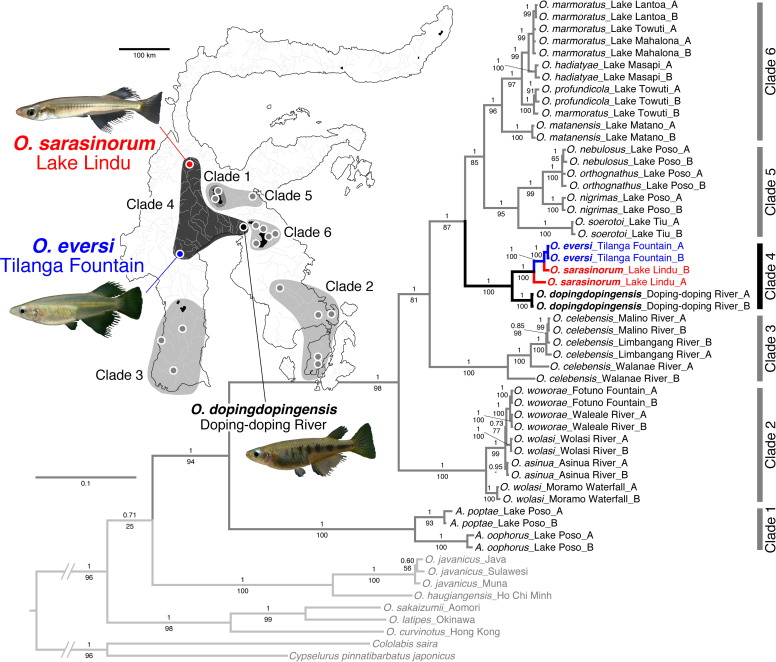
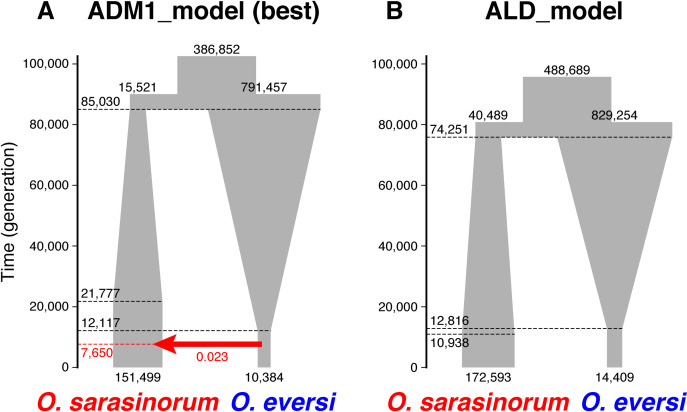
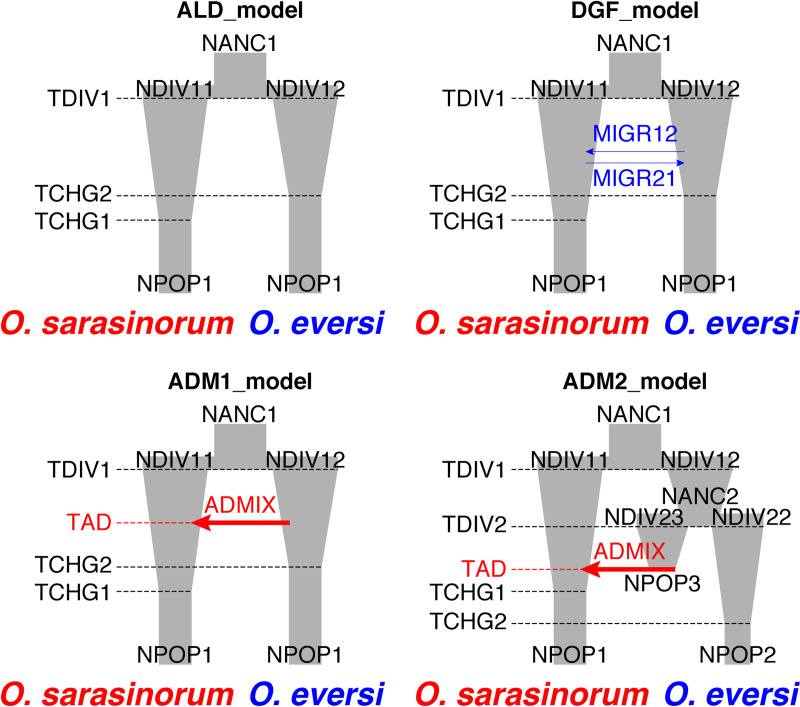
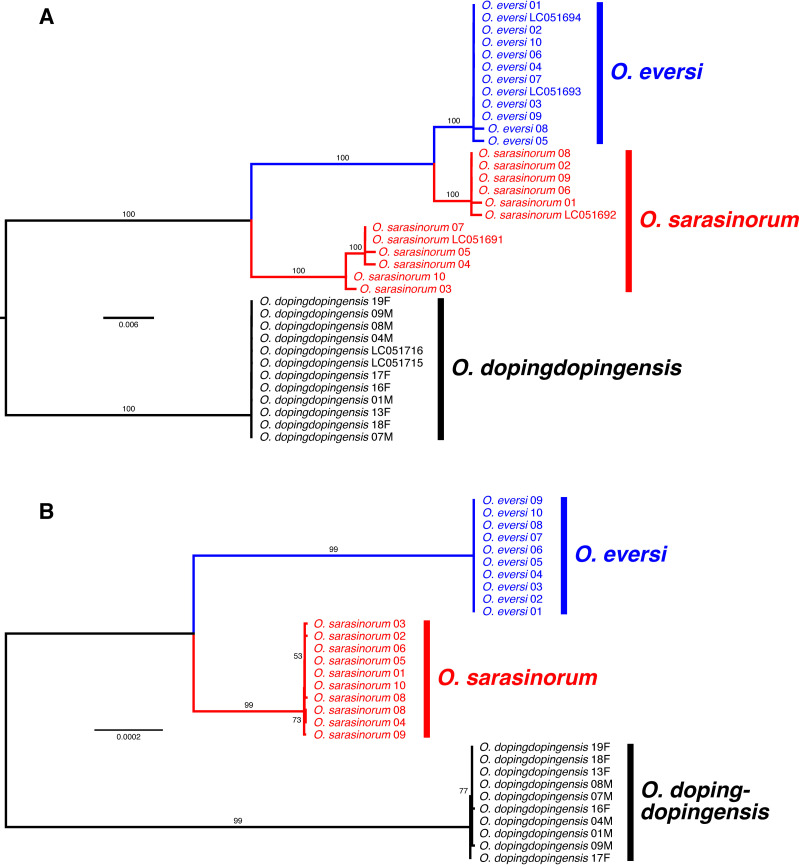
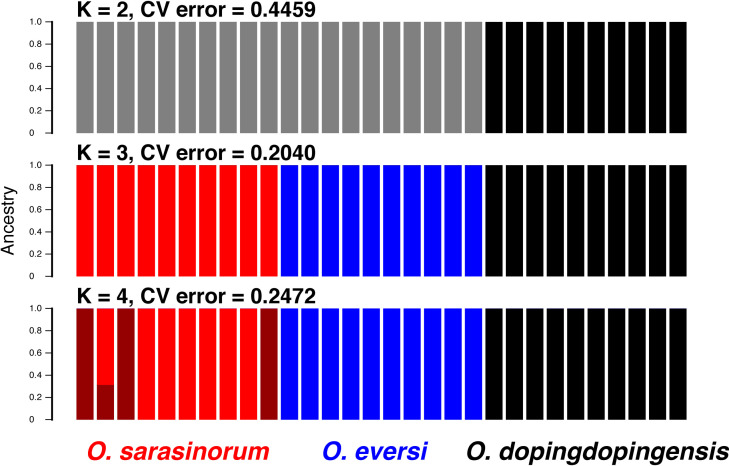
Sulawesi, an island located in a biogeographical transition zone between Indomalaya and Australasia, is famous for its high levels of endemism. Ricefishes (family Adrianichthyidae) are an example of taxa that have uniquely diversified on this island. It was demonstrated that habitat fragmentation due to the Pliocene juxtaposition among tectonic subdivisions of this island was the primary factor that promoted their divergence; however, it is also equally probable that habitat fusions and resultant admixtures between phylogenetically distant species may have frequently occurred. Previous studies revealed that some individuals of Oryzias sarasinorum endemic to a tectonic lake in central Sulawesi have mitochondrial haplotypes that are similar to the haplotypes of O. eversi, which is a phylogenetically related but geologically distant (ca. 190 km apart) adrianichthyid endemic to a small fountain. In this study, we tested if this reflects ancient admixture of O. eversi and O. sarasinorum. Population genomic analyses of genome-wide single-nucleotide polymorphisms revealed that O. eversi and O. sarasinorum are substantially reproductively isolated from each other. Comparison of demographic models revealed that the models assuming ancient admixture from O. eversi to O. sarasinorum was more supported than the models assuming no admixture; this supported the idea that the O. eversi-like mitochondrial haplotype in O. sarasinorum was introgressed from O. eversi. This study is the first to demonstrate ancient admixture of lacustrine or pond organisms in Sulawesi beyond 100 km. The complex geological history of this island enabled such island-wide admixture of lacustrine organisms, which usually experience limited migration.
苏拉威西岛位于印度-马来亚和澳大拉西亚生物地理过渡带,以其高度的特有性而闻名。稻鱼(Adrianichthyidae 科)是在该岛上独特多样化的分类群的一个例子。已经证明,由于该岛构造细分之间的上新世并置导致的生境破碎化是促进其分化的主要因素;然而,生境融合以及由此导致的亲缘关系较远的物种之间的混合也很可能经常发生。以前的研究表明,苏拉威西岛中部一个构造湖特有的 Oryzias sarasinorum 的一些个体具有与 O. eversi 的线粒体单倍型相似的单倍型,O. eversi 是一个亲缘关系较近但地质上较远(相距约 190 公里)的 Adrianichthyidae 特有种。在这项研究中,我们测试了这是否反映了 O. eversi 和 O. sarasinorum 的古老混合。全基因组单核苷酸多态性的种群基因组分析表明,O. eversi 和 O. sarasinorum 彼此在生殖上存在很大的隔离。比较种群动态模型表明,假设 O. eversi 向 O. sarasinorum 的古老混合模型比假设没有混合的模型更受支持;这支持了 O. sarasinorum 中 O. eversi 样线粒体单倍型是从 O. eversi 渗入的观点。这项研究首次证明了苏拉威西岛超过 100 公里的湖泊或池塘生物的古老混合。该岛复杂的地质历史使这种湖泊生物在整个岛上进行广泛的混合,而这种混合通常是有限的。