Huang Xin, Chen Cunte, Zhong Mengjun, Geng Suxia, Zhao Yujie, Li Minming, Deng Chenxin, Zeng Lingji, Wu Ping, Lu Zesheng, Weng Jianyu, Du Xin, Li Yangqiu
Department of Hematology, Guangdong Provincial People's Hospital, Guangdong Academy of Medical Sciences, 510080, Guangzhou, PR China.
Key Laboratory for Regenerative Medicine of Ministry of Education, Institute of Hematology, Jinan University, 510632, Guangzhou, PR China.
Biomark Res. 2021 Jun 10;9(1):46. doi: 10.1186/s40364-021-00302-y.
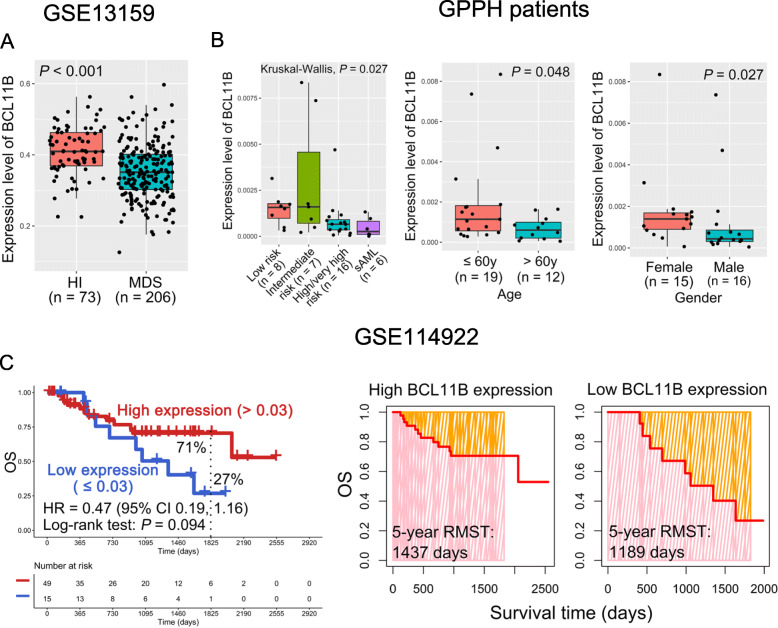
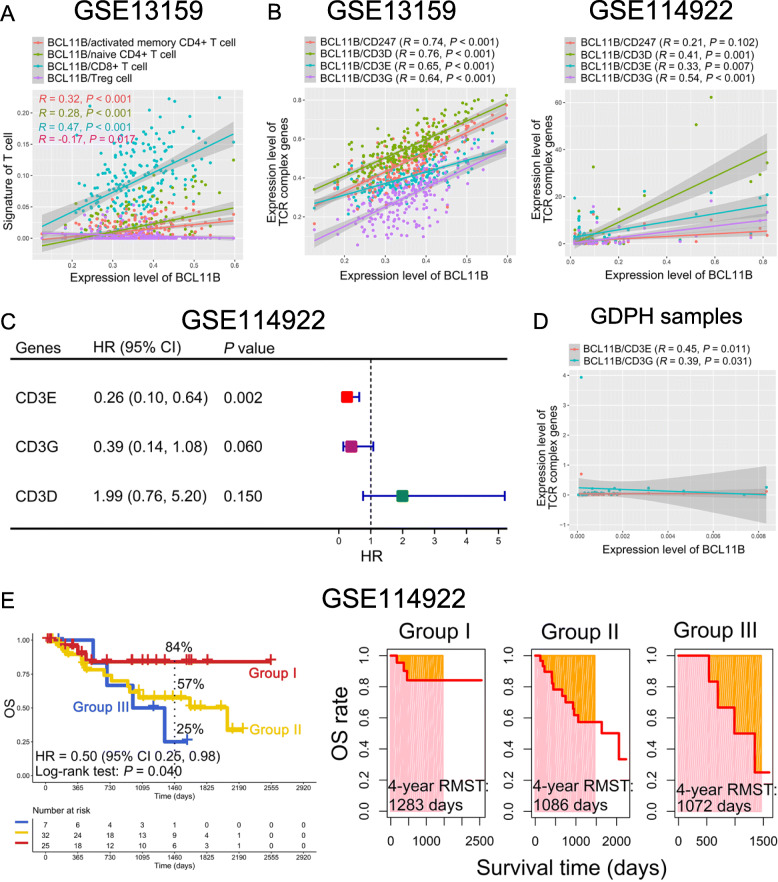
Myelodysplastic syndrome (MDS) is an aggressive and genetically heterogeneous disease with poor prognosis. Cellular immune disorder is a common characteristic of this disease and is thought to be related to clinical outcome. Alterations in T cell clonal expansion and T cell dysfunction has been detected in MDS patients. Little is known about whether there are immune biomarkers to evaluate the T cell alterations with clinical outcome. Previous studies have demonstrated that B-cell leukemia/lymphoma 11B (BCL11B) plays an important role in regulating T cell development and proliferation. In this study, the prognostic value of BCL11B for MDS patients was explored by analyzing RNA-seq data from 270 patients in two datasets in the Gene Expression Omnibus (GEO) database and real-time quantitative PCR data (qRT-PCR) of 31 bone marrow (BM) samples of MDS and 6 BM samples of patients with MDS progress to secondary acute myeloid leukemia (sAML) from our clinical center. The results demonstrated that BCL11B is significantly down-regulated in MDS patients as compared with healthy individuals (HIs). Importantly, lower BCL11B expression was found in MDS patients who were of high/very high risk, older than 60 y, or male and patients with sAML. Furthermore, low BCL11B expression appeared to be associated with poor overall survival (OS) for MDS patients, though the data were not yet significant enough at this point. In addition, BCL11B low-expressing MDS patients had shorter restricted mean survival time (RMST) than those with high BCL11B expression. Interestingly, BCL11B positively correlated with naive and activated memory CD4 + T cells, CD8 + T cells, and the T cell receptor complex genes CD3E and CD3G, but it negatively correlated with regulatory T cells (Treg). Additionally, co-occurrence of low BCL11B expression and CD3E and CD3G was associated with poor OS and shorter RMST. In conclusion, lower BCL11B expression in BM samples of MDS patients was associated with adverse clinical outcome.
骨髓增生异常综合征(MDS)是一种侵袭性且基因异质性的疾病,预后较差。细胞免疫紊乱是该疾病的一个常见特征,并且被认为与临床结局相关。在MDS患者中已检测到T细胞克隆扩增和T细胞功能障碍的改变。关于是否存在可评估T细胞改变与临床结局的免疫生物标志物,人们知之甚少。先前的研究表明,B细胞白血病/淋巴瘤11B(BCL11B)在调节T细胞发育和增殖中起重要作用。在本研究中,通过分析基因表达综合数据库(GEO)中两个数据集中270例患者的RNA测序数据以及我们临床中心31例MDS骨髓(BM)样本和6例进展为继发性急性髓系白血病(sAML)患者的BM样本的实时定量PCR数据(qRT-PCR),探讨了BCL11B对MDS患者的预后价值。结果表明,与健康个体(HI)相比,MDS患者中BCL11B显著下调。重要的是,在高危/极高危、年龄大于60岁或男性的MDS患者以及sAML患者中发现BCL11B表达较低。此外,尽管目前数据尚未足够显著,但低BCL11B表达似乎与MDS患者的总生存期(OS)较差相关。此外,BCL11B低表达的MDS患者的受限平均生存时间(RMST)比BCL11B高表达的患者短。有趣的是,BCL11B与初始和活化记忆CD4 + T细胞、CD8 + T细胞以及T细胞受体复合物基因CD3E和CD3G呈正相关,但与调节性T细胞(Treg)呈负相关。此外,低BCL11B表达与CD3E和CD3G的共出现与较差的OS和较短的RMST相关。总之,MDS患者BM样本中较低的BCL11B表达与不良临床结局相关。