
在. 中,雌性减数分裂过程中的微管重排。
Microtubule reorganization during female meiosis in .
机构信息
Experimental Center, Faculty of Medicine Carl Gustav Carus, Technische Universität Dresden, Dresden, Germany.
Department of Electrical and Computer Engineering, University of California, Santa Barbara, Santa Barbara, United States.
出版信息
Elife. 2021 Jun 11;10:e58903. doi: 10.7554/eLife.58903.
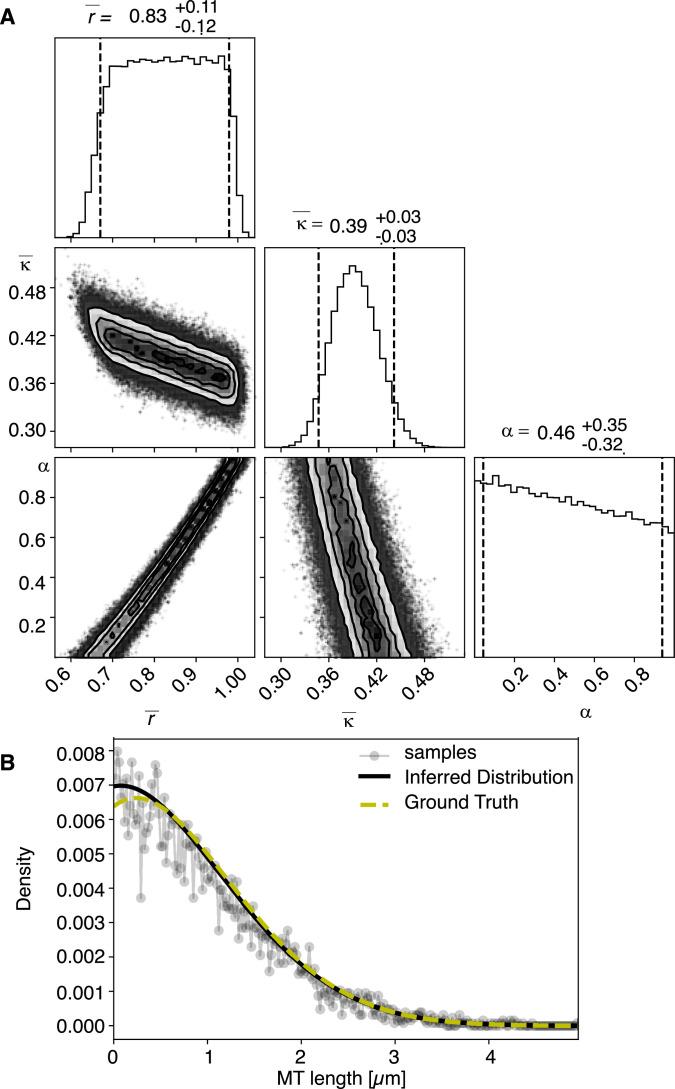
Most female meiotic spindles undergo striking morphological changes while transitioning from metaphase to anaphase. The ultra-structure of meiotic spindles, and how changes to this structure correlate with such dramatic spindle rearrangements remains largely unknown. To address this, we applied light microscopy, large-scale electron tomography and mathematical modeling of female meiotic spindles. Combining these approaches, we find that meiotic spindles are dynamic arrays of short microtubules that turn over within seconds. The results show that the metaphase to anaphase transition correlates with an increase in microtubule numbers and a decrease in their average length. Detailed analysis of the tomographic data revealed that the microtubule length changes significantly during the metaphase-to-anaphase transition. This effect is most pronounced for microtubules located within 150 nm of the chromosome surface. To understand the mechanisms that drive this transition, we developed a mathematical model for the microtubule length distribution that considers microtubule growth, catastrophe, and severing. Using Bayesian inference to compare model predictions and data, we find that microtubule turn-over is the major driver of the spindle reorganizations. Our data suggest that in metaphase only a minor fraction of microtubules, those closest to the chromosomes, are severed. The large majority of microtubules, which are not in close contact with chromosomes, do not undergo severing. Instead, their length distribution is fully explained by growth and catastrophe. This suggests that the most prominent drivers of spindle rearrangements are changes in nucleation and catastrophe rate. In addition, we provide evidence that microtubule severing is dependent on katanin.
大多数雌性减数分裂纺锤体在从中期向后期过渡时会发生显著的形态变化。减数分裂纺锤体的超微结构,以及这种结构的变化如何与如此剧烈的纺锤体重排相关,在很大程度上仍然未知。为了解决这个问题,我们应用了光学显微镜、大规模电子断层扫描和雌性减数分裂纺锤体的数学建模。结合这些方法,我们发现减数分裂纺锤体是由短微管组成的动态阵列,这些微管在几秒钟内就会翻转。结果表明,从中期到后期的转变与微管数量的增加和平均长度的减少有关。对断层扫描数据的详细分析表明,微管长度在中期到后期的转变过程中发生了显著变化。对于位于染色体表面 150nm 以内的微管,这种效应最为明显。为了了解驱动这种转变的机制,我们开发了一个考虑微管生长、崩解和切断的微管长度分布的数学模型。使用贝叶斯推断来比较模型预测和数据,我们发现微管周转是纺锤体重组的主要驱动因素。我们的数据表明,在中期只有一小部分微管,即最靠近染色体的微管,被切断。绝大多数不与染色体紧密接触的微管,不会发生切断。相反,它们的长度分布完全可以用生长和崩解来解释。这表明,纺锤体重排的最主要驱动因素是成核和崩解率的变化。此外,我们提供了证据表明微管的切断依赖于katanin。


 Zotero 插件