Cao Jianhua, Balluff Benjamin, Arts Martijn, Dubois Ludwig J, van Loon Luc J C, Hackeng Tilman M, van Eijk Hans M H, Eijkel Gert, Heij Lara R, Soons Zita, Olde Damink Steven W M, Heeren Ron M A
Maastricht MultiModal Molecular Imaging institute (M4I), Maastricht University, Universiteitssingel 50, 6229 ER, Maastricht, The Netherlands.
Department of General Surgery (NUTRIM), Maastricht University, Maastricht, The Netherlands.
Cancer Metab. 2021 Jun 11;9(1):26. doi: 10.1186/s40170-021-00262-9.
Metabolic reprogramming is a common phenomenon in tumorigenesis and tumor progression. Amino acids are important mediators in cancer metabolism, and their kinetics in tumor tissue are far from being understood completely. Mass spectrometry imaging is capable to spatiotemporally trace important endogenous metabolites in biological tissue specimens. In this research, we studied L-[ring-C]-labeled phenylalanine and tyrosine kinetics in a human non-small cell lung carcinoma (NSCLC) xenografted mouse model using matrix-assisted laser desorption/ionization Fourier-transform ion cyclotron resonance mass spectrometry imaging (MALDI-FTICR-MSI).
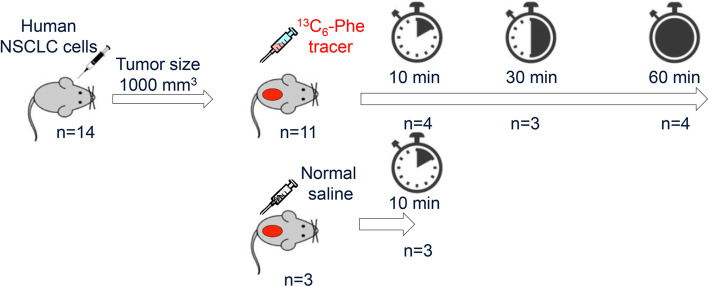
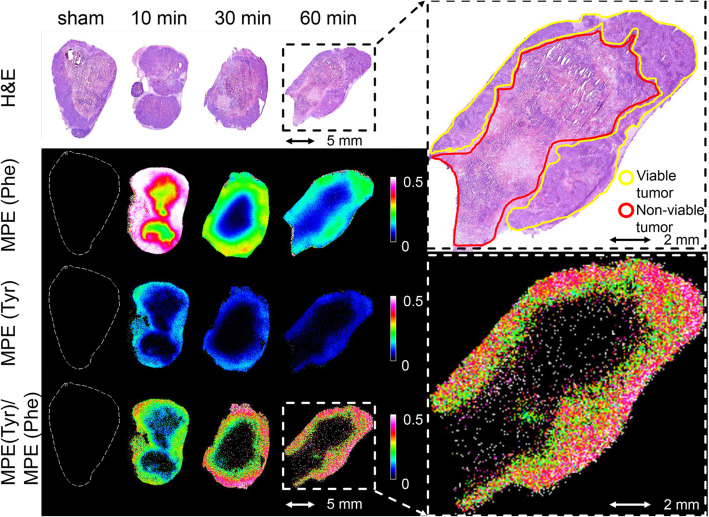
We investigated the L-[ring-C]-Phenylalanine (C-Phe) and L-[ring-C]-Tyrosine (C-Tyr) kinetics at 10 min (n = 4), 30 min (n = 3), and 60 min (n = 4) after tracer injection and sham-treated group (n = 3) at 10 min in mouse-xenograft lung tumor tissues by MALDI-FTICR-MSI.
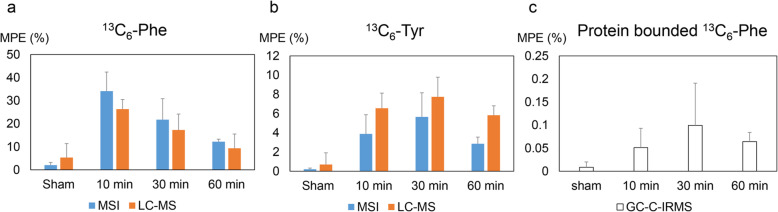
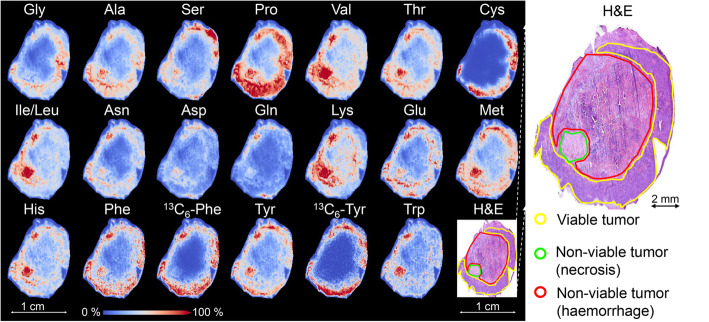
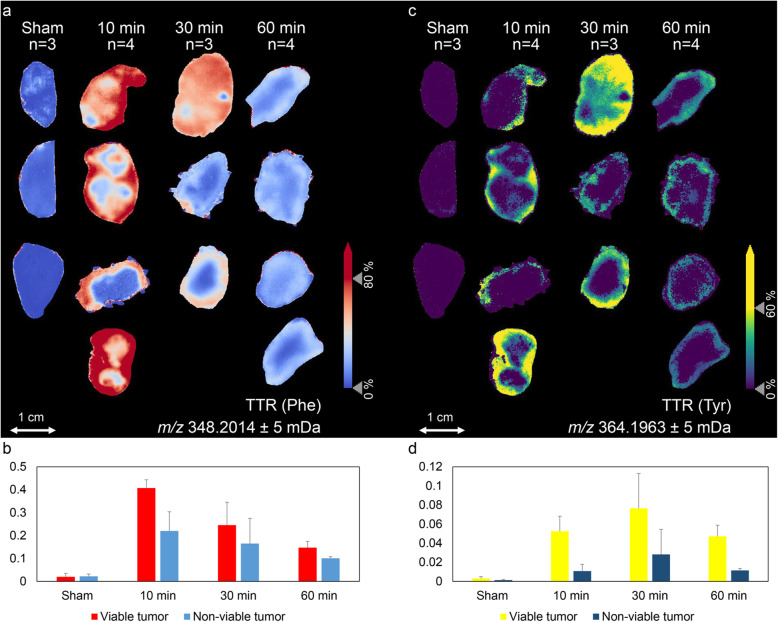
The dynamic changes in the spatial distributions of 19 out of 20 standard amino acids are observed in the tumor tissue. The highest abundance of C-Phe was detected in tumor tissue at 10 min after tracer injection and decreased progressively over time. The overall enrichment of C-Tyr showed a delayed temporal trend compared to C-Phe in tumor caused by the Phe-to-Tyr conversion process. Specifically, C-Phe and C-Tyr showed higher abundances in viable tumor regions compared to non-viable regions.
We demonstrated the spatiotemporal intra-tumoral distribution of the essential aromatic amino acid C-Phe and its de-novo synthesized metabolite C-Tyr by MALDI-FTICR-MSI. Our results explore for the first time local phenylalanine metabolism in the context of cancer tissue morphology. This opens a new way to understand amino acid metabolism within the tumor and its microenvironment.
代谢重编程是肿瘤发生和进展中的常见现象。氨基酸是癌症代谢中的重要介质,其在肿瘤组织中的动力学尚未完全了解。质谱成像能够在生物组织标本中对重要的内源性代谢物进行时空追踪。在本研究中,我们使用基质辅助激光解吸/电离傅里叶变换离子回旋共振质谱成像(MALDI-FTICR-MSI),研究了L-[环-C]-标记的苯丙氨酸和酪氨酸在人非小细胞肺癌(NSCLC)异种移植小鼠模型中的动力学。
我们通过MALDI-FTICR-MSI研究了示踪剂注射后10分钟(n = 4)、30分钟(n = 3)和60分钟(n = 4)以及假手术组(n = 3)在10分钟时小鼠异种移植肺肿瘤组织中L-[环-C]-苯丙氨酸(C-Phe)和L-[环-C]-酪氨酸(C-Tyr)的动力学。
在肿瘤组织中观察到20种标准氨基酸中19种的空间分布动态变化。示踪剂注射后10分钟肿瘤组织中检测到的C-Phe丰度最高,并随时间逐渐降低。由于苯丙氨酸向酪氨酸的转化过程,肿瘤中C-Tyr的总体富集显示出比C-Phe延迟的时间趋势。具体而言,与非存活区域相比,C-Phe和C-Tyr在存活肿瘤区域显示出更高的丰度。
我们通过MALDI-FTICR-MSI证明了必需芳香族氨基酸C-Phe及其从头合成代谢物C-Tyr在肿瘤内的时空分布。我们的结果首次在癌症组织形态学背景下探索了局部苯丙氨酸代谢。这为理解肿瘤及其微环境中的氨基酸代谢开辟了一条新途径。