
超重和肥胖与 ADPKD 的进展。
Overweight and Obesity and Progression of ADPKD.
机构信息
University of Colorado Anschutz Medical Campus, Aurora, Colorado.
Otsuka Pharmaceutical Development and Commercialization, Princeton, New Jersey.
出版信息
Clin J Am Soc Nephrol. 2021 Jun;16(6):908-915. doi: 10.2215/CJN.16871020. Epub 2021 Jun 11.
BACKGROUND AND OBJECTIVES
On the basis of earlier observations, we evaluated the association between overweight and obesity and rapid progression of autosomal dominant polycystic kidney disease in participants in the Tolvaptan Efficacy and Safety in Management of Autosomal Dominant Polycystic Kidney Disease and Its Outcomes (TEMPO) 3:4 trial. More importantly, we also determined whether efficacy of tolvaptan was attenuated in individuals with baseline overweight or obesity.
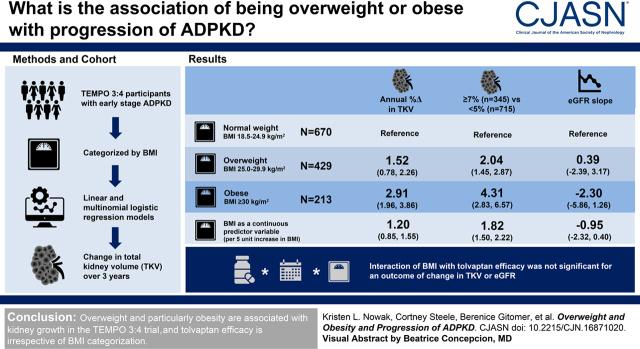
DESIGN, SETTING, PARTICIPANTS, & MEASUREMENTS: A total of 1312 study participants with relatively early-stage autosomal dominant polycystic kidney disease (mean eGFR 78±22 ml/min per 1.73 m) who were at high risk of rapid progression were categorized by body mass index (BMI; calculated using nonkidney weight) as normal weight (18.5-24.9 kg/m; =670), overweight (25.0-29.9 kg/m; =429), or obese (≥30 kg/m; =213). Linear and multinomial logistic regression models were used to determine the association of baseline overweight and obesity with change in total kidney volume (TKV) over the 3-year study period.
RESULTS
In fully adjusted models, higher BMI was associated with greater annual percent change in TKV (difference of 1.20 [95% confidence interval (95% CI), 0.85 to 1.55] per five-unit higher BMI). Overweight and obesity were associated with higher odds of annual percent change in TKV of ≥7% versus <5% (overweight: odds ratio, 2.04 [95% CI, 1.45 to 2.87]; obese: odds ratio, 4.31 [95% CI, 2.83 to 6.57] versus normal weight). eGFR decline did not differ according to BMI (fully adjusted difference in decline of -0.95 [95% CI, -2.32 to 0.40] ml/min per 1.73 m per year per five-unit higher BMI). The three-way interaction (treatment×time×BMI group) was not statistically significant in linear mixed models with an outcome of TKV (log-transformed estimated coefficient comparing the treatment effect for overweight versus normal weight: 0.56% [95% CI, -0.70% to 1.84%] per year; =0.38; obese versus normal weight: 0.07% [95% CI, -1.47% to 1.63%] per year; =0.93) or eGFR (estimated coefficient comparing overweight versus normal weight: -0.07 [95% CI, -0.95 to 0.82] ml/min per 1.73 m per year; =0.88; obese versus normal weight: 0.22 [95% CI, -0.93 to 1.36] ml/min per 1.73 m per year; =0.71).
CONCLUSIONS
Overweight and particularly obesity are strongly and independently associated with kidney growth, but not eGFR slope, in the TEMPO 3:4 trial, and tolvaptan efficacy is irrespective of BMI categorization.
CLINICAL TRIAL REGISTRY NAME AND REGISTRATION NUMBER
Tolvaptan Efficacy and Safety in Management of Autosomal Dominant Polycystic Kidney Disease and Its Outcomes (TEMPO) 3:4, NCT00428948.
背景与目的
基于早期观察结果,我们评估了超重和肥胖与常染色体显性遗传多囊肾病(ADPKD)患者的疾病快速进展之间的相关性,这些患者参与了托伐普坦治疗常染色体显性遗传多囊肾病及其结局(TEMPO)3:4 试验。更重要的是,我们还确定了托伐普坦的疗效是否在基线超重或肥胖的个体中减弱。
设计、地点、参与者和测量方法:共有 1312 名患有相对早期常染色体显性遗传多囊肾病(平均 eGFR 为 78±22 ml/min per 1.73 m)的研究参与者,他们处于快速进展的高风险中,根据体重指数(BMI;使用非肾脏重量计算)分为正常体重(18.5-24.9 kg/m;=670)、超重(25.0-29.9 kg/m;=429)或肥胖(≥30 kg/m;=213)。线性和多项逻辑回归模型用于确定基线超重和肥胖与 3 年研究期间总肾体积(TKV)变化的关系。
结果
在完全调整的模型中,较高的 BMI 与 TKV 的年百分比变化更大相关(每增加 5 个单位 BMI,差异为 1.20 [95%置信区间(95%CI),0.85 至 1.55])。超重和肥胖与 TKV 年百分比变化≥7%与<5%的比值更高相关(超重:比值比,2.04 [95%CI,1.45 至 2.87];肥胖:比值比,4.31 [95%CI,2.83 至 6.57]与正常体重)。根据 BMI,eGFR 下降没有差异(每增加 5 个单位 BMI,每年 eGFR 下降差异为-0.95 [95%CI,-2.32 至 0.40] ml/min per 1.73 m)。在 TKV 的线性混合模型中(对数转换的 TKV 结果),治疗×时间×BMI 组的三向交互作用不具有统计学意义(超重与正常体重相比的治疗效果的比较:每年 0.56%[95%CI,-0.70%至 1.84%];=0.38;肥胖与正常体重相比:每年 0.07%[95%CI,-1.47%至 1.63%];=0.93)或 eGFR(超重与正常体重相比的比较:每年-0.07 [95%CI,-0.95 至 0.82] ml/min per 1.73 m;=0.88;肥胖与正常体重相比:每年 0.22 [95%CI,-0.93 至 1.36] ml/min per 1.73 m;=0.71)。
结论
在 TEMPO 3:4 试验中,超重特别是肥胖与肾脏生长密切相关,但与 eGFR 斜率无关,而托伐普坦的疗效与 BMI 分类无关。
临床试验注册号和名称
托伐普坦治疗常染色体显性遗传多囊肾病及其结局(TEMPO)3:4,NCT00428948。
 Zotero 插件