School of Medicine and Public Health, The University of Newcastle, University Drive, Callaghan, 2308, NSW, Australia.
Hunter New England Population Health, Hunter New England Local Health District, Locked Bag No. 10, Wallsend, NSW, 2287, Australia.
Implement Sci. 2021 Jun 12;16(1):62. doi: 10.1186/s13012-021-01134-y.
Sustainment has been defined as the sustained use or delivery of an intervention in practice following cessation of external implementation support. This review aimed to identify and synthesise factors (barriers and facilitators) that influence the sustainment of interventions (policies, practices, or programmes) in schools and childcare services that address the leading risk factors of chronic disease.
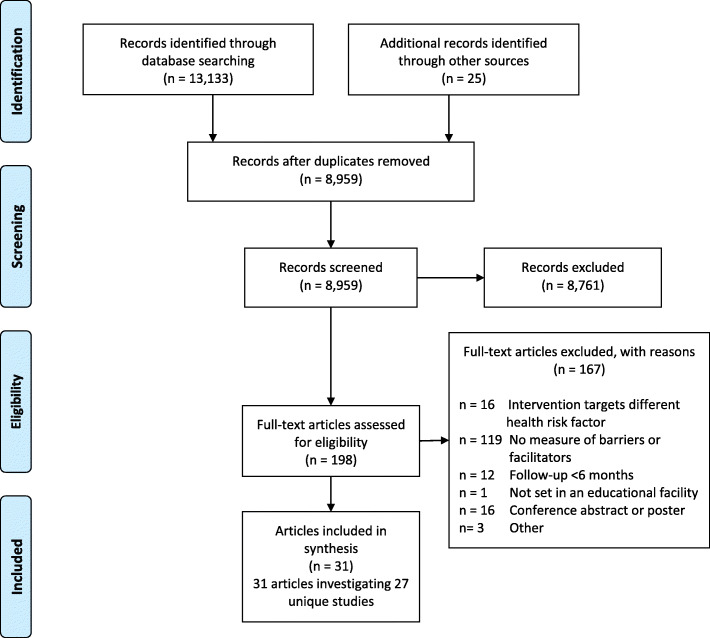
Seven electronic databases and relevant reference lists were searched for articles, of any design, published in English, from inception to March 2020. Articles were included if they qualitatively and/or quantitatively reported on school or childcare stakeholders' (including teachers, principals, administrators, or managers) perceived barriers or facilitators to the sustainment of interventions addressing poor diet/nutrition, physical inactivity, obesity, tobacco smoking, or harmful alcohol use. Two independent reviewers screened texts, and extracted and coded data guided by the Integrated Sustainability Framework, an existing multi-level sustainability-specific framework that assesses factors of sustainment.
Of the 13,158 articles identified, 31 articles met the inclusion criteria (8 quantitative, 12 qualitative, 10 mixed-methods, and 1 summary article). Overall, 29 articles were undertaken in schools (elementary n=17, middle n=3, secondary n=4, or a combination n=5) and two in childcare settings. The main health behaviours targeted included physical activity (n=9), diet (n=3), both diet and physical activity (n=15), and smoking (n=4), either independently (n=1) or combined with other health behaviours (n=3). Findings suggest that the majority of the 59 barriers and 74 facilitators identified to impact on intervention sustainment were similar across school and childcare settings. Factors predominantly relating to the 'inner contextual factors' of the organisation including: availability of facilities or equipment, continued executive or leadership support present, and team cohesion, support, or teamwork were perceived by stakeholders as influential to intervention sustainment.
Identifying strategies to improve the sustainment of health behaviour interventions in these settings requires a comprehensive understanding of factors that may impede or promote their ongoing delivery. This review identified multi-level factors that can be addressed by strategies to improve the sustainment of such interventions, and suggests how future research might address gaps in the evidence base.
This review was prospectively registered on PROSPERO: CRD42020127869 , Jan. 2020.
维持是指在停止外部实施支持后,持续使用或提供干预措施。本综述旨在确定和综合影响学校和儿童保育服务中干预措施(政策、实践或方案)维持的因素(障碍和促进因素),这些措施针对慢性病的主要风险因素。
从 2020 年 3 月以前,检索了七个电子数据库和相关的参考文献列表,以获取以任何设计发表的英文文章。如果文章定性和/或定量报告了学校或儿童保育利益相关者(包括教师、校长、行政人员或管理人员)对维持饮食/营养不良、身体活动不足、肥胖、吸烟或有害饮酒干预措施的看法,包括教师、校长、行政人员或管理人员)。两名独立审查员根据综合可持续性框架筛选文本,并提取和编码数据,该框架是一个现有的多层次可持续性特定框架,用于评估维持因素。
在 13158 篇文章中,有 31 篇文章符合纳入标准(8 篇定量、12 篇定性、10 篇混合方法和 1 篇综述文章)。总体而言,29 篇文章在学校进行(小学 n=17、初中 n=3、高中 n=4 或组合 n=5),2 篇在儿童保育环境中进行。主要针对的健康行为包括身体活动(n=9)、饮食(n=3)、饮食和身体活动(n=15)和吸烟(n=4),要么独立(n=1),要么与其他健康行为相结合(n=3)。研究结果表明,在学校和儿童保育环境中,影响干预措施维持的 59 个障碍和 74 个促进因素大多是相似的。利益相关者认为,组织的“内在环境因素”主要与设施或设备的可用性、持续的行政或领导层支持以及团队凝聚力、支持或团队合作有关,这些因素对干预措施的维持有影响。
要确定提高这些环境中健康行为干预措施维持的策略,需要全面了解可能阻碍或促进其持续提供的因素。本综述确定了可以通过提高这些干预措施维持的策略来解决的多层次因素,并提出了未来研究如何解决证据基础中的差距。
本综述于 2020 年 1 月在 PROSPERO(CRD42020127869)上进行了前瞻性注册。