Baez Saiyet de la C, García Del Barco Diana, Hardy-Sosa Anette, Guillen Nieto Gerardo, Bringas-Vega Maria Luisa, Llibre-Guerra Jorge J, Valdes-Sosa Pedro
The Clinical Hospital of Chengdu Brain Sciences Institute, University Electronic Sciences and Technology of China UESTC, Chengdu, China.
Center for Genetic Engineering and Biotechnology, Havana, Cuba.
Front Neurol. 2021 May 28;12:638693. doi: 10.3389/fneur.2021.638693. eCollection 2021.
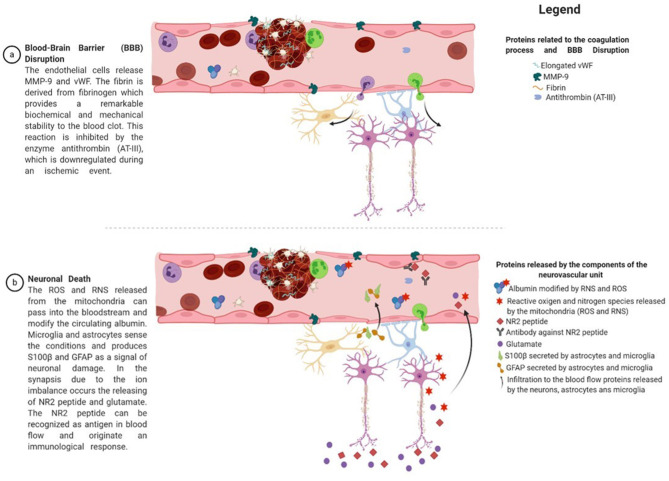
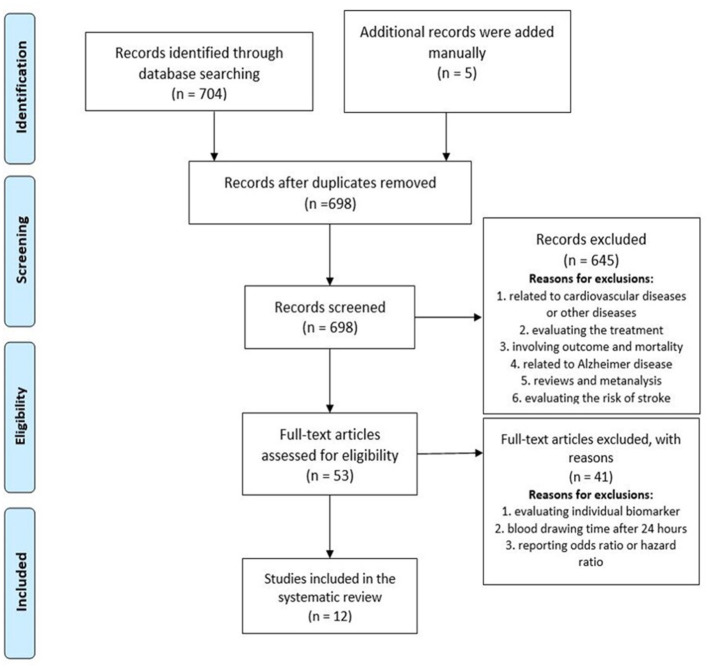
Acute stroke treatment is a time-critical process in which every minute counts. Laboratory biomarkers are needed to aid clinical decisions in the diagnosis. Although imaging is critical for this process, these biomarkers may provide additional information to distinguish actual stroke from its mimics and monitor patient condition and the effect of potential neuroprotective strategies. For such biomarkers to be effectively scalable to public health in any economic setting, these must be cost-effective and non-invasive. We hypothesized that blood-based combinations (panels) of proteins might be the key to this approach and explored this possibility through a systematic review. We followed the PRISMA (Preferred Reporting Items for Systematic Reviews and Meta-Analysis) guidelines for systematic review. Initially, the broader search for biomarkers for early stroke diagnosis yielded 704 hits, and five were added manually. We then narrowed the search to combinations (panels) of the protein markers obtained from the blood. Twelve articles dealing with blood-based panels of protein biomarkers for stroke were included in the systematic review. We observed that NR2 peptide (antibody against the NR2 fragment) and glial fibrillary acidic protein (GFAP) are brain-specific markers related to stroke. Von Willebrand factor (vWF), matrix metalloproteinase 9 (MMP-9), and S100β have been widely used as biomarkers, whereas others such as the ischemia-modified albumin (IMA) index, antithrombin III (AT-III), and fibrinogen have not been evaluated in combination. We herein propose the following new combination of biomarkers for future validation: panel 1 (NR2 + GFAP + MMP-9 + vWF + S100β), panel 2 (NR2 + GFAP + MMP-9 + vWF + IMA index), and panel 3 (NR2 + GFAP + AT-III + fibrinogen). More research is needed to validate, identify, and introduce these panels of biomarkers into medical practice for stroke recurrence and diagnosis in a scalable manner. The evidence indicates that the most promising approach is to combine different blood-based proteins to provide diagnostic precision for health interventions. Through our systematic review, we suggest three novel biomarker panels based on the results in the literature and an interpretation based on stroke pathophysiology.
急性中风治疗是一个时间紧迫的过程,分秒必争。需要实验室生物标志物来辅助诊断中的临床决策。尽管影像学对这一过程至关重要,但这些生物标志物可能提供额外信息,以区分真正的中风与其模仿病症,并监测患者状况以及潜在神经保护策略的效果。为了使此类生物标志物在任何经济环境中都能有效地推广至公共卫生领域,它们必须具有成本效益且为非侵入性。我们假设基于血液的蛋白质组合(面板)可能是此方法的关键,并通过系统综述探索了这种可能性。我们遵循PRISMA(系统综述和荟萃分析的首选报告项目)指南进行系统综述。最初,对早期中风诊断生物标志物的广泛搜索产生了704条结果,并手动添加了5条。然后,我们将搜索范围缩小至从血液中获得的蛋白质标志物组合(面板)。系统综述纳入了12篇关于基于血液的中风蛋白质生物标志物面板的文章。我们观察到NR2肽(抗NR2片段抗体)和胶质纤维酸性蛋白(GFAP)是与中风相关的脑特异性标志物。血管性血友病因子(vWF)、基质金属蛋白酶9(MMP-9)和S100β已被广泛用作生物标志物,而其他一些指标,如缺血修饰白蛋白(IMA)指数、抗凝血酶III(AT-III)和纤维蛋白原,尚未进行联合评估。我们在此提出以下新的生物标志物组合以供未来验证:面板1(NR2 + GFAP + MMP-9 + vWF + S100β)、面板2(NR2 + GFAP + MMP-9 + vWF + IMA指数)和面板3(NR2 + GFAP + AT-III + 纤维蛋白原)。需要更多研究以验证、识别这些生物标志物面板并以可扩展的方式将其引入中风复发和诊断的医疗实践中。证据表明,最有前景的方法是结合不同的基于血液的蛋白质,为健康干预提供诊断精度。通过我们的系统综述,我们根据文献结果和基于中风病理生理学的解释提出了三个新型生物标志物面板。