Belkahia Hanène, Selmi Rachid, Zamiti Sayed, Daaloul-Jedidi Monia, Messadi Lilia, Ben Said Mourad
Service de Microbiologie et Immunologie, Ecole Nationale de Médecine Vétérinaire, University of Manouba, Sidi Thabet, Tunisia.
Ministère de la Défense Nationale, Direction Générale de la Santé Militaire, Service Vétérinaire, Tunis, Tunisia.
Front Vet Sci. 2021 May 26;8:676896. doi: 10.3389/fvets.2021.676896. eCollection 2021.
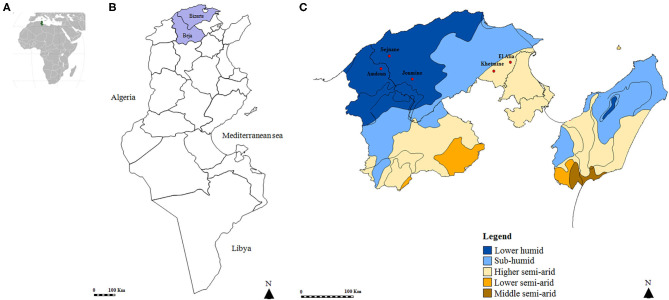
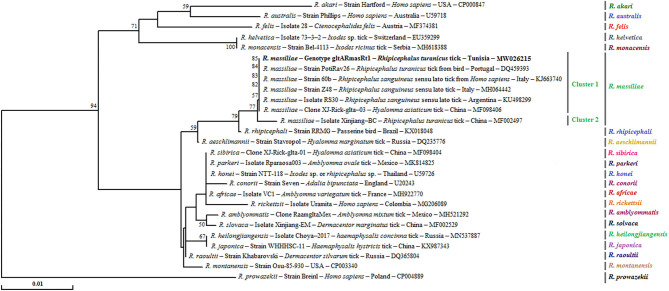
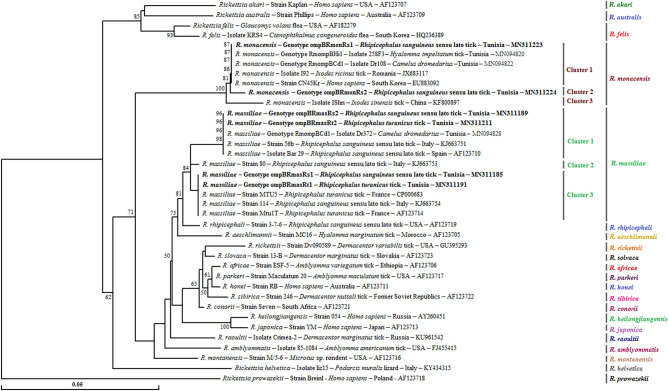
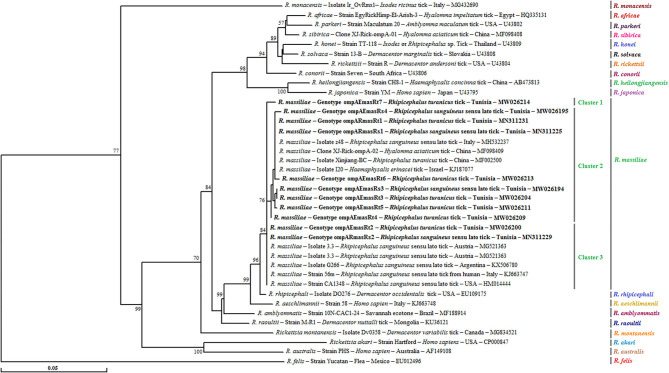
Tick-borne rickettsioses present a significant public health threat among emerging tick-borne diseases. In Tunisia, little is known about tick-borne pathogens. Therefore, the aim of this study was to investigate the presence of species in small ruminant ticks from Tunisia. Adult ticks ( = 694) were collected from goats and sheep in northern Tunisia. Obtained ticks were identified as ( = 434) and sensu lato ( = 260). Selected ticks ( = 666) were screened for the presence of spp. by PCR targeting a partial sequence of the gene followed by sequence analysis. Rickettsial DNA was detected in 122 (18.3%) tested tick samples. The infection rates in and s.l. ticks were 23.4 and 9.5%, respectively. The overall prevalence of rickettsial DNA was markedly higher in ticks collected from goats (23.2%) compared to those infesting sheep (7.9%). The detection of rickettsial DNA was significantly higher in ticks from the governorate of Beja (39.0%) than those from the governorate of Bizerte (13.9%). Two additional genes, the outer membrane protein A gene () and the citrate synthase gene (), were also targeted for further characterization of the detected species. Genotyping and phylogenetic analysis based on partial sequences ( = 106) of the three different genes revealed that positive ticks are infected with different isolates of two Spotted Fever Group (SFG) , namely, and , closely related to those infecting camels and associated ticks from Tunisia, and humans and small ruminant ticks from neighboring countries like Italy, France, and Spain.
蜱传立克次体病在新兴的蜱传疾病中对公共卫生构成重大威胁。在突尼斯,人们对蜱传病原体知之甚少。因此,本研究的目的是调查突尼斯小反刍动物蜱中物种的存在情况。从突尼斯北部的山羊和绵羊身上采集了成年蜱(n = 694)。所获蜱被鉴定为肩突硬蜱(n = 434)和狭义篦子硬蜱(n = 260)。通过针对ompA基因部分序列的PCR及后续序列分析,对选取的蜱(n = 666)进行了嗜吞噬细胞无形体属物种筛查。在122份(18.3%)检测的蜱样本中检测到立克次体DNA。肩突硬蜱和狭义篦子硬蜱中的感染率分别为23.4%和9.5%。与感染绵羊的蜱(7.9%)相比,从山羊身上采集的蜱中立克次体DNA的总体患病率明显更高(23.2%)。来自贝贾省的蜱(39.0%)中立克次体DNA的检测率显著高于比塞大省的蜱(13.9%)。另外两个基因,外膜蛋白A基因(ompA)和柠檬酸合酶基因(gltA),也被用于对检测到的无形体物种进行进一步鉴定。基于三个不同基因部分序列(n = 106)的基因分型和系统发育分析表明,阳性蜱感染了斑点热群(SFG)无形体的不同分离株,即肩突硬蜱无形体和反刍动物无形体,它们与感染突尼斯骆驼及相关蜱、以及来自意大利、法国和西班牙等邻国的人类和小反刍动物蜱的分离株密切相关。