Aandahl Mats Holst, Noordhof Dionne A, Tjønna Arnt Erik, Sandbakk Øyvind
Department of Circulation and Medical Imaging, Faculty of Medicine and Health Sciences, Norwegian University of Science and Technology, Trondheim, Norway.
Department of Neuromedicine and Movement Science, Centre for Elite Sports Research, Norwegian University of Science and Technology, Trondheim, Norway.
Front Sports Act Living. 2021 May 28;3:664270. doi: 10.3389/fspor.2021.664270. eCollection 2021.
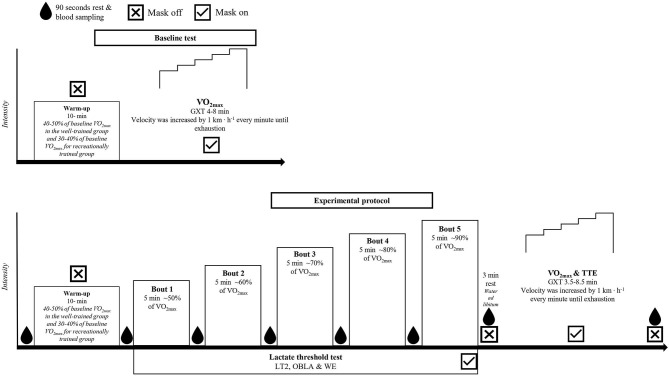
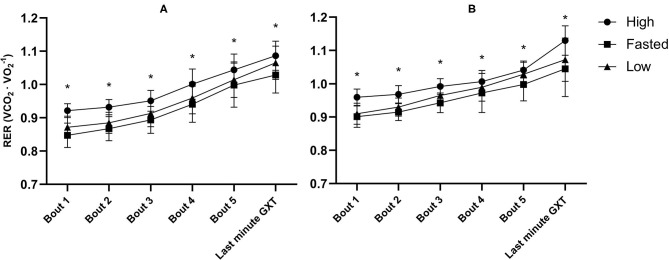
The current study aimed to investigate the effect of the relative CHO content in a pre-event meal on time to exhaustion (TTE), peak oxygen uptake ( ), the 2nd lactate threshold (LT2), onset of blood lactate accumulation (OBLA), and work economy (WE) and to compare responses between well-trained and recreationally trained individuals. Eleven well-trained and 10 recreationally trained men performed three trials in a randomized cross-over design, in which they performed exercise tests (1) after a high-CHO pre-event meal (3 g · kg), (2) a low-CHO pre-event meal (0.5 g · kg), or (3) in a fasted-state. The test protocol consisted of five submaximal 5-min constant-velocity bouts of increasing intensity and a graded exercise test (GXT) to measure TTE. A repeated measure ANOVA with a between-subjects factor (well-trained vs. recreational) was performed. A main effect of pre-event meal was found ( = 0.001), with TTE being 8.0% longer following the high-CHO meal compared to the fasted state ( = 0.009) and 7.2% longer compared to the low-CHO meal ( = 0.010). No significant effect of pre-event meal on , LT2, OBLA, or WE ( ≥ 0.087) was found and no significant interaction effect between training status and pre-event CHO intake was found for TTE or any of the performance-determining variables ( ≥ 0.257). In conclusion, high-CHO content in the pre-event meal led to a longer TTE compared to a meal with a low-CHO content or exercising in a fasted state, both in well-trained and recreationally trained participants. However, the underlying physiological reason for the increased TTE is unclear, as no effect of pre-event meal on the main physiological performance-determining variables was found. Thus, pre-event CHO intake should be standardized when the goal is to assess endurance performance but seems to be of less importance when assessing the main performance-determining variables.
本研究旨在探讨赛前餐中碳水化合物(CHO)相对含量对力竭时间(TTE)、峰值摄氧量( )、第二乳酸阈(LT2)、血乳酸积累起始点(OBLA)和工作效率(WE)的影响,并比较训练有素者和普通锻炼者的反应。11名训练有素的男性和10名普通锻炼的男性采用随机交叉设计进行了三项试验,他们在(1)高碳水化合物赛前餐(3 g·kg)后、(2)低碳水化合物赛前餐(0.5 g·kg)后或(3)空腹状态下进行运动测试。测试方案包括五次强度递增的5分钟次最大恒速运动回合以及一次用于测量TTE的递增负荷运动测试(GXT)。进行了一项带有受试者间因素(训练有素者与普通锻炼者)的重复测量方差分析。发现赛前餐有主要效应( = 0.001),与空腹状态相比,高碳水化合物餐后TTE长8.0%( = 0.009),与低碳水化合物餐相比长7.2%( = 0.010)。未发现赛前餐对 、LT2、OBLA或WE有显著影响( ≥ 0.087),且未发现训练状态与赛前碳水化合物摄入量之间对于TTE或任何性能决定变量有显著交互作用( ≥ 0.257)。总之,无论是训练有素的参与者还是普通锻炼的参与者,与低碳水化合物含量的餐食或空腹运动相比,赛前餐中高碳水化合物含量导致TTE更长。然而,TTE增加的潜在生理原因尚不清楚,因为未发现赛前餐对主要生理性能决定变量有影响。因此,当目标是评估耐力表现时,赛前碳水化合物摄入量应标准化,但在评估主要性能决定变量时似乎不太重要。