School of Psychology, Shenzhen University, Shenzhen, 518060, Guangdong, China.
Women' s Hospital/Center for Tobacco Control Research, Zhejiang University School of Medicine, Hangzhou, 310058, Zhejiang, China.
BMC Psychiatry. 2021 Jun 14;21(1):306. doi: 10.1186/s12888-021-03310-2.
The COVID-19 pandemic brings unprecedented uncertainty and stress. This study aimed to characterize general sleep status among Chinese residents during the early stage of the outbreak and to explore the network relationship among COVID-19 uncertainty, intolerance of uncertainty, perceived stress, and sleep status.
A cross-sectional correlational survey was conducted online. A total of 2534 Chinese residents were surveyed from 30 provinces, municipalities, autonomous regions of China and regions abroad during the period from February 7 to 14, 2020, the third week of lockdown. Final valid data from 2215 participants were analyzed. Self-report measures assessed uncertainty about COVID-19, intolerance of uncertainty, perceived stress, and general sleep status. Serial mediation analysis using the bootstrapping method and path analysis were applied to test the mediation role of intolerance of uncertainty and perceived stress in the relationship between uncertainty about COVID-19 and sleep status.
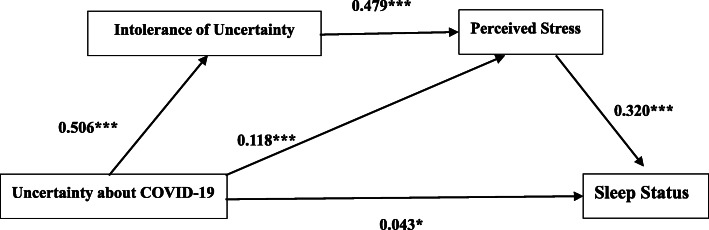
The total score of sleep status was 4.82 (SD = 2.72). Age, place of residence, ethnicity, marital status, infection, and quarantine status were all significantly associated with general sleep status. Approximately half of participants (47.1%) reported going to bed after 12:00 am, 23.0% took 30 min or longer to fall asleep, and 30.3% slept a total of 7 h or less. Higher uncertainty about COVID-19 was significantly positively correlated with higher intolerance of uncertainty (r = 0.506, p < 0.001). The mediation analysis found a mediating role of perceived stress in the relationship between COVID-19 uncertainty and general sleep status (β = 0.015, 95%C.I. = 0.009-0.021). However, IU was not a significant mediator of the relationship between COVID-19 uncertainty and sleep (β = 0.009, 95%C.I. = - 0.002-0.020). Moreover, results from the path analysis further showed uncertainty about COVID-19 had a weak direct effect on poor sleep (β = 0.043, p < 0.05); however, there was a robust indirect effect on poor sleep through intolerance of uncertainty and perceived stress.
These findings suggest that intolerance of uncertainty and perceived stress are critical factors in the relationship between COVID-19 uncertainty and sleep outcomes. Results are discussed in the context of the COVID-19 pandemic, and practical policy implications are also provided.
新冠疫情带来了前所未有的不确定性和压力。本研究旨在描述疫情早期中国居民的一般睡眠状况,并探讨新冠不确定性、不确定性容忍度、感知压力与睡眠状况之间的网络关系。
采用横断面相关性调查方法,于 2020 年 2 月 7 日至 14 日(封锁的第三周),对来自中国 30 个省、直辖市、自治区和国外地区的 2534 名中国居民进行了在线调查。共分析了 2215 名参与者的最终有效数据。自我报告量表评估了对新冠的不确定性、不确定性容忍度、感知压力和一般睡眠状况。使用 bootstrap 方法和路径分析的序列中介分析检验了不确定性容忍度和感知压力在新冠与睡眠状况关系中的中介作用。
睡眠状况总分为 4.82(SD=2.72)。年龄、居住地、民族、婚姻状况、感染和隔离状态均与一般睡眠状况显著相关。约一半的参与者(47.1%)在 12:00 后入睡,23.0%入睡时间超过 30min,30.3%的人总睡眠时间不足 7h。对新冠的不确定性越高,不确定性容忍度越高(r=0.506,p<0.001)。中介分析发现,感知压力在新冠不确定性与一般睡眠状况之间起中介作用(β=0.015,95%CI=0.009-0.021)。然而,IU 并不是新冠不确定性与睡眠之间关系的显著中介(β=0.009,95%CI=-0.002-0.020)。此外,路径分析的结果进一步表明,对新冠的不确定性对睡眠质量有较弱的直接影响(β=0.043,p<0.05);然而,通过不确定性容忍度和感知压力,对新冠的不确定性对睡眠质量有较强的间接影响。
这些发现表明,不确定性容忍度和感知压力是新冠不确定性与睡眠结果之间关系的关键因素。本研究结果在新冠疫情背景下进行了讨论,并提出了实际的政策意义。